JAKARTA, Indonesia — The political landscape in Indonesia faces a profound constitutional and administrative dilemma following a definitive legal ruling by the Supreme Court (Mahkamah Agung – MA) regarding the high school equivalency credential utilized by Vice President Gibran Rakabuming Raka during his registration for the 2024 Presidential Election. Former Chief Justice of the Constitutional Court (Mahkamah Konstitusi – MK), Mahfud MD, has publicly stated that any subsequent actions concerning Gibran’s continuity in office now reside strictly within the political domain, transforming a legal controversy into an intense institutional debate.
The controversy escalated when the Supreme Court formally granted a cassation appeal, effectively invalidating the official letter of equivalency (Surat Keterangan – Suket) for a senior high school (SMA) diploma that had permitted Gibran Rakabuming Raka to fulfill the mandatory administrative requirements set forth by the General Elections Commission (KPU). This landmark judicial decision has triggered widespread discussions among legal experts, political analysts, and the general public, raising critical questions about administrative compliance, electoral integrity, and the stability of the executive branch.
The Supreme Court Cassation Ruling and Legal Mechanics
The legal challenge reached its culmination when the Supreme Court reviewed the cassation petition registered under number 742 K/TUN/2026. The plaintiff in the administrative lawsuit, HM Subhan, confirmed that the formal verdict was issued and communicated through the court’s electronic litigation system, e-court.
"I received a notification through my e-court account from the Supreme Court dated October 30, 2026. Regarding case number 742/K/TUN/2026, the verdict of the assembly is to grant the cassation," Subhan stated following the dissemination of the ruling.
Under the terms of the Supreme Court’s amar putusan (judgment order), the administrative letter certifying the foreign high school curriculum equivalency for Gibran has been declared legally void. This specific document served as a cornerstone verification instrument utilized during the 2024 presidential candidate registration phase, where candidates must prove the completion of secondary education or its recognized equivalent to satisfy the General Elections Commission Regulation (PKPU) Number 19 of 2023.
Mahfud MD’s Stance: Between Political Resolution and Criminal Accountability
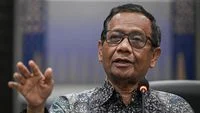
Weighing in on the multifaceted implications of the ruling, Mahfud MD took to his official social media channel on X (formerly Twitter) to delineate the separation between legal outcomes and political realities. According to the prominent legal scholar, while the Supreme Court has made its determination on the administrative validity of the equivalency document, the ultimate fate of the vice president’s tenure cannot be resolved purely through automatic judicial enforcement.
"The follow-up regarding his position as vice president is up to the political realm, whichever path they choose to take," Mahfud wrote on Friday, October 30.
Beyond the political fate of the executive official, Mahfud emphasized that the administrative anomalies surrounding the issuance of the equivalency letter—as well as alleged procedural irregularities involving Article 19 paragraph (3) of PKPU 19/2023—warrant immediate criminal investigation. He argued that accountability must extend to the bureaucratic machinery that facilitated the documentation.
"The KPU [General Elections Commission] and the Directorate of Primary and Secondary Education should be investigated immediately," Mahfud asserted, pointing toward potential administrative misconduct and regulatory breaches during the candidate vetting process.
Chronology of the Educational Credential Dispute
The legal scrutiny surrounding Vice President Gibran Rakabuming Raka’s educational background is not a sudden development but rather the culmination of a protracted legal and administrative battle that spans multiple judicial bodies. Understanding the trajectory of this controversy requires examining the timeline of events leading up to the Supreme Court’s intervention.
- Pre-Election Registration (Late 2023): During the registration period for the 2024 presidential and vice-presidential candidates, Gibran Rakabuming Raka submitted documentation to the KPU. Because portions of his secondary education were completed overseas, he provided an official letter of equivalency (Suket) issued by the relevant educational authorities to satisfy the high school diploma requirement mandated by PKPU 19/2023.
- Electoral Phase and Validation (February – October 2024): The election proceeded, culminating in the inauguration of Prabowo Subianto and Gibran Rakabuming Raka as President and Vice President of the Republic of Indonesia for the 2024–2029 term. However, civil society groups and legal advocates continued to question the authenticity and regulatory compliance of the educational certificates through administrative court channels.
- Constitutional Court Review (October 2025): Prior to the Supreme Court’s final intervention, the Constitutional Court (MK) examined aspects of the dispute. On October 6, the MK officially rejected a substantive petition challenging the legitimacy of the credentials. Nevertheless, within its legal considerations, the Constitutional Court explicitly noted that during the judicial review process, it did not encounter definitive physical documents demonstrating that Gibran possessed a foreign graduation certificate officially equated to a domestic high school diploma. This nuance provided the foundational opening for subsequent administrative challenges.
- Supreme Court Cassation Decision (October 30, 2026): The legal saga reached a decisive juncture when the Supreme Court granted the cassation appeal filed by HM Subhan under case number 742 K/TUN/2026, annulling the high school equivalency letter and declaring it legally invalid.
Broader Implications for Indonesian Governance and Electoral Law
The ruling by the Supreme Court and the subsequent commentary from figures like Mahfud MD introduce significant implications for the Indonesian constitutional system. While Indonesia operates under a strict presidential system where removal mechanisms for a sitting president or vice president are constitutionally restricted—typically requiring impeachment through the People’s Consultative Assembly (MPR) based on specific legal violations such as treason, corruption, or moral turpitude—administrative court rulings invalidating candidate prerequisites create an unprecedented legal friction.
Legal analysts point out that administrative courts (PTUN) hold jurisdiction over the legality of administrative decisions issued by state bodies, such as the issuance of equivalency letters by educational ministries or verification approvals by the KPU. However, once a candidate has transitioned into an inaugurated official holding an elected office legitimized by the Constitutional Court’s final election results decree, translating a retrospective administrative invalidation into the removal of a sitting vice president remains a complex constitutional labyrinth.
This dichotomy explains Mahfud’s assertion that the matter has transitioned into the political arena. In a democratic republic, political parties, parliamentary factions, and executive leadership must navigate how to respond to judicial decisions that undermine the foundational paperwork of a high-ranking official without triggering a destabilizing constitutional crisis.
Institutional Scrutiny on KPU and Educational Bureaucracy
Furthermore, Mahfud’s call for the investigation of the General Elections Commission and the Directorate of Primary and Secondary Education underscores systemic concerns regarding the verification rigor applied during national elections. The integrity of Indonesia’s democratic transitions relies heavily on the meticulous vetting of candidate credentials by election organizers.
If administrative instruments used to verify educational milestones are subsequently dismantled by the Supreme Court, it exposes potential vulnerabilities in how regulatory frameworks are implemented by state agencies. Civil society organizations have consistently advocated for heightened transparency and institutional accountability to ensure that future electoral cycles are insulated from similar legal ambiguities.
As political parties and state institutions begin to digest the full legal weight of the Supreme Court’s cassation ruling, attention remains focused on Jakarta. Whether political actors will pursue formal parliamentary mechanisms, demand institutional audits of the KPU, or seek further legal clarifications will shape the trajectory of Indonesian governance in the wake of this unprecedented administrative ruling.