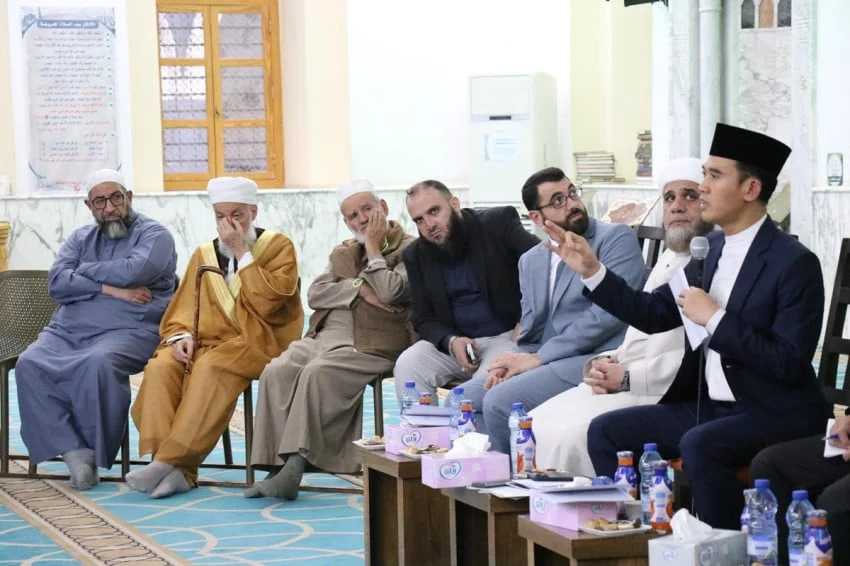
The relationship between religion and the state remains one of the most complex and debated subjects in modern political theology, particularly within regions undergoing profound socio-political transitions. Amidst these global discussions, the Chairman for Fatwa of the Indonesian Ulema Council (MUI), Prof. KH Asrorun Niam Sholeh, took center stage at a major religious symposium held at the historic Jami’ Khalid bin Walid in the Syrian province of Homs. Speaking before an audience comprising hundreds of prominent Syrian clerics, religious scholars, and academic figures, the Indonesian Islamic scholar delivered a comprehensive address detailing Indonesia’s unique socio-political framework, offering the archipelago’s national consensus as a viable paradigm for harmonizing faith and governance.
The gathering, which took place on Thursday, October 29, 2026, served as a vital platform for cross-cultural and cross-national theological dialogue. As nations across the Middle East and Southeast Asia grapple with the challenges of modernization, sectarian tensions, and the preservation of public order, Prof. Niam’s intervention underscored the practical necessity of a symbiotic relationship between spiritual institutions and secular governing bodies. His presentation meticulously dissected the theoretical underpinnings of religious-state dynamics, drawing heavily from the Indonesian constitutional experience to illustrate how pluralism and religious adherence can successfully reinforce one another within a unified republic.
Theoretical Frameworks of Religious-State Relations
In his keynote address, Prof. Niam, who also serves as a Professor of Islamic Jurisprudence at UIN Syarif Hidayatullah Jakarta, categorized the global spectrum of governance models into three distinct paradigms: integralistic, secularistic, and symbiotic.
The integralistic model fuses religion and the state entirely, asserting that political authority is fundamentally religious authority, leaving little separation between civil law and divine jurisprudence. Conversely, the secularistic model operates on a strict division, often pushing religion entirely into the private sphere and stripping public governance of religious ethics. Situated between these two polar opposites is the symbiotic model, which Prof. Niam champions as the most constructive framework for contemporary societies.
Under the symbiotic paradigm, religion and the state are neither identical nor entirely estranged; rather, they are mutually dependent and cooperative. "Agama hadir membimbing pemerintahan di atas koridor etika, sementara negara menjamin ketertiban dan memfasilitasi syiar keagamaan," Prof. Niam noted, emphasizing that religion provides the moral compass necessary for just governance, while the state maintains the security, legal infrastructure, and institutional facilitation required for religious life to flourish freely.
The Indonesian Model: Pancasila and the Mitsaq Wathani
Elaborating on how this symbiotic framework is manifested in reality, Prof. Niam pointed to the Republic of Indonesia as a prime operational model. He explained that the Unitary State of the Republic of Indonesia (NKRI) is built upon Pancasila—the nation’s five foundational philosophical principles—and the 1945 Constitution. Together, these founding documents function as a Mitsaq Wathani, or a grand national consensus forged among diverse ethnic, religious, and cultural groups upon the nation’s independence.
This constitutional arrangement ensures that the state is neither a theocracy nor a strict secular state, but rather a Pancasila state that protects freedom of worship while integrating ethical religious values into national development. "Pengalaman Indonesia membuktikan bahwa relasi agama dan negara bersifat dinamis dan saling memerlukan. Perubahan adalah sunnatullah, dan agama hadir untuk memastikan setiap perubahan sosial bermuara pada kemaslahatan umum dan perdamaian," Prof. Niam stated to the international assembly.
This dynamic relationship allows for a two-way enrichment process: state regulations increasingly absorb substantive aspirations of Islamic jurisprudence and moral ethics, while religious fatwas and institutional edicts actively respond to emerging national issues, such as environmental conservation, economic justice, and social integration.
Historical Context and the Finality of the NKRI
The articulation of Indonesia’s national consensus by the MUI leadership is deeply rooted in contemporary Indonesian Islamic jurisprudence. Prof. Niam reminded the audience of the historic resolution established during the second National Assembly of Indonesian Fatwa Commission Ulema (Ijtima Ulama Komisi Fatwa se-Indonesia II) held in 2006. That landmark gathering officially decreed the Unitary State of the Republic of Indonesia based on Pancasila as the final and legitimate form of the state for Indonesian Muslims.
This theological and political stance effectively resolved decades of debate regarding the formalistic establishment of an Islamic state, positioning national integration and patriotism as religious duties. By framing the preservation of the nation-state as an obligation of faith, Indonesian Islamic institutions have consistently neutralized radical ideologies and separatist movements that threaten national unity. Consequently, Indonesian Muslims view their active participation in civic life and defense of the constitution as direct manifestations of religious piety.
The Choice of Homs as a Venue for Dialogue
The selection of the Jami’ Khalid bin Walid in Homs as the venue for this international symposium holds profound symbolic weight. Homs, one of Syria’s most historically significant and resilient cities, has experienced vast socio-political upheaval over the past decade and a half. Following years of conflict, the region has entered a protracted phase of stabilization, reconstruction, and civic reconciliation.
Hosting an intellectual discourse focused on statecraft, religious moderation, and the peaceful coexistence of diverse communities signals a deliberate effort by regional scholars to rebuild societal cohesion from the ground up. By inviting prominent international voices—such as representatives from Indonesia, the world’s largest Muslim-majority democracy—Syrian academic and religious leaders sought to glean insights from nations that have successfully navigated internal diversity without fracturing their state institutions.
Reactions and Broader Implications for the Global Islamic Community
The intervention by the MUI delegation has generated substantial discourse among international observers and academic circles following the symposium. Analysts of Islamic politics note that exporting Indonesia’s model of moderate Islam (Islam Nusantara) provides a stabilizing narrative in regions recovering from sectarian strife.
Local Syrian clerics in attendance expressed appreciation for the Indonesian perspective, noting that the separation of religion from extremist political exploitation is paramount for establishing lasting peace. Several academic figures highlighted that Indonesia’s ability to reconcile Islamic values with democratic governance and constitutionalism offers a hopeful counter-narrative to the polarizations often witnessed in the Middle East and Western nations alike.
Furthermore, the emphasis on the symbiotic relationship between faith and governance addresses a core anxiety in post-conflict zones: how to restore public morality without descending into authoritarian religious enforcement or alienating religious populations through aggressive secularization. Prof. Niam’s exposition provided a blueprint for how state institutions can respect and accommodate religious identity while maintaining pluralistic, inclusive legal systems.
Geopolitical and Diplomatic Dimensions
Beyond its theological significance, Prof. Niam’s visit underscores the active role of Indonesian religious diplomacy on the global stage. Organizations like the MUI and major Indonesian Islamic mass organizations, such as Nahdlatul Ulama and Muhammadiyah, have increasingly engaged in international peace-building efforts, interfaith dialogues, and ideological counter-terrorism campaigns.
By sharing the Indonesian narrative in countries like Syria, Indonesian religious leaders project soft power rooted in moderation (wasathiyah), tolerance, and constructive nationalism. This diplomatic outreach reinforces Indonesia’s constitutional mandate to contribute toward world order based on independence, eternal peace, and social justice.
Conclusion: A Path Forward for Adaptive Governance
As the symposium concluded, the consensus among participating scholars centered on the necessity of continuous dialogue and adaptability in governance. Prof. Niam’s address served as a timely reminder that religious institutions must remain dynamic, engaging constructively with state authorities to address modern socio-economic and humanitarian challenges.
The Indonesian experience demonstrates that when religion and the state operate in a symbiotic balance—guided by constitutional consensus, mutual respect, and a commitment to the public good (maslahah mursalah)—nations can achieve stability even amid profound global change. The discussions in Homs mark another step forward in fostering international solidarity among scholars committed to peace, justice, and the harmonious integration of faith and civic life.