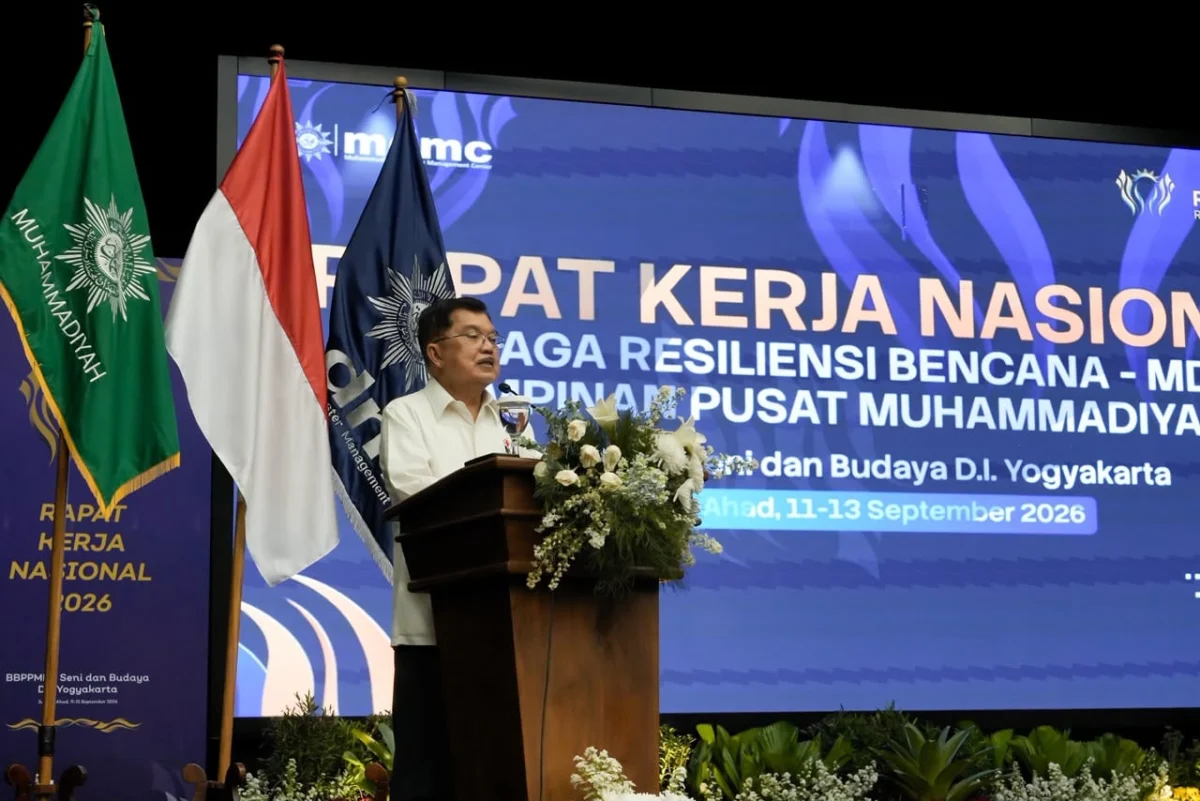
Disaster management in Indonesia must undergo a fundamental paradigm shift away from a reactive post-crisis approach toward robust, community-driven prevention and long-term environmental mitigation. This critical directive was delivered by the Chairman of the Indonesian Red Cross (PMI), Muhammad Jusuf Kalla, during the official closing ceremony of the National Working Meeting (Rakernas) organized by the Disaster Resilience Institute (LRB)—widely recognized as the Muhammadiyah Disaster Management Center (MDMC)—under the Central Board of Muhammadiyah.
The high-profile event, held at the Center for Development of Vocational Education and Training Quality Assurance for Arts and Culture (BBPPMPV Seni dan Budaya) in Special Region of Yogyakarta, brought together key stakeholders, humanitarian workers, and organizational leaders to evaluate and strategize the future of national resilience and humanitarian aid. Kalla, who served as the 10th and 12th Vice President of the Republic of Indonesia, emphasized that addressing recurring catastrophes such as seasonal flooding and prolonged droughts requires proactive upstream interventions rather than merely managing the devastating consequences downstream.
The Imperative of Upstream Prevention and Environmental Stewardship
Drawing a parallel to the medical profession, Kalla underscored that preventive measures hold far greater value than curative actions when dealing with predictable natural hazards. Environmental degradation, deforestation, and poor watershed management remain the primary catalysts behind many of Indonesia’s recurring hydrological disasters. Consequently, disaster mitigation must begin long before disaster strikes, embedding environmental sustainability into the daily fabric of community life.
To operationalize this vision, Kalla challenged faith-based organizations and community networks, specifically Muhammadiyah, to pioneer localized environmental conservation movements. As a practical and scalable example, he suggested repurposing wastewater from ablution (wudu) at mosques to support urban forestry, botanical nurseries, and local agricultural initiatives. Such grassroots initiatives not only promote ecological preservation but also foster a heightened sense of collective responsibility and disaster awareness among everyday citizens.
Indonesia’s geographical positioning along the Pacific Ring of Fire and the equatorial tropical belt makes it uniquely vulnerable to a complex array of natural hazards, including earthquakes, volcanic eruptions, tsunamis, landslides, and extreme weather events driven by climate change. According to data from the National Disaster Management Agency (BNPB), the vast majority of recorded emergencies in the archipelago are hydro-meteorological in nature. Against this backdrop, shifting focus toward localized environmental management is viewed by humanitarian experts as a vital strategic realignment for civil society organizations.
Optimizing the Golden Time: Speed and Logistics in Emergency Response
While robust mitigation minimizes vulnerability, Kalla stressed that institutional readiness remains paramount when disasters inevitably strike. During the acute crisis phase, the speed of deployment is the single most critical determinant of survivor survival rates, often referred to in emergency medicine and disaster management as the "golden time."
As the leader of the Indonesian Red Cross, Kalla outlined the stringent operational standard enforced by PMI, which dictates that emergency humanitarian relief must reach disaster-affected zones within a maximum window of six hours. However, achieving this benchmark requires meticulous logistical preparation, preemptive supply chain mapping, and pre-positioned relief inventories across vulnerable regions.
In the immediate aftermath of a disaster, affected populations require tangible material assistance rather than hollow moral platitudes. Kalla starkly dismissed the cultural inclination toward passive patience during crises, asserting that immediate survival depends on the rapid delivery of basic human necessities. Survivors require immediate provisions, safe drinking water, emergency apparel, and temporary shelter long before long-term rehabilitation discussions begin.
Institutional Identity and Public Accessibility in Crisis Communication
Beyond operational strategy, Kalla offered a pragmatic critique regarding the institutional naming and communication protocols of Muhammadiyah’s humanitarian wing. He pointed out that lengthy organizational titles utilizing foreign acronyms—such as the Muhammadiyah Disaster Management Center (MDMC)—can inadvertently create cognitive barriers for grassroots communities during high-stress emergency situations.
When individuals face imminent danger, clarity, simplicity, and ease of recall are essential. Kalla recommended that local humanitarian entities adopt concise, indigenous terminology that resonates immediately with the general public. Utilizing simple Indonesian phrases, such as a hypothetical "Surya Membantu Bencana" (Surya Disaster Relief), ensures instant comprehension and lowers the psychological threshold for citizens seeking urgent assistance. While delivered with a touch of humor that drew laughter from the assembly, the critique highlighted a crucial lesson in crisis communications: accessibility and clarity save lives.
Accountability and Public Trust as the Currency of Humanitarianism
Addressing the broader scope of Muhammadiyah’s extensive humanitarian infrastructure—which encompasses numerous hospitals, higher education institutions, community networks, and a vast cadre of volunteers—Kalla emphasized that institutional scale must be matched by uncompromising transparency and financial accountability.
Humanitarian organizations occupy a delicate intermediary position between donors who provide financial resources and disaster survivors who require aid. Because humanitarianism relies fundamentally on public goodwill, an organization’s primary currency is trust. To maintain this trust and safeguard the integrity of charitable operations, Kalla urged the leadership to institutionalize rigorous public audits and regular financial disclosures. Transparent reporting assures donors that their contributions reach the intended beneficiaries efficiently and honestly, thereby securing long-term institutional credibility.
Collaborative Synergies for National Resilience
The closing of the MDMC Rakernas marks a pivotal milestone in shaping Indonesia’s disaster resilience architecture. By bridging the gap between localized environmental stewardship and rapid-response logistics, organizations like Muhammadiyah and PMI play an irreplaceable role in safeguarding vulnerable populations across the archipelago.
In his concluding remarks, Kalla issued a passionate call to action for deepened collaboration between PMI, Muhammadiyah, and various stakeholders to enhance public education, enforce environmental preservation, and accelerate humanitarian assistance nationwide. The formal proceedings concluded with a shared commitment to advance humanitarian causes through unified action, administrative transparency, and an enduring dedication to public welfare.