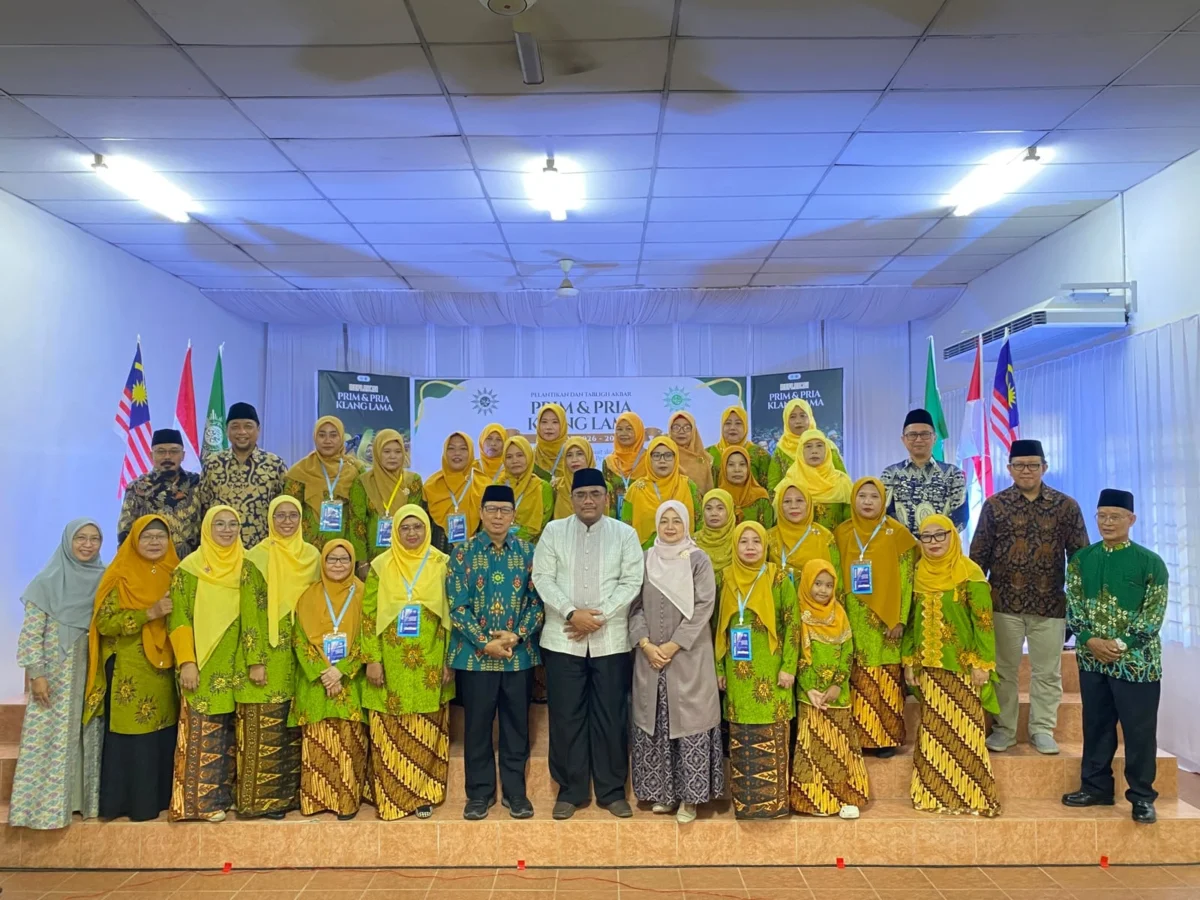
KUALA LUMPUR — In a landmark development for Indonesian Islamic da’wah and diaspora community building abroad, the Muhammadiyah and ‘Aisyiyah movements have etched a new chapter in their international history. On Sunday, September 20, the Special Branch of Muhammadiyah (Pimpinan Ranting Istimewa Muhammadiyah – PRIM) and the Special Branch of ‘Aisyiyah (Pimpinan Ranting Istimewa ‘Aisyiyah – PRIA) for Klang Lama in Kuala Lumpur, Malaysia, were officially inaugurated. This event transcends a standard organizational setup, marking the first time in the global history of the century-old movement that a grassroots branch (ranting) has been inaugurated directly by the Central Leadership (Pimpinan Pusat – PP) of Muhammadiyah.
The inauguration ceremony, held in the bustling urban district of Klang Lama, drew notable figures from both religious and diplomatic spheres. It underscored the profound socio-religious ties connecting Indonesia and Malaysia, while highlighting the vital role Indonesian diaspora organizations play in supporting expatriate communities.
A Historic First: Direct Central Inauguration and Organizational Significance
The decision by the Muhammadiyah Central Leadership to directly oversee the inauguration of a sub-district-level branch (ranting) highlights the strategic importance of the Malaysian diaspora to Indonesia’s largest modernist Islamic organizations. Traditionally, branch-level inaugurations are handled by regional or local leadership boards. However, the unprecedented direct intervention by the central board signals a shifting paradigm in how Muhammadiyah engages with its international chapters.
Muhammad Sayuti, Secretary of the Pimpinan Pusat Muhammadiyah, officially inducted the new boards of PRIM and PRIA Klang Lama and delivered the central mandate. During his address, Sayuti emphasized the unique historical weight of the occasion.
"The special branch in Klang Lama is officially the first ranting in the world to be inaugurated directly from the center," Sayuti stated firmly, drawing applause from the gathered members and dignitaries.
He urged the newly appointed leaders to maintain organizational resilience and execute their duties with unwavering dedication, despite the daunting challenges of balancing demanding work lives in a foreign country with active community service. Highlighting the legendary resilience of the Indonesian diaspora—specifically invoking the cultural tenacity often attributed to migrants from Lamongan, East Java—Sayuti praised their relentless spirit.
"Even when exhausted from work, they still think about the organization. It is no wonder that the ‘Bangladesa’—a humorous acronym for Bangsa Lamongan Desa—spread everywhere with extraordinary spirit," he remarked, capturing the cultural ethos of grassroots Indonesian resilience abroad.
Strengthening State-Diaspora Synergy: The Perspective of the Indonesian Embassy
The strategic importance of the new branches extends beyond religious outreach, intersecting directly with the welfare, protection, and representation of Indonesian citizens (WNI) and migrant workers (PMI) residing in Malaysia. The event was graced by the presence of Danang Waskito, Deputy Chief of Mission (DCM) at the Embassy of the Republic of Indonesia (KBRI) in Kuala Lumpur.
In his remarks, DCM Danang Waskito expressed profound admiration for the vibrancy, cultural richness, and creative execution of the inauguration ceremony. He noted that despite being a local branch-level event, the scale and artistic presentation reflected a high degree of communal engagement.
"This is an inauguration at the ranting level, yet the festivity is extraordinary. Every time there is an introductory speech, there is accompanying music as officials take the stage," Danang observed.
He evaluated this creative expression as an effective, modern form of da’wah capable of resonating with a broader demographic. Drawing a personal parallel, Danang reminisced about his own upbringing and his mother’s active participation in ‘Aisyiyah’s traditional arts and religious circles, noting her involvement in samroh rebana (traditional Islamic tambourine ensembles).
Beyond the cultural celebrations, Danang addressed pressing logistical and geopolitical realities facing Indonesian diplomatic missions abroad. He candidly acknowledged that the vast geographical expanse of Malaysia presents a continuous challenge for the KBRI in reaching, monitoring, and servicing the millions of Indonesian nationals living across peninsular and eastern Malaysia.
Consequently, the establishment of grassroots organizations like PRIM and PRIA Klang Lama is viewed not merely as a religious milestone, but as a critical civil society partnership for the Indonesian state. Danang explicitly appealed to the newly inaugurated boards to act as an extension of the embassy’s outreach network.
"PRIM and PRIA can serve as the eyes, ears, and hands of the KBRI because the KBRI cannot possibly reach all locations scattered across Malaysia. Certainly, the embassy is fully prepared to coordinate and communicate with mass organizations regarding the service and protection of Indonesian citizens and migrant workers," Danang emphasized.
Contextualizing Muhammadiyah’s Expansion in Malaysia
The formalization of the Klang Lama branch does not occur in a vacuum; it is part of a broader, decades-long evolution of Muhammadiyah’s international footprint, known formally as Pimpinan Istimewa Muhammadiyah (PIM). Malaysia hosts one of the largest concentrations of Indonesian expatriates, students, professionals, and migrant workers in the world. Estimates suggest that hundreds of thousands of Indonesians reside in the Klang Valley alone, making Kuala Lumpur and its surrounding urban sprawl a vital hub for diaspora organizing.
Historically, Muhammadiyah’s international expansion focused heavily on establishing Special Branches (PIM) at the country level (such as PIM Malaysia, PIM Egypt, PIM Saudi Arabia, and PIM Australia). However, as Indonesian communities in dense overseas hubs have grown exponentially, the need for sub-national structures—such as regional, branch, and sub-branch levels (ranting)—has become paramount to address localized social, educational, and spiritual needs.
The Klang Lama branch is designed to cater directly to the grassroots needs of workers and families living in the working-class and commercial districts of southwestern Kuala Lumpur. By securing formal institutional status, these branches can more effectively organize religious studies, parenting classes, youth empowerment programs, and informal educational support for children of migrant workers who may face barriers to formal schooling.
Witnessing History: Regional and Institutional Support
The significance of the Klang Lama inauguration was further underscored by the presence of high-ranking regional delegates from Indonesia, reflecting the strong institutional pipelines connecting domestic chapters with international outposts. Tamhid Mashudi, Chairman of the East Java Regional Leadership (PWM) of Muhammadiyah, along with Zaenal Arifin, Vice Secretary of PWM East Java, traveled to Kuala Lumpur to bear witness to the historic ceremony.
The involvement of the East Java regional board is particularly poignant, given that a significant portion of the Indonesian diaspora in Malaysia—particularly working-class laborers and small-business owners—hails from East Javanese enclaves such as Lamongan, Malang, Madura, and Gresik. The presence of regional leaders serves to bridge the gap between homeland institutions and diaspora communities, ensuring that members abroad maintain strong administrative, spiritual, and communal ties with their places of origin.
Broader Implications: Faith-Based Diplomacy and Migrant Welfare
The official establishment and central inauguration of PRIM and PRIA Klang Lama carry several broader implications for international civil society, religious diplomacy, and migrant governance:
- Decentralized Welfare and Community Protection: With the Indonesian Embassy openly inviting diaspora organizations to act as its "eyes, ears, and hands," religious and civil society groups like Muhammadiyah and ‘Aisyiyah are increasingly integrated into the formal architecture of state-sponsored citizen protection. This collaborative model helps mitigate the structural limitations embassies face in foreign territories.
- Empowerment of Women through ‘Aisyiyah: The parallel establishment of the PRIA (Women’s Wing) alongside Muhammadiyah ensures that female migrant workers and expatriate spouses—demographics often uniquely vulnerable to isolation and labor exploitation—receive targeted social support, capacity building, and leadership opportunities.
- Cultural Adaptation of Da’wah: As noted by diplomatic officials, the integration of local creative arts and modern community engagement strategies demonstrates that Islamic mass organizations are successfully modernizing their outreach methods to appeal to younger generations of urban expatriates.
- Institutional Resilience Abroad: By receiving direct validation from the Central Leadership in Yogyakarta, overseas branches gain enhanced legitimacy, institutional stability, and alignment with the parent organization’s core theological and social development goals, known as Islam Berkemajuan (Progressive Islam).
As the newly minted leaders of PRIM and PRIA Klang Lama assume their responsibilities, their success will likely serve as a benchmark for future international expansions. In an era marked by high global mobility and complex migration patterns, the integration of spiritual community-building with state-backed migrant advocacy offers a resilient blueprint for diaspora resilience across Southeast Asia and beyond.