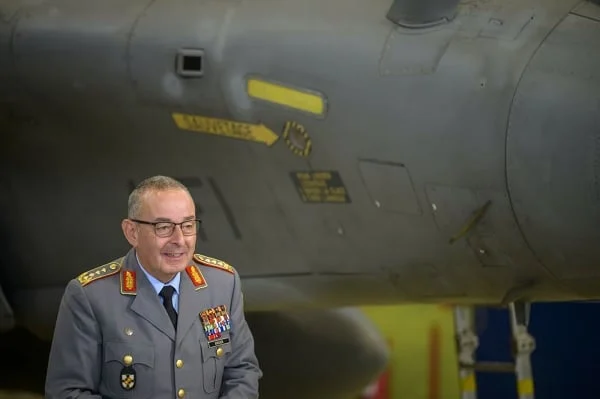
BERLIN — In a significant development for European security architecture, German General Carsten Breuer has been elected as the next chairman of the NATO Military Committee. The appointment comes at a pivotal juncture for the transatlantic alliance, as European member states aggressively reform and expand their armed forces to counter mounting geopolitical instability and potential Russian aggression.
General Breuer, who currently serves as the Inspector General of the Bundeswehr—Germany’s unified armed forces—will succeed Italian Navy Admiral Giuseppe Cavo Dragone. Breuer’s prestigious three-year tenure is formally scheduled to commence in the summer of 2027. His selection reflects not only his extensive military pedigree but also Germany’s evolving and increasingly assertive role in collective regional defense.
The decision was finalized during the annual conference of the NATO Military Committee in Copenhagen, where the chiefs of defense from all allied member states cast their votes. The Military Committee functions as the alliance’s highest military authority, providing crucial strategic advice to NATO’s civilian leadership and coordinating joint military operations and doctrine across all member nations.
The Rise of General Carsten Breuer
General Carsten Breuer has built a reputation as a pragmatic, crisis-tested strategist over a distinguished decades-long military career. He rose to international prominence during the COVID-19 pandemic when he was tapped to lead Germany’s federal crisis coordination cell, where he successfully mobilized logistical and medical support nationwide.
However, his most consequential mandate began when he was appointed Inspector General of the Bundeswehr in 2023. Stepping into the role shortly after the escalation of the Russia-Ukraine war, Breuer became the chief architect of the Zeitenwende—Germany’s historic defense policy shift aimed at reversing decades of underinvestment and modernizing its military capabilities. Under his leadership, the German military has focused heavily on operational readiness, digital transformation, and restructuring its combat brigades to align with NATO’s enhanced forward presence on the eastern flank.
Breuer’s appointment to one of the most powerful uniformed positions within the Western alliance is seen by defense analysts as a vote of confidence in Germany’s military renaissance. By placing a German general at the helm of its primary military advisory body, NATO is signaling a balanced distribution of leadership among its major European and North American stakeholders.
Strategic Implications and Defense Spending Context
The selection of a German military leader to head the NATO Military Committee occurs against a backdrop of sweeping transformation in European defense economics and strategic priorities. For years, Germany faced persistent criticism from allies—most notably the United States—for failing to meet NATO’s benchmark target of allocating 2 percent of Gross Domestic Product (GDP) to defense.

That dynamic has shifted dramatically. According to recent economic and defense data, Germany has rapidly scaled up its military expenditure, currently ranking first among European NATO members in absolute defense spending, with allocations reaching approximately €125 billion ($143 billion). This massive fiscal injection is funding the procurement of advanced air defense systems, modern armored vehicles, fifth-generation fighter jets, and critical infrastructure upgrades necessary for high-intensity collective defense.
German Defense Minister Boris Pistorius welcomed Breuer’s appointment, describing the election as international recognition of Berlin’s growing contributions to the alliance. "This is a testament to the rigorous steps Germany has taken to reinforce the security of the alliance and assume greater responsibility in safeguarding our shared values," Pistorius stated following the vote in Copenhagen.
The elevation of German officials to senior command positions within NATO reflects a broader trend of Berlin stepping out of its post-Cold War strategic reticence. As the war in Ukraine enters a protracted phase, European capitals are increasingly aware of the imperative to build a robust "European pillar" within NATO that can deter aggression independently while remaining fully interoperable with United States forces.
Chronology of NATO’s Military Leadership Transition
The transition of leadership within the NATO Military Committee follows a carefully structured multi-year cycle designed to ensure seamless continuity in strategic planning.
- Early 2023: General Carsten Breuer assumes office as the Inspector General of the Bundeswehr, immediately prioritizing the overhaul of Germany’s armed forces in response to the security crisis in Eastern Europe.
- Mid-2024 to 2025: NATO member states initiate informal consultations regarding the succession of the Military Committee chairmanship, evaluating candidates based on operational experience, geopolitical acumen, and their respective nations’ commitment to alliance defense benchmarks.
- September 2026: During the annual NATO Military Committee conference in Copenhagen, allied chiefs of defense formally vote to elect General Breuer as the next chairman.
- Summer 2027: General Breuer is scheduled to officially take over the chairmanship from outgoing Italian Admiral Giuseppe Cavo Dragone, beginning his three-year mandate at NATO Headquarters in Brussels.
Broader Impact on Transatlantic Relations
As General Breuer prepares to step into his new role in 2027, he will inherit a security environment characterized by profound complexity. Beyond the immediate imperative of deterring Russian military expansion, the next NATO Military Committee chairman will oversee the integration of newly joined members, manage the ongoing adaptation of alliance command structures, and navigate shifting political dynamics in Washington and European capitals.
Defense experts note that Breuer’s background in managing large-scale institutional transformation will be an asset for NATO. The alliance is currently modernizing its regional defense plans—the most comprehensive overhaul since the Cold War—requiring member states to commit specific forces to pre-assigned geographic zones. Ensuring that these national contributions translate into cohesive, combat-ready formations will be one of Breuer’s primary responsibilities.
Furthermore, Breuer’s leadership is expected to reinforce the bond between European defense initiatives and NATO frameworks. As the European Union pursues closer defense industrial cooperation, maintaining strategic alignment with NATO remains vital to avoid duplication and ensure resource efficiency.
With his appointment, Germany cements its position not only as a logistical and financial anchor for European security but also as a intellectual driver of military strategy within the world’s most powerful defensive alliance.