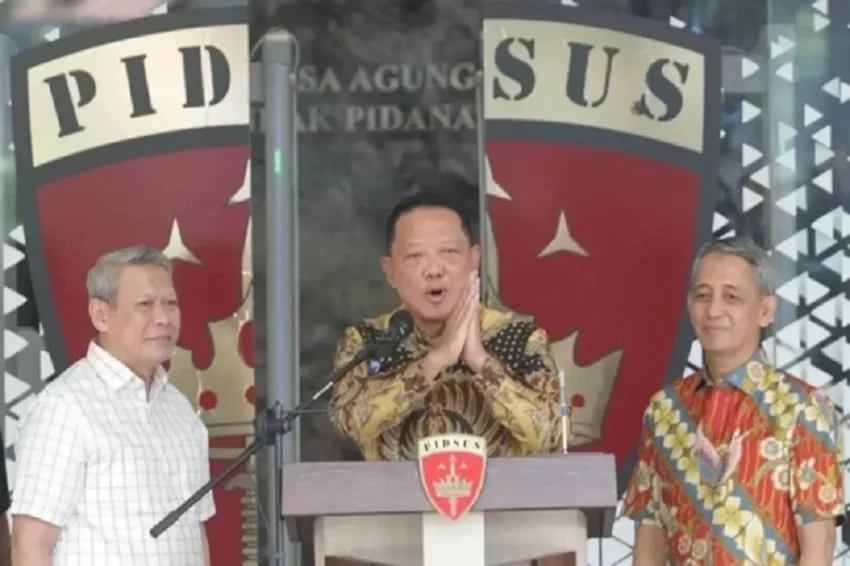
The Attorney General’s Office (AGO) of the Republic of Indonesia has officially detained Febrie Adriansyah, the former Junior Attorney General for Extraordinary Crimes (Jampidsus), following an intensive interrogation regarding his alleged involvement in several high-profile corruption cases and Money Laundering (TPPU). The detention took place late Friday night, July 24, 2026, at the AGO headquarters in Jakarta, marking a significant and dramatic turn in the nation’s ongoing anti-corruption efforts. Febrie, who once led the very department now investigating him, was seen exiting the AGO’s Main Building at approximately 11:02 PM WIB.
The former high-ranking official was escorted through the lower lobby of the building under heavy security provided by the AGO’s internal security detail. Despite the gravity of the allegations, observers noted that Febrie was not wearing the customary pink or red detention vest usually seen on corruption suspects, nor was he handcuffed during his transfer to the detention vehicle. Before being driven away, Febrie briefly addressed the gathered media, providing a short statement regarding his legal status before being whisked away to a detention facility.
This legal action follows the transfer of case files and suspects from the Jakarta Metropolitan Police (Polda Metro Jaya) to the AGO. Along with Febrie, a private sector individual identified as Don Ritto has also been named as a suspect in this sprawling investigation. The case is particularly notable due to Febrie’s previous role as one of the most powerful prosecutors in Indonesia, responsible for overseeing the prosecution of some of the country’s largest financial scandals.
The Issuance of Three New Investigation Orders
The detention of Febrie Adriansyah is tied to the issuance of three separate Letters of Instruction for Investigation (Sprindik) by the Attorney General’s Office. These documents outline a complex web of alleged criminal activity spanning several state-owned enterprises (BUMN) and critical national infrastructure projects. The three primary focal points of the investigation include:
- Alleged Corruption within PT Krakatau Steel: This branch of the investigation focuses on financial irregularities and potential kickbacks related to strategic projects within the state-owned steel manufacturer. Historically, Krakatau Steel has faced scrutiny over its blast furnace projects and various restructuring efforts, which investigators now believe were manipulated for illicit personal gain.
- Coal Procurement for Perusahaan Listrik Negara (PLN): This investigation seeks to uncover the roots of corruption in the procurement of coal for Steam Power Plants (PLTU). Prosecutors allege that fraudulent procurement practices directly contributed to catastrophic "blackouts" or widespread power outages that affected the national grid. The investigation explores how substandard coal or manipulated supply chains resulted in both financial losses for the state and operational failures for the utility provider.
- The ASABRI Corruption Scandal: Perhaps the most high-profile of the three, this involves the continued fallout from the massive corruption case at PT ASABRI (Persero), the social insurance and pension fund for the Indonesian Armed Forces (TNI) and National Police (Polri). The case, which originally broke several years ago involving losses estimated at IDR 22.7 trillion, has entered a new phase with allegations that Febrie may have been involved in the mismanagement of recovered assets or other illicit dealings related to the case’s resolution.
Chronology of the Detention
The path to Febrie Adriansyah’s detention began earlier this year when Polda Metro Jaya initiated a probe into suspicious financial transactions and administrative irregularities linked to his tenure as Jampidsus. By July 2026, the investigation had reached a "P-21" status, meaning the case files were deemed complete and ready for prosecution.
On the morning of Friday, July 24, Febrie arrived at the AGO’s Building for Extraordinary Crimes to undergo questioning as a witness. However, by the afternoon, his status was upgraded to that of a suspect based on the strength of the evidence gathered by investigators. The interrogation continued for over twelve hours, focusing on his relationships with private sector figures like Don Ritto and his influence over specific case settlements.
By 10:00 PM, the legal team at the AGO concluded that detention was necessary to prevent the potential tampering of evidence or the influencing of other witnesses. At 11:02 PM, the formal detention process was executed. The transfer of the case from the police to the AGO signifies a "one-roof" legal process where the state’s primary prosecutorial body takes full control over the trial preparation phase.
Background Context: The Fall of a "Corruption Hunter"
The detention of Febrie Adriansyah has sent shockwaves through Indonesia’s legal community. As the former Jampidsus, Febrie was once hailed as a "corruption hunter." During his tenure, he was the face of several major investigations, including the Garuda Indonesia procurement scandal, the Jiwasraya insurance fraud, and the initial stages of the ASABRI case. His department was responsible for seizing trillions of rupiah in assets from corruptors.
The irony of his current situation is not lost on the public. The very institution he led to prosecute financial crimes is now accusing him of the same offenses. Legal analysts suggest that this case highlights the systemic risks within high-level prosecutorial offices, where the power to seize assets and negotiate settlements can be exploited if oversight mechanisms are insufficient.
The involvement of Don Ritto, a private sector figure, suggests a "quid pro quo" dynamic where government officials may have facilitated favorable outcomes for private entities in exchange for financial incentives. Investigators are currently tracing the flow of funds through various offshore accounts and shell companies, a process central to the Money Laundering (TPPU) charges.
Supporting Data and Financial Implications
The scale of the corruption involved in the three mentioned cases is immense. To understand the gravity of the charges against Febrie, one must look at the historical data associated with these entities:
- ASABRI: The original loss of IDR 22.7 trillion remains one of the largest in Indonesian history. If the new investigation proves that the recovery process was compromised by Febrie, it could mean that hundreds of billions of rupiah intended for the state treasury were diverted.
- Krakatau Steel: Between 2012 and 2022, the steel giant struggled with debts exceeding $2 billion. Corruption in its procurement and project management has been cited as a primary reason for its inability to compete with imported steel. The AGO is investigating specific losses in the hundreds of billions related to the 2026-era contracts.
- PLN Coal Procurement: The 2019 Java-Bali blackout resulted in estimated economic losses of nearly IDR 90 billion in just a few hours. Investigators are now linking similar, more recent grid instabilities to the procurement of low-quality coal that damaged turbines, a scheme allegedly protected by high-ranking officials in the legal system.
Official Responses and Institutional Integrity
The Attorney General’s Office has maintained a strictly professional stance regarding the detention of their former colleague. A spokesperson for the AGO stated that the institution remains committed to the principle of "equality before the law."
"The Attorney General has made it clear that no one is above the law, regardless of their previous position or rank within this office," the spokesperson said in a press briefing following the detention. "This action is part of our internal ‘clean-up’ initiative to ensure that the integrity of the AGO is not compromised by the actions of individuals. We are working closely with the Financial Transaction Reports and Analysis Center (PPATK) to ensure every penny of laundered money is accounted for."
Meanwhile, representatives for Polda Metro Jaya confirmed that they have handed over all relevant evidence, including digital forensics and witness testimonies, to the AGO. The cooperation between the police and the prosecutors in this case is being viewed as a litmus test for the "Integrated Criminal Justice System" in Indonesia.
Broader Impact and Legal Analysis
The detention of Febrie Adriansyah is likely to have far-reaching implications for the Indonesian judiciary. First, it may lead to the reopening or review of previous cases handled during his tenure. If it is proven that Febrie accepted bribes or engaged in money laundering, every settlement and asset seizure he oversaw could potentially be challenged in court by previously convicted individuals.
Secondly, this case underscores the necessity for the "Anti-Money Laundering Law" to be applied rigorously to public officials. The TPPU charges are critical because they allow the state to freeze and confiscate assets that are disproportionate to an official’s legal income.
From a political perspective, this move by the AGO is seen as an attempt to restore public trust. In recent years, public perception of legal institutions in Indonesia has fluctuated. By prosecuting one of its own high-ranking former members, the AGO is signaling that it is capable of self-correction. However, critics argue that the lack of a detention vest and handcuffs during Febrie’s transfer suggests that "special treatment" for former elites still persists within the system.
Future Proceedings
Following his detention, Febrie Adriansyah will remain in custody for an initial period of 20 days, which can be extended as the investigation proceeds toward the trial phase. The AGO is expected to present a comprehensive indictment that connects the three separate Sprindiks into a singular narrative of systemic corruption and money laundering.
As the legal team for Febrie prepares his defense, the public eye remains fixed on the AGO. The upcoming trial will not only determine the fate of a former top prosecutor but will also serve as a definitive moment for Indonesia’s commitment to transparency and the rule of law. The involvement of state-owned giants like Krakatau Steel and PLN ensures that the economic stakes are as high as the legal ones, making this one of the most consequential trials of the decade.