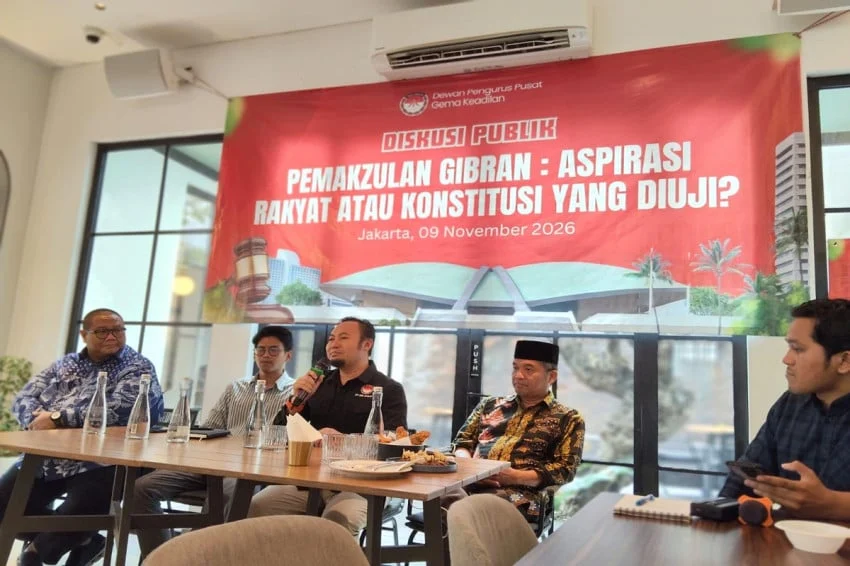
The political landscape in Jakarta has intensified following a public discussion hosted by the Central Executive Board of Gema Keadilan (DPP Gema Keadilan) in Cikini, Central Jakarta. Amid ongoing national debates concerning administrative integrity and constitutional compliance within the highest offices of the state, key political figures and legal advocates have openly called for legislative intervention. Rahmat Saleh, Chairman of DPP Gema Keadilan and a sitting member of the House of Representatives (DPR RI), announced his unequivocal readiness to initiate and sign a formal proposal for the Exercise of the Right to State an Opinion (Hak Menyatakan Pendapat or HMP). This parliamentary mechanism is being framed as a vital constitutional instrument to address the unfolding controversy surrounding Vice President Gibran Rakabuming Raka’s educational credentials—frequently referred to in public discourse as "Ijazah Gate."
The forum, themed "Gibran’s Impeachment: Public Aspiration or Constitution Put to the Test?", served as a focal point for legal scholars, political analysts, and civil society members to dissect the intersection of judicial rulings, administrative law, and executive legitimacy. As political factions within the legislature begin to signal varying degrees of responsiveness to the proposal, the debate moves beyond partisan friction, touching directly on the foundational norms governing public office eligibility in the Republic of Indonesia.
Background Context and the Evolution of the Controversy
The genesis of the current political standoff traces back to prolonged public scrutiny over the administrative documents and educational requirements submitted by candidates during the preceding presidential election cycle. Under Indonesian electoral law and the regulations stipulated by the General Elections Commission (KPU), candidates for the presidency and vice presidency must meet rigorous educational and administrative thresholds.
Over the past year, various groups, including independent watchdogs and legal coalitions, have questioned the transparency and authentication processes surrounding the credentials presented by Vice President Gibran Rakabuming Raka. These grievances culminated in legal challenges and petitions directed at the Constitutional Court (Mahkamah Konstitusi – MK) and the Supreme Court (Mahkamah Agung – MA). While these judicial bodies have issued various determinations addressing procedural and statutory frameworks, critics argue that the underlying questions regarding institutional integrity and adherence to statutory mandates remain unresolved.
The involvement of the MK and MA has shifted the debate from a purely political grievance to a constitutional examination. DPP Gema Keadilan and allied legal experts argue that recent judicial developments have inadvertently highlighted ambiguities or potential oversights in how candidate verifications were handled, providing a legitimate legal anchor for the legislative branch to exercise its oversight functions.
Chronology of Recent Developments
The timeline leading up to the Cikini public discussion highlights the rapid acceleration of the impeachment discourse within parliamentary circles:
- Initial Legal Challenges: Independent civil society organizations and legal aid groups file formal inquiries regarding the educational documentation of high-ranking executive officials, sparking social media discourse and grassroots campaigns under the banner of "Ijazah Gate."
- Judicial Responses: The Constitutional Court and the Supreme Court review petitions related to electoral candidate requirements. While specific rulings dismiss procedural challenges based on existing legal standing or technicalities, they generate substantial debate among constitutional law experts regarding the precise interpretation of eligibility criteria.
- Parliamentary Stirrings: Reports emerge from legislative quarters indicating that individual lawmakers are privately and publicly discussing the viability of parliamentary oversight tools, specifically the Right to Interpelasi (Inquiry), Hak Angket (Investigation), and the more potent Hak Menyatakan Pendapat (HMP).
- Public Forum in Cikini: On November 9, 2026, DPP Gema Keadilan convenes a high-profile public discussion. It is during this event that Rahmat Saleh makes his definitive commitment to sign an HMP proposal, accompanied by legal assessments from the organization’s Legal Aid Bureau (LBH Gema Keadilan).
- Broadening Legislative Reactions: Senior lawmakers, including prominent figures such as Ahmad Doli Kurnia, acknowledge that various legislators have begun responding positively or cautiously to the prospect of evaluating the HMP mechanism, signaling that the topic is transitioning from fringe discourse to official parliamentary corridors.
The Mechanics of Hak Menyatakan Pendapat (HMP)
In the architecture of the Indonesian legislative system, the Right to State an Opinion (Hak Menyatakan Pendapat) is one of the ultimate oversight tools possessed by the House of Representatives (DPR RI). Regulated under the Law on the People’s Consultative Assembly, House of Representatives, Regional Representative Council, and Regional House of Representatives (UU MD3), HMP is an instrument whereby the DPR can express its views on national policies, critical incidents, or alleged violations of the constitution and laws by the executive branch.
Unlike the Right to Inquiry (Hak Interpelasi) or the Right of Investigation (Hak Angket), which primarily serve to gather information and demand explanations from the government, HMP carries a heavier political and constitutional weight. A successful HMP process can serve as a formal parliamentary declaration that the executive has breached its oath of office or failed to uphold constitutional standards, potentially paving the way for subsequent constitutional processes, including inquiries that may lead to formal impeachment proceedings through the Constitutional Court.
However, invoking HMP is a complex and high-stakes legislative maneuver. It requires substantial political backing, meeting strict quorum requirements and securing cross-factional support within the plenary session of the DPR. Rahmat Saleh’s declaration is seen by analysts as an attempt to test the waters and build a coalition among dissenting or reform-minded legislators willing to push the executive branch toward greater accountability.

Statements and Stakeholder Reactions
During the Cikini discussion, Rahmat Saleh elaborated on why the legislative branch cannot afford to remain passive in the face of persistent public doubts regarding executive credentials.
"If HMP is rolled out in the DPR, I am ready to be part of the members of the DPR who sign the proposal," Rahmat stated during the forum. He emphasized that the unfolding situation regarding the rulings of the MK and MA represents a critical juncture for Indonesian jurisprudence. "This is not merely a political issue, but also concerns the constitution, the requirements for public office, and public trust in democracy."
Echoing these sentiments, Anton Aryadi, Chairman of the Legal Aid Bureau (LBH Gema Keadilan), took a more direct stance regarding executive accountability. Aryadi articulated the organization’s official position by suggesting that voluntary resignation by the Vice President could serve as a pragmatic resolution to restore public confidence and alleviate constitutional friction, should the administrative discrepancies prove irreconcilable with the dignity of the office.
Meanwhile, reactions from other political factions within the DPR have been mixed, reflecting the delicate coalition dynamics of the current administration. While some opposition and independent legislators have welcomed the discourse as a healthy exercise of checks and balances, leaders from ruling coalition parties have urged caution, warning against the politicization of administrative disputes that have already passed through institutional legal review. Ahmad Doli Kurnia, a senior lawmaker, noted that while some legislators have responded positively to exploring the parameters of HMP, any formal movement would require rigorous adherence to constitutional procedures rather than emotional or reactionary politics.
Broader Impact and Implications for Indonesian Democracy
The push for HMP centered on "Ijazah Gate" carries profound implications for the trajectory of Indonesian democratic governance. At its core, the controversy forces a national conversation about the rigor of vetting processes for high-level political candidates. Critics argue that if systemic flaws exist in how educational and personal credentials are authenticated prior to elections, future electoral integrity could be compromised, weakening the legitimacy of elected leaders.
Conversely, political analysts caution that utilizing high-level mechanisms like HMP for contentious administrative disputes risks deepening political polarization. In a post-election environment where national stability and economic recovery remain paramount, prolonged institutional friction between the legislature and the executive could disrupt governance, deter foreign investment, and distract from pressing socio-economic challenges facing the populace.
Furthermore, the involvement of the judiciary—specifically the MK and the MA—adds another layer of complexity. When political actors seek to overturn or challenge executive legitimacy through parliamentary tools following judicial determinations, it tests the boundaries of separation of powers. It raises critical questions regarding whether political bodies should function as appellate forums for contested administrative facts or if such matters must remain strictly within the purview of courts of law.
Conclusion and Outlook
As the debate surrounding the DPP Gema Keadilan initiative gains traction, all eyes remain fixed on the legislative complex in Senayan. Whether Rahmat Saleh and his supporters can successfully mobilize the necessary political capital to table an official HMP proposal will depend heavily on shifting coalition alignments and the broader public response in the coming weeks.
For now, the controversy serves as a stark reminder of the enduring tensions within Indonesia’s democratic framework. It highlights the constant friction between executive power, legislative oversight, judicial interpretation, and the persistent demand for absolute transparency from those entrusted with the nation’s highest offices. As the discourse evolves from public forums to formal parliamentary corridors, the ultimate test will be whether institutional mechanisms can resolve the crisis while preserving the stability and integrity of the constitutional order.