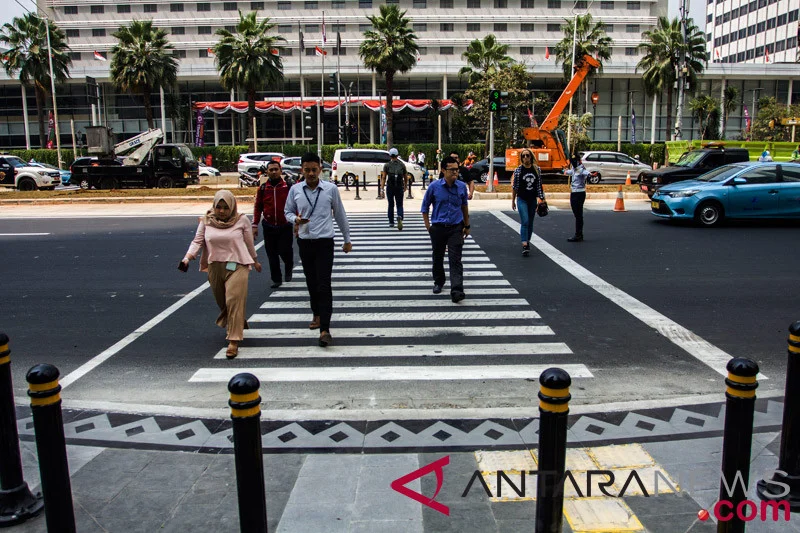
The Jakarta Provincial Transportation Agency (Dishub DKI) and the Jakarta Metropolitan Police (Polda Metro Jaya) are significantly escalating efforts to enhance road user compliance, particularly at signalized pedestrian crossings known as pelican crossings. This intensified oversight, employing both on-field personnel and advanced surveillance cameras (CCTV), comes in response to a recent incident where a vehicle allegedly ran a red light at the Pelican Crossing near Bundaran HI, Central Jakarta, on Thursday, July 23rd. The initiative underscores a critical commitment to bolstering pedestrian safety within the capital’s bustling urban landscape.
The Incident and Immediate Response
The alleged red-light violation at the Bundaran HI pelican crossing served as a stark reminder of the inherent dangers posed by non-compliance with traffic regulations, especially at facilities designed to protect vulnerable road users. While details of the specific incident remain under investigation, its occurrence prompted an immediate and decisive reaction from city authorities. Head of the DKI Jakarta Provincial Transportation Agency, Budi Awaluddin, emphasized the gravity of such transgressions, stating that "as an effort to enhance road user compliance, Dishub DKI, in collaboration with Polda Metro Jaya, will continuously conduct supervision through field officers and CCTV cameras." This prompt and unified response highlights the authorities’ zero-tolerance stance on actions that endanger public safety and disrupt the orderly flow of traffic. The Bundaran HI area, a prominent landmark and a nexus of significant pedestrian and vehicular activity, makes any violation there particularly concerning, amplifying the need for robust enforcement and public education.
Understanding Pelican Crossings and Their Importance
Pelican crossings, an acronym derived from "PEdestrian LIght CONtrolled" crossing, are a vital component of urban traffic management infrastructure, designed specifically to facilitate safe passage for pedestrians across busy roadways. Originating in the United Kingdom, these crossings operate on a push-button system, allowing pedestrians to request a signal change that stops vehicular traffic and provides a dedicated time slot for crossing. Unlike zebra crossings, which rely solely on driver vigilance, pelican crossings integrate traffic lights (APILL – Alat Pemberi Isyarat Lalu Lintas in Indonesia) for both vehicles and pedestrians, providing a clear indication of when it is safe to cross and when vehicles must stop.
In a dense metropolitan area like Jakarta, where pedestrian volumes are high and vehicular traffic is often heavy and fast-moving, pelican crossings play an indispensable role in preventing accidents. They are strategically placed at locations with significant pedestrian demand, such as near public transport hubs, commercial centers, schools, and residential areas. Budi Awaluddin underscored this, stating, "Pelican crossings are one of the road safety facilities that function to reduce the potential for traffic accidents." Adherence to the APILL at these crossings is not merely a matter of legal compliance but a fundamental aspect of maintaining the safety and integrity of the entire transportation ecosystem, especially for pedestrians who are the most vulnerable road users.
Enhanced Enforcement Measures: Technology and Human Oversight
To achieve greater compliance, Dishub DKI is implementing a multi-pronged enforcement strategy that combines traditional human oversight with cutting-edge technology. Currently, field officers are deployed at key pelican crossings to monitor behavior and intervene when necessary. These officers play a crucial role in direct enforcement, traffic flow management, and public education on the spot. Complementing this human presence are existing CCTV cameras, which provide continuous surveillance, capturing violations and serving as crucial evidence for prosecution.
Looking ahead, Dishub DKI plans to significantly upgrade its technological arsenal. Budi Awaluddin revealed intentions to "add more surveillance cameras and loudspeakers connected to the Network Operation Center (NOC) to provide direct warnings and education to both drivers and pedestrians." This initiative marks a significant step towards a more intelligent and proactive traffic management system. The integration of additional high-definition cameras will enhance monitoring capabilities, allowing for wider coverage and clearer identification of violations. The introduction of loudspeakers, directly linked to the NOC, represents a paradigm shift in real-time intervention. From a centralized control room, operators will be able to issue immediate audio warnings to drivers who attempt to run red lights or pedestrians who cross outside designated areas or against signals. This direct, immediate feedback mechanism is expected to be a powerful deterrent and an effective tool for on-the-spot education, fostering a greater sense of accountability among road users. The NOC will serve as the nerve center for this integrated surveillance and communication system, enabling rapid response and data collection for analysis and future policy formulation.
Broader Context of Jakarta’s Traffic Challenges
Jakarta, as one of the world’s most populous megacities, faces monumental challenges in managing its urban mobility. With a population exceeding 10 million in the city proper and over 30 million in its greater metropolitan area (Jabodetabek), the sheer volume of daily commuters and vehicles places immense strain on its infrastructure. Reports frequently highlight Jakarta’s severe traffic congestion, often ranking among the worst globally. This congestion is exacerbated by a rapid increase in private vehicle ownership, insufficient public transportation penetration in some areas, and historical urban planning that sometimes prioritized vehicular movement over pedestrian infrastructure.
Data from various sources, including the National Police and transportation research institutes, consistently points to a high incidence of traffic accidents, with pedestrians and motorcyclists often being the most vulnerable groups. Despite ongoing infrastructure development, including the expansion of public transport networks like the MRT and LRT, and the construction of elevated roads, the behavioral aspect of road safety remains a significant hurdle. Many drivers exhibit a lack of discipline, frequently disregarding traffic signals, speed limits, and pedestrian rights. This challenging environment makes the enforcement and educational efforts at pelican crossings not just a localized initiative but a critical component of a broader strategy to civilize Jakarta’s roads and enhance the overall quality of urban life.
Pedestrian Safety Imperatives: Legal and Moral Obligations
The discourse surrounding pelican crossings inevitably leads to the fundamental principles of road safety and the legal and moral obligations of all road users. Awaluddin firmly reiterated that "running a pelican crossing when the red light is on is not only a traffic violation but can also endanger the safety of pedestrians and potentially cause traffic accidents resulting in injuries or even fatalities." This statement underscores the severe consequences of non-compliance. Traffic laws are not arbitrary rules; they are meticulously designed to minimize risk and ensure equitable access to public spaces.
Specifically, drivers are legally mandated to stop when the red light illuminates at a pelican crossing, giving absolute priority to pedestrians. Failure to do so can result in fines, demerit points, and in serious cases, criminal charges if an accident occurs. Conversely, pedestrians also bear responsibility for their safety. They are urged to utilize the available crossing facilities and to ensure that traffic conditions are safe before proceeding, even when the pedestrian signal indicates a "walk" phase. This reciprocal obligation is crucial for fostering a culture of mutual respect and safety on the roads. The emphasis on APILL compliance at pelican crossings is a direct effort to ingrain these fundamental safety principles into the daily routines of Jakarta’s millions of commuters.
Technological Integration and Smart City Vision
The planned integration of additional cameras and loudspeakers connected to a Network Operation Center is a clear manifestation of Jakarta’s broader "Smart City" vision. This vision seeks to leverage technology to improve urban services, enhance efficiency, and increase liveability. In the context of traffic management, smart city initiatives involve:
- Real-time Data Collection and Analysis: CCTVs and sensors provide continuous data on traffic flow, congestion, and violations, allowing authorities to respond dynamically.
- Intelligent Traffic Signal Systems: Optimizing signal timings to reduce congestion and improve safety, sometimes using AI algorithms.
- Integrated Command Centers (NOCs): Centralized hubs for monitoring various urban systems, including traffic, emergency services, and public safety.
- Public Information Systems: Providing real-time traffic updates and safety messages to commuters.
By linking pelican crossing surveillance directly to a NOC with immediate communication capabilities, Jakarta is moving towards a more responsive and intelligent traffic enforcement system. This not only aids in deterring violations but also provides valuable data for urban planners to identify accident hotspots, evaluate the effectiveness of interventions, and design safer infrastructure in the future. The technological backbone being built will allow for greater precision in enforcement, more efficient deployment of resources, and a more robust evidence base for policy decisions.
Collaboration, Public Awareness, and Future Outlook
The success of this intensified enforcement strategy hinges not only on technological upgrades and diligent fieldwork but also on strong inter-agency collaboration and sustained public awareness campaigns. The partnership between Dishub DKI and Polda Metro Jaya is critical, ensuring that enforcement efforts are comprehensive, legally sound, and consistently applied. This collaboration extends to data sharing, joint operations, and coordinated communication strategies.
Furthermore, Budi Awaluddin’s call for all road users to "respect each other’s rights to create safe, orderly, and secure traffic" highlights the indispensable role of public education. Enforcement alone cannot fundamentally alter behavior; it must be complemented by continuous campaigns that educate citizens about traffic laws, the rationale behind them, and the collective benefits of compliance. These campaigns could utilize various media channels, community outreach programs, and even school curricula to instill a culture of road safety from a young age. Pedestrian advocacy groups and urban planning experts often echo this sentiment, emphasizing that truly safe roads require a combination of robust infrastructure, rigorous enforcement, and an informed, responsible citizenry.
Looking ahead, the challenge for Jakarta will be to sustain these efforts, scale successful initiatives across the entire city, and adapt to evolving urban mobility patterns. While the immediate focus is on pelican crossings, the lessons learned and the systems developed will undoubtedly contribute to broader improvements in traffic management and pedestrian safety across all types of crossings and roads. The commitment demonstrated by Dishub DKI and Polda Metro Jaya represents a vital step towards creating a safer, more orderly, and ultimately more liveable Jakarta for all its inhabitants. The vision is clear: a city where advanced technology, dedicated enforcement, and a culture of mutual respect converge to ensure that every journey, especially for the most vulnerable, is a safe one.