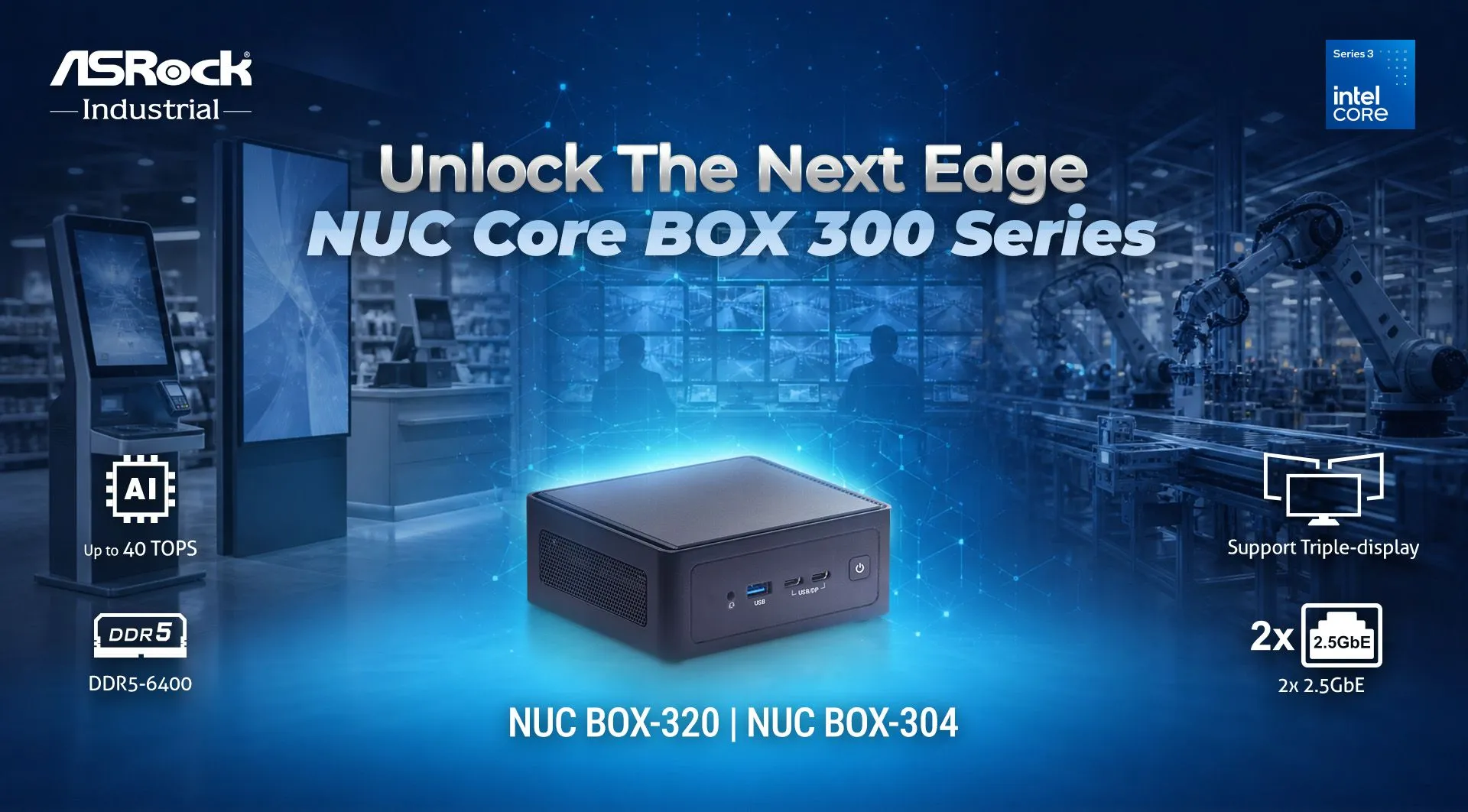
ASRock, a globally recognized leader in motherboards, graphics cards, and compact form-factor computing solutions, has officially expanded its robust catalog with the introduction of the NUC BOX 300 Series mini PCs. Designed to cater to a diverse array of computing environments ranging from enterprise corporate offices and digital signage deployments to space-constrained home workstations, the newly announced lineup comprises two primary models: the NUC BOX-320 and the NUC BOX-304. Both iterations harness the computational efficiency of Intel’s latest Core 300 processors, which are built upon the advanced Wildcat Lake architecture. Despite occupying a remarkably minuscule physical footprint—measuring under a single liter in volume—these compact systems do not compromise on performance, offering support for up to 64GB of high-speed DDR5 memory and robust dual 2.5GbE network connectivity.
The introduction of the NUC BOX 300 Series arrives at a pivotal juncture in the personal computing and enterprise hardware markets. Over the past several years, the demand for ultra-small form factor (USFF) PCs has experienced exponential growth. Organizations and individual consumers alike are continuously seeking hardware solutions that minimize desktop clutter, reduce power consumption, and eliminate acoustic distractions without sacrificing the multitasking capabilities traditionally associated with bulkier tower desktops or standard mid-range laptops. By adopting Intel’s Wildcat Lake processor lineup, ASRock aims to capture a significant market share within the entry-to-mid-range mini PC sector, providing an optimal balance between energy efficiency and responsive daily computing performance.
Detailed Architectural Breakdown and Technical Specifications
At the heart of the ASRock NUC BOX 300 Series are Intel’s freshly minted Core 300 processors. The flagship model of this initial launch, the NUC BOX-320, is anchored by the Intel Core 5 320 processor. This specific silicon configuration features a hybrid core architecture consisting of two Performance-cores (P-cores) and four Efficient-cores (E-cores), delivering a total of six execution cores designed to dynamically balance intensive workloads and background tasks effectively. Conversely, the more budget-friendly NUC BOX-304 variant is powered by the Intel Core 3 304 processor, which scales down the physical core count to a single P-core paired with four E-cores, rendering it exceptionally well-suited for light office productivity, web browsing, point-of-sale terminals, and media streaming applications.
Memory capacity and performance represent a critical bottleneck in many ultra-compact systems, but ASRock has engineered the NUC BOX 300 Series to surpass these limitations. Both models feature a single SODIMM slot capable of housing up to 64GB of lightning-fast DDR5-6400 memory. This inclusion of high-bandwidth DDR5 architecture ensures that memory-intensive multitasking operations, data buffering, and complex software applications run smoothly and without noticeable latency.

Storage expandability is equally impressive given the physical constraints of the chassis. ASRock has outfitted the motherboards within the NUC BOX 300 Series with a versatile array of storage interfaces. Users can install high-speed solid-state drives via an M.2 2242 slot supporting PCIe Gen 4 x1 speeds, as well as a larger M.2 2280 slot utilizing PCIe Gen 4 x2 lanes. This dual-slot configuration allows for flexible storage tiering, enabling professionals to pair a fast boot drive with a high-capacity secondary drive for extensive file storage. Furthermore, wireless connectivity is addressed through a dedicated M.2 2230 slot pre-populated or configured for modern wireless cards, bringing Wi-Fi 6E and Bluetooth 5.3 standards to ensure stable, high-speed wireless networking and peripheral pairing.
Comprehensive Connectivity and Form Factor Ergonomics
In the realm of mini PCs, input/output (I/O) versatility often dictates real-world utility, and the ASRock NUC BOX 300 Series excels significantly in this domain. Despite their diminutive dimensions, the devices feature a surprisingly generous assortment of physical ports. For display outputs, the units incorporate dual HDMI 2.1 ports alongside two USB Type-C ports equipped with DisplayPort 1.4a alternate mode functionality. This configuration allows users to drive multiple high-resolution displays simultaneously, making the mini PCs ideal for multi-monitor workstations, financial trading desks, and digital signage control rooms.
Wired networking is anchored by dual 2.5GbE Ethernet ports. The inclusion of two high-speed Ethernet interfaces provides significant advantages for network administrators, allowing the mini PCs to function effectively as secure edge gateways, network-attached storage (NAS) clients, or dedicated routers running specialized firewall distributions. Additional peripheral connectivity is facilitated by three standard USB Type-A ports for legacy devices, alongside a traditional 3.5mm audio jack for headphones or external microphones.
The physical enclosure housing these components is a masterclass in space optimization. Measuring precisely 117.5 x 110 x 49 millimeters, the chassis boasts a total internal volume of just 0.63 liters and a modest dead weight of approximately 1 kilogram. To maximize deployment flexibility, ASRock has designed the chassis with integrated VESA mount compatibility. This allows the NUC BOX-320 and NUC BOX-304 to be mounted discreetly on the rear of professional computer monitors or commercial television displays, completely removing the system unit from the desktop workspace.
Industry Context and Market Positioning

ASRock’s strategic rollout of the NUC BOX 300 Series reflects broader macroeconomic and technological trends within the hardware industry. As remote and hybrid work models stabilize worldwide, businesses are constantly re-evaluating their capital expenditure on IT infrastructure. Bulky desktop hardware incurs higher shipping costs, consumes more office space, and draws greater electrical power compared to compact alternatives. Mini PCs powered by energy-efficient architectures like Intel Wildcat Lake present an attractive proposition for enterprise buyers seeking to reduce their corporate carbon footprint while maintaining fleet reliability.
Moreover, the embedded and industrial computing sectors represent lucrative secondary markets for such hardware. The inclusion of dual 2.5GbE networking, robust thermal management, and reliable Intel silicon makes these systems prime candidates for factory automation, smart kiosks, and medical equipment interfaces. While ASRock historically caters heavily to enthusiast gamers and DIY PC builders through its motherboard and graphics card divisions, the expansion of its Industrial Computer (IPC) and business-class mini PC divisions demonstrates a diversified approach to sustained market growth.
Implications, Pricing, and Availability Outlook
As of the official product launch announcement, ASRock has maintained a cautious stance regarding the official pricing structure and regional availability timelines for the NUC BOX-320 and NUC BOX-304. Industry analysts anticipate that the manufacturer will position these units competitively within the entry-to-mid-tier commercial segment to challenge established competitors from brands such as ASUS, Minisforum, and MSI.
The eventual arrival of the NUC BOX 300 Series in international markets—including Southeast Asian territories such as Indonesia—will likely depend on local distribution channels and regional regulatory certifications. Should these units debut at an aggressive price point, they are expected to garner substantial interest among budget-conscious system integrators, educational institutions, and office workers seeking reliable, future-proof desktop solutions that occupy minimal physical space. As consumer and enterprise expectations continue to shift toward streamlined, high-efficiency computing ecosystems, ASRock’s latest offering underscores the ongoing evolution of form-factor engineering where physical size is no longer an indicator of computational capability.