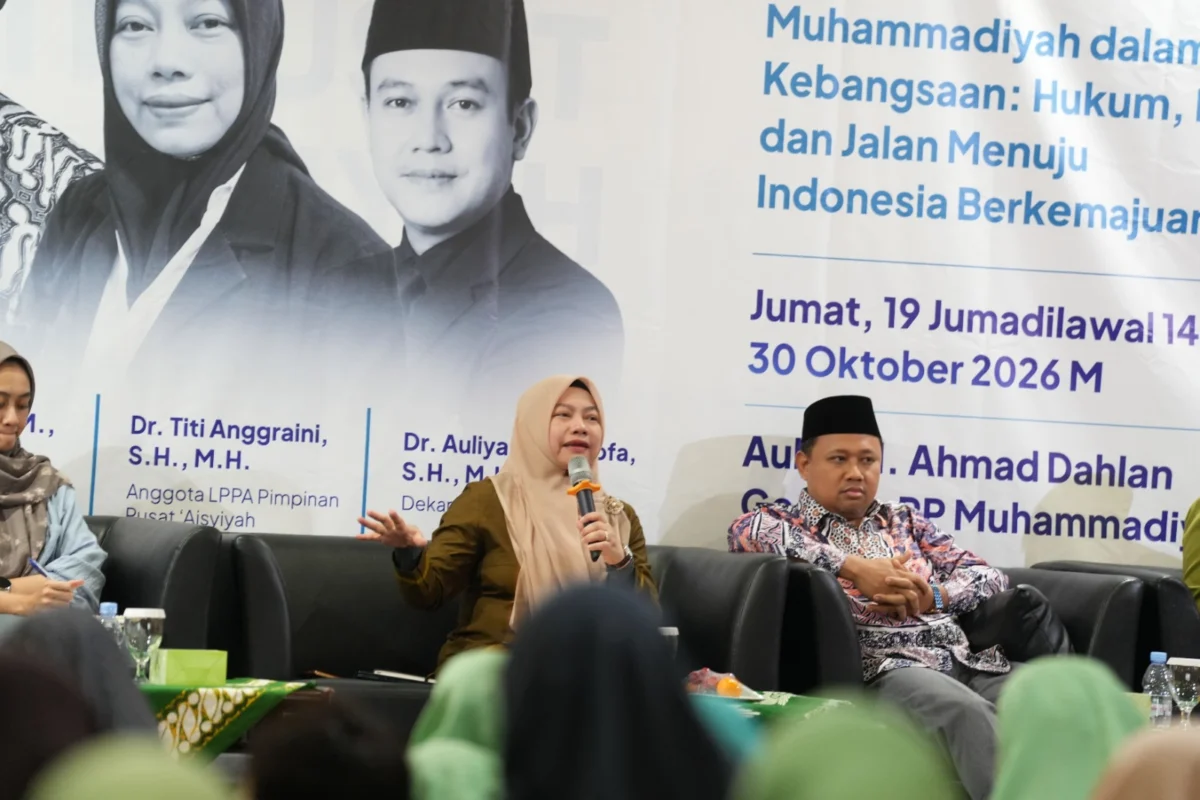
As Indonesia looks ahead to the 2029 general elections, the landscape of national democracy faces profound introspection, structural challenges, and renewed calls for ethical governance. Titi Anggraini, a prominent member of the Research and Development Board (LPPA) of the Central Board of Aisyiyah, delivered a comprehensive and critical reflection on the trajectory of Indonesian democracy during the Central Board of Muhammadiyah’s periodic study forum. The event, themed "Muhammadiyah in National Politics," was held at the Muhammadiyah Dakwah Building in Jakarta, serving as a intellectual gathering to discuss the intersection of faith, civil society responsibility, and statecraft.
Centered around the provocative and guiding theme "From the Khittah to the Ballot Box: Guarding Election Law and Ethics Toward a Progressive Indonesia," Titi’s address dissected the multifaceted role that Muhammadiyah—one of Indonesia’s largest Islamic socio-religious organizations—must play in safeguarding the integrity of democratic processes. Her analysis arrived at a critical juncture in Indonesia’s sociopolitical development, as scholars, activists, and policymakers grapple with the erosion of democratic norms, the prevalence of transactional politics, and the ongoing struggle for substantive political representation, particularly for women.
The Three Foundational Pillars of Muhammadiyah’s Political Stance
To understand Muhammadiyah’s approach to national politics, Titi anchored her presentation on three distinct pillars that define the organization’s ideological and practical framework. These pillars serve as a compass for millions of members, ensuring that the movement remains politically engaged without compromising its moral independence or organizational integrity.
The first pillar is rooted in the Indonesian constitutional framework. Titi emphasized that the state constitution explicitly establishes that sovereignty rests with the hands of the people, executed through elections that must adhere to the principles of direct, public, free, confidential, honest, and fair (luber jurdil). Furthermore, this constitutional foundation demands that election organizers operate as national, permanent, and independent bodies. By grounding Muhammadiyah’s perspective in constitutionalism, Titi underscored that defending the integrity of elections is not merely a political preference, but a constitutional and civic duty.
The second pillar relies on the historic 2002 Muhammadiyah Khittah adopted in Denpasar, Bali. This foundational document explicitly stipulates that Muhammadiyah does not maintain structural affiliations or organizational ties with any political party or wielded political force. However, this neutrality does not translate to political apathy. Titi clarified that Muhammadiyah continuously exercises its political role as a manifestation of amar ma’ruf nahi munkar (enjoining good and forbidding evil), acting as a societal cohesive force and a vehicle for healthy political education. This philosophy embodies what political scientists and organization leaders refer to as "high politics"—a pursuit centered on values, public morality, and substantive policy rather than the pursuit of partisan seats or transactional power.
The third pillar is drawn from the conceptual frameworks of Darul Ahdi wa Syahadah (The Abode of Covenant and Testimony, established at the 2015 Muhammadiyah Congress) and the Risalah Islam Berkemajuan (The Message of Progressive Islam, established in 2022). Through these frameworks, Muhammadiyah firmly positions the Pancasila-based Indonesian state as an ideal and final consensus. Consequently, the organization interprets democracy not merely as a mechanical administrative tool for establishing government, but as a moral ecosystem that must continuously resist the corrosive effects of transactional politics, nepotism, and meritocratic decay.
The Current State of Indonesian Democracy: Structural Challenges and Global Indices
Expanding her discourse beyond organizational philosophy, Titi provided a sobering assessment of the structural and systemic challenges confronting contemporary Indonesian democracy. She highlighted a disturbing global and domestic trend of democratic recession, pointing out that elections serve as the ultimate stress test for national law and public ethics.
This assessment is supported by various independent international and domestic watchdogs. In recent years, Indonesia’s standing in global democracy and governance indexes has experienced notable stagnation or decline. According to Freedom House reports referenced in broader civic discourse, Indonesia’s scores regarding political rights, civil liberties, and the freedom of expression have faced mounting pressures, driven by legislative restrictions, shrinking civic space, and executive overreach. Furthermore, corruption indices—such as those published by Transparency International—have underscored the persistent vulnerability of state institutions to graft and clientelism, reflecting the grim reality that corruption remains a systemic hurdle to equitable development.
Domestically, the pervasive normalization of money politics (politik uang) poses an existential threat to electoral integrity. Titi noted that transactional politics has increasingly become accepted as a standard operational cost of campaigning, severely undercutting the principles of meritocracy and popular sovereignty. When electoral outcomes are dictated by financial capital rather than visionary policy and moral integrity, the resulting governance inevitably prioritizes elite interests over public welfare.
In light of these compounding crises, Titi argued that Muhammadiyah cannot remain passive. The organization must actively position itself as an institutional guardian of the democratic rules of game, utilizing its vast network of educational, health, and social institutions to elevate political literacy among the citizenry.
The Imperative of Women’s Political Representation
A significant portion of Titi’s reflection focused on the persistent underrepresentation of women in formal legislative bodies and the structural mechanisms required to rectify this imbalance. Despite accounting for roughly half of the Indonesian population and electorate, women have historically struggled to achieve proportional representation in the People’s Representative Council (DPR) and regional legislative councils (DPRD), constrained by patriarchal political cultures, high campaign costs, and exclusionary internal party mechanisms.
However, a pivotal turning point emerged with the issuance of Constitutional Court (MK) Decision Number 128/2026. This landmark legal ruling explicitly mandates that political party candidate lists across every electoral district must contain a minimum of 30 percent female candidates, with mandatory rounding up to ensure compliance. Crucially, the decision carries a severe enforcement mechanism: if a political party fails to meet the 30 percent threshold of female representation in a given electoral district, that party risks disqualification from competing in that district.
Titi hailed this constitutional ruling as a historic breakthrough that provides renewed momentum for women’s movements across the archipelago. She urged female cadres within the Muhammadiyah and Aisyiyah networks to aggressively seize this opportunity, transforming legal mandates into substantive political power.
"For all of us in the women’s movement, momentum like this must continue to be maximized, especially by female cadres within the organization," Titi stated during her presentation. The integration of capable, ethical women into political candidate pools is seen not only as a matter of social justice, but as a crucial strategy to infuse legislative bodies with perspectives that prioritize family welfare, education, public health, and ethical governance.
Implications for the 2029 General Elections and Beyond
As Indonesia looks toward the horizon of the 2029 electoral cycle, the insights shared by Titi Anggraini offer a strategic roadmap for civil society engagement. The convergence of declining democratic quality, entrenched transactional politics, and newly strengthened legal safeguards for gender representation creates a complex battlefield of challenges and opportunities.
The implications of Muhammadiyah’s involvement in the 2029 elections extend far beyond partisan alignments. By championing what she termed "constitutional jihad"—a relentless commitment to defending constitutional principles, promoting ethical political education, and engaging in participatory election monitoring—Muhammadiyah seeks to insulate the democratic process from populist manipulation and oligarchic capture.
Furthermore, the organization’s insistence on high politics serves as a direct counterweight to the cynicism that frequently plagues modern electorates. When religious and civil society organizations actively refuse to be co-opted by transactional powerbrokers, they preserve a moral authority that can hold elected officials accountable long after the ballots have been cast.
Conclusion: A Call to Action for the Muhammadiyah Family
Concluding her comprehensive reflection, Titi issued a passionate call to action to the entire extended family of the Muhammadiyah movement. She urged members not to retreat into civic indifference, but rather to embrace their historical responsibility as moral guardians of the republic.
"Muhammadiyah, insyaallah, will hopefully always be able to carry out constitutional jihad for elections, provide healthy political education, engage in participatory oversight, and serve as a source of cadres and role models in our political recruitment leading toward 2029," Titi concluded.
Through such intellectual discourse and grounded activism, Muhammadiyah continues to demonstrate that religion and modern democratic citizenship are not mutually exclusive. Instead, when guided by a progressive theological framework and an unwavering commitment to public ethics, civil society can serve as the ultimate bulwark against democratic decay, ensuring that the promise of Indonesian independence—justice, prosperity, and sovereignty for all citizens—remains attainable.