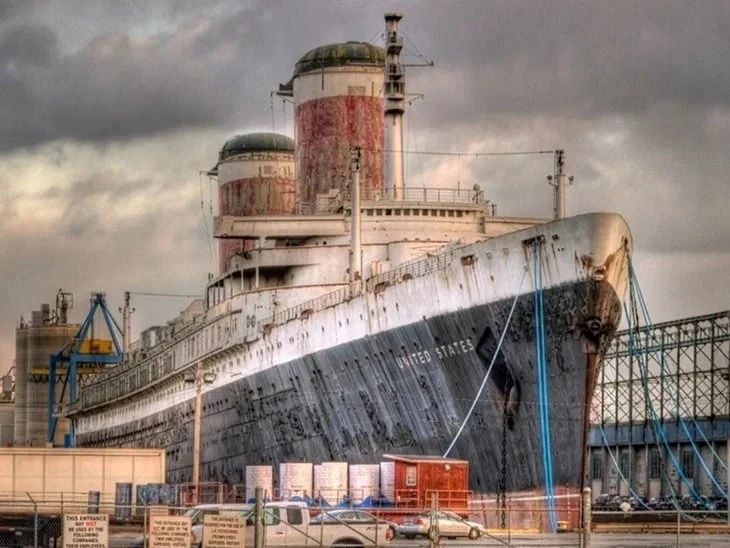
The legendary ocean liner SS United States, an architectural marvel of the mid-20th century that once held the prestigious Blue Riband for the fastest transatlantic crossing and served as a floating White House for numerous American presidents, is slated for a dramatic transformation. Destined for a final resting place on the floor of the Gulf of Mexico, the historic vessel will be deliberately scuttled approximately 25.3 miles (40.7 kilometers) southwest of the coast of Destin-Fort Walton Beach, Florida. This ambitious marine engineering project, spearheaded by local natural resource authorities in collaboration with maritime conservationists, aims to repurpose the aging behemoth into the world’s largest artificial reef. By sinking the majestic hull, officials hope to catalyze marine biodiversity, establish a thriving habitat for a multitude of Gulf species, and generate a sustainable boon for regional tourism and the scuba diving industry, all while managing the mounting costs of preserving a decaying national landmark.
The Genesis of a Maritime Legend
Launched in 1952 during the height of the Cold War, the SS United States was designed not only as a luxury passenger liner capable of rivaling the finest hotels on land, but also as a strategic naval asset. Funded in large part by the United States Department of Defense, the vessel was constructed with military utility in mind. During a time of international tension, the ship was engineered to be swiftly converted into a troop transport capable of carrying up to 14,000 service members over long distances without refueling. Its compartmentalized design, high-speed propulsion system, and extensive use of lightweight, non-flammable aluminum made it a triumph of American naval architecture and engineering ingenuity.
Throughout its operational heyday, the SS United States represented the pinnacle of transatlantic travel, ferrying Hollywood celebrities, European royalty, foreign dignitaries, and sitting United States presidents across the ocean in unprecedented style and speed. Its passenger manifest famously included nearly every American president from the mid-20th century, cementing its status as a floating embassy of American prestige. On its maiden voyage in July 1952, the ship captured the Blue Riband—an unofficial accolade for the fastest passenger liner crossing of the Atlantic Ocean in regular service—by completing the eastbound journey in a staggering 3 days, 10 hours, and 40 minutes, maintaining an average speed of over 35 knots. On the return trip, it broke its own record traveling westward. This unmatched maritime velocity record remains unbroken by any ocean liner to this day, leaving a permanent legacy in maritime history.
A Slow Decline and Decades of Uncertainty
As commercial aviation advanced and jet airliners superseded ocean liners as the preferred method for crossing the Atlantic, the economic viability of the SS United States plummeted. In 1969, facing mounting operational deficits and shifting travel trends, the vessel was retired from active service and laid up in Virginia. For more than half a century, the ship languished through a revolving door of owners, numerous failed revitalization schemes, and extensive interior gutting that removed asbestos and original furnishings.
Despite various non-profit advocacy groups fighting tirelessly to save the historic vessel from the scrapyard, the financial realities of restoration proved insurmountable. Maintaining a ship of its immense scale—measuring nearly 1,000 feet in length—demanded millions of dollars in pier-side docking fees and structural preservation efforts that no private entity or preservation society could sustain indefinitely. The turning point arrived when legal and financial pressures forced stakeholders to seek a definitive, dignified resolution for the vessel, leading to the groundbreaking agreement to transform the historic liner into a permanent marine habitat.
Chronology of the Scuttling Initiative
The path toward transforming the SS United States into an artificial reef involved years of meticulous environmental planning, legal negotiations, and logistical coordination among municipal governments, federal environmental agencies, and marine conservation organizations.
Phase One involved the acquisition of the vessel by the Okaloosa County Board of County Commissioners, who recognized the unique opportunity to combine historical preservation through documentation with substantial economic and ecological enhancements. Following the purchase agreement, comprehensive environmental remediation protocols were established to ensure the ship complied strictly with the stringent standards of the United States Environmental Protection Agency (EPA).
Phase Two centered on the meticulous stripping of all remaining hazardous materials. Prior to any sinking operation, environmental engineers must remove all traces of polychlorinated biphenyls (PCBs), asbestos, fuel residues, oils, and other toxic substances that could potentially leach into the marine environment. This rigorous decontamination process often takes many months and represents the most financially demanding phase of any ship-sinking project.
Phase Three encompasses the final transit and controlled scuttling. Once the hull is entirely sanitized and certified safe for immersion, the ship will be towed from its long-term berth to the designated deployment zone in the Gulf of Mexico. Engineers will utilize precision explosive charges or sea-valve flooding techniques to ensure the vessel settles evenly onto the sandy ocean floor upright, maximizing its structural longevity and utility as a diving attraction.
Environmental Science and Artificial Reef Mechanics
The decision to sink the SS United States is rooted in decades of proven marine ecology principles regarding artificial reefs. When a massive metallic structure is introduced to a relatively barren sandy seabed, it fundamentally alters the local ecosystem by creating immediate vertical relief. In the vast expanse of the Gulf of Mexico, where natural hard-bottom habitats can be scarce, large shipwrecks serve as structural oases for marine life.
Once submerged, the massive steel hull and internal framing of the ocean liner will act as a foundational scaffold. Almost immediately, microscopic organisms such as algae, barnacles, and hydroids will begin to colonize the metal surfaces. Within a matter of months, hard and soft corals will establish themselves on the superstructure, utilizing the iron and steel substrate to anchor securely.
As the coral growth flourishes, it attracts an extensive array of invertebrate species, including crabs, sea urchins, and mollusks. These organisms form the base of a complex marine food web. Small reef fish, such as damselfish, snapper, and grouper, will soon populate the wreck to feed and seek shelter from open-water predators. In turn, larger pelagic predators—including amberjack, barracuda, sharks, and various species of rays—will frequent the site, transforming the sunken relic into a dynamic biological hotspot.
Furthermore, artificial reefs of this magnitude play a crucial role in fisheries management. By providing abundant nursery habitats and shelter for juvenile fish populations, the submerged SS United States will actively contribute to the replenishment of regional fish stocks. Marine biologists and researchers from regional academic institutions have already outlined monitoring programs to study the ecological succession of species colonization following the ship’s deployment.
Official Responses and Stakeholder Perspectives
Local authorities and tourism boards in northwest Florida have expressed profound enthusiasm for the project, anticipating a transformative impact on the local economy. Representatives from the Destin-Fort Walton Beach tourism sector emphasized that the conversion of the SS United States aligns with successful precedents set by previous marine conservation projects in the region. Okaloosa County has previously overseen the deliberate sinking of approximately 12 other large vessels and retired military hardware, all of which have yielded measurable ecological and economic dividends.
"This is a monumental opportunity to honor the historical significance of the SS United States while securing a generational asset for our marine environment and local economy," stated a regional planning official involved in the coordination effort. "While we recognize the emotional weight carried by maritime historians and former passengers who cherish the ship’s storied past, this project ensures that the vessel will not be reduced to scrap metal in a foreign yard. Instead, it will embark on a noble second life as a vibrant underwater sanctuary that will captivate divers and sustain marine life for centuries."
Conversely, heritage preservation advocates have expressed mixed emotions regarding the outcome. While acknowledging the logistical impossibility of maintaining the ship afloat, many historians have advocated for comprehensive digital preservation initiatives. Museums, archives, and digital mapping specialists have been granted access to document the interior and exterior architecture of the liner thoroughly through high-resolution 3D scanning, ensuring that future generations can explore the vessel’s opulent design and engineering mastery in virtual reality long after the physical hull has been subsumed by the sea.
Broader Economic and Tourism Implications
Beyond its ecological benefits, the scuttling of the SS United States is projected to generate substantial economic activity for coastal communities in Florida. Destin-Fort Walton Beach is already recognized as a premier destination for recreational fishing and scuba diving. The addition of a world-class, deep-water wreck of this unprecedented scale is expected to draw diving enthusiasts, marine researchers, and underwater photographers from across the globe.
Economic impact analyses derived from similar artificial reef deployments suggest that the influx of dive tourism directly supports local charter boat operators, hotels, restaurants, equipment rental shops, and hospitality providers. Unlike shallow-water reefs that experience high environmental stress from heavy recreational traffic, the depth at which the SS United States will rest ensures that diver traffic is distributed sustainably, allowing the delicate coral ecosystems time to mature without excessive human disruption.
Conclusion: A Legacy Submerged Yet Enduring
The transition of the SS United States from a celebrated icon of transatlantic passenger travel to a submerged artificial reef marks the conclusion of one chapter and the beginning of another in maritime history. While the ship will no longer grace the surface of the ocean or host presidents and dignitaries on its polished decks, its massive steel frame will continue to serve a vital purpose. By anchoring a thriving marine ecosystem in the Gulf of Mexico, the legendary ocean liner guarantees that its name will remain synonymous with discovery, resilience, and the enduring connection between human engineering and the natural world.