Leadership transitions within higher education institutions affiliated with major religious organizations often serve as pivotal moments for strategic realignment, institutional growth, and community impact. This dynamic was underscored recently in Tangerang, where the Central Executive Board of Muhammadiyah formally inaugurated Dr. Warsito as the new Rector of Universitas Muhammadiyah Tangerang (UMT) for the 2025–2029 operational term. The solemn inauguration ceremony, held on Friday, September 25, brought together academic leaders, organizational figures, and institutional stakeholders to witness the dawn of a new administrative chapter for the university.
The event, however, carried profound emotional resonance alongside its administrative significance. During the proceedings, leadership figures and attendees paused to honor the indelible legacy of the late Desri Arwen, the preceding rector whose unexpected passing in August 2026 left a void within the academic community. The solemn remembrance set a tone of continuity, reverence, and heightened responsibility for the incoming administration, reminding stakeholders of the high standards set by past leadership.
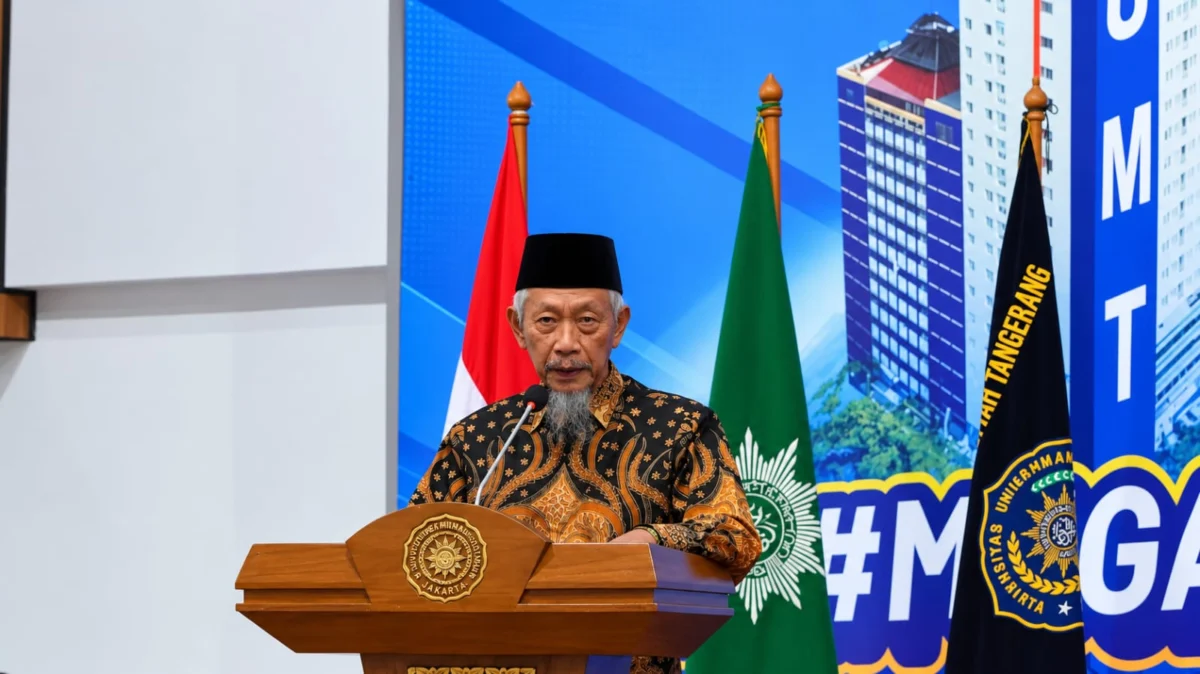
Addressing the academic assembly, Kiai Saad Ibrahim, a prominent leader of the Muhammadiyah Central Executive Board, delivered a comprehensive address outlining the core philosophical, operational, and strategic expectations for Dr. Warsito. The directives emphasized the harmonization of institutional legacy with aggressive modernization, collaborative advancement within the broader network of Muhammadiyah higher education institutions, and an unwavering commitment to the foundational educational ethos established by the organization’s founder, K.H. Ahmad Dahlan.
Institutional Transition and Honoring a Legacy
The path to the 2025–2029 administrative term at Universitas Muhammadiyah Tangerang was marked by both anticipation and profound reflection. Following the unexpected passing of former Rector Desri Arwen in August 2026, the university faced the critical task of maintaining operational stability while initiating a structured succession process. Academic governance requires seamless continuity to ensure that ongoing research initiatives, student enrollment pipelines, and accreditation milestones proceed without disruption.
During the inauguration ceremony, Kiai Saad Ibrahim dedicated a substantial portion of his address to paying tribute to the late Desri Arwen. He offered formal prayers for the departed leader, asking the Almighty to grant him eternal peace, divine forgiveness, and boundless mercy, while extending heartfelt condolences and patience to the grieving family. Kiai Saad noted that Arwen’s visionary leadership laid a robust foundation upon which the current administration must build.
"The core directive for the new rector is to extract maximum value from the visionary initiatives left behind by our late brother," Kiai Saad stated during his address. "This involves faithfully continuing the commendable programs and extraordinary achievements of the previous period, and subsequently elevating them to even greater heights in the future."
This emphasis on continuity serves as a strategic buffer against the institutional turbulence that frequently accompanies leadership changes in higher education. By positioning Dr. Warsito’s administration as a natural evolution of Arwen’s unfinished blueprint, Muhammadiyah leadership aims to preserve institutional memory while clearing the path for contemporary pedagogical innovations.
The Philosophical and Historical Roots of Muhammadiyah Higher Education
To fully contextualize the expectations placed upon Dr. Warsito, Kiai Saad expanded his address into a broader discourse on the philosophy of leadership within Islam and the historical genesis of Muhammadiyah educational institutions. In Islamic scholarly tradition, executive leadership—particularly within institutions dedicated to intellectual development—is viewed as a direct continuation of the prophetic mission. This sacred duty encompasses two primary responsibilities: preserving the integrity of religious values (hifdz ad-din) and managing worldly affairs with justice and efficacy (siyasah dunyawiyah).
Applying this framework to modern academia, Kiai Saad stressed that Muhammadiyah universities bear a unique obligation to construct curricula that seamlessly integrate profound spiritual principles with rigorous empirical sciences. This dual mandate traces its lineage directly back to K.H. Ahmad Dahlan, the visionary founder of Muhammadiyah, who revolutionized indigenous education in the early 20th century by dismantling the artificial dichotomy between religious instruction and secular sciences.
Kiai Saad reminded the audience that K.H. Ahmad Dahlan’s pioneering schools did not limit their syllabi exclusively to traditional disciplines such as Quranic recitation and Hadith scholarship. Instead, the curriculum was deliberately expanded to include modern subjects like arithmetic, geography, and contemporary sciences. This progressive pedagogical philosophy was designed to produce graduates who were not only spiritually grounded but also intellectually equipped to navigate and solve the complex socio-economic challenges of a rapidly changing world.
"This foundational spirit must be perpetually nurtured and expanded across all tiers of Muhammadiyah educational infrastructure, culminating in our higher education institutions," Kiai Saad explained. For Universitas Muhammadiyah Tangerang, this historical mandate translates into a continuous drive for academic quality, ensuring that modernization does not outpace ethical grounding.
Current Institutional Profile and Strategic Assets of UMT
As Dr. Warsito assumes the responsibilities of the rectorate, he inherits an institution characterized by substantial scale and demonstrated academic capacity. Universitas Muhammadiyah Tangerang has steadily evolved into a prominent regional center of higher learning, boasting a comprehensive academic portfolio designed to meet the demands of the contemporary labor market.
According to institutional data highlighted during the inauguration, UMT currently oversees a diverse array of 36 distinct study programs spanning various faculties, including engineering, economics, education, social sciences, and health disciplines. Among these academic offerings, a remarkable milestone has been achieved: 15 study programs have attained the coveted "Unggul" (Superior) accreditation status from national accreditation bodies. This elite designation reflects rigorous standards in faculty qualifications, curriculum design, research output, and student support services.
These quantitative achievements serve multiple strategic functions. Internally, they validate the institutional quality of education provided to thousands of enrolled students, enhancing graduate employability and institutional reputation. Externally, this robust accreditation profile positions UMT as a regional anchor institution within the broader network of higher education providers affiliated with Muhammadiyah.
However, Kiai Saad cautioned against institutional complacency or insular thinking. He emphasized that the accumulation of academic excellence and accreditation milestones should not be leveraged solely for competitive advantage or self-congratulation within the confines of the Tangerang campus. Instead, the central leadership articulated a vision of collaborative upliftment, wherein well-resourced institutions actively assist their sister campuses facing developmental hurdles.
The Imperative of Inter-Institutional Solidarity
One of the most salient themes of the inauguration address was the call for systemic solidarity across the extensive network of Muhammadiyah universities, colleges, and polytechnics nationwide. Muhammadiyah operates one of the largest non-governmental educational networks in Indonesia, comprising dozens of higher education institutions distributed across diverse geographic regions with varying degrees of economic and infrastructural maturity.
Kiai Saad articulated a philosophy of collective progression, arguing that true institutional greatness is measured not by isolated triumphs, but by the systemic elevation of the entire network. He challenged the newly inaugurated rector and the broader UMT academic community to look beyond their immediate campus boundaries and extend technical, managerial, and academic assistance to smaller or developing Muhammadiyah campuses that require institutional strengthening.
"A truly great achievement is realized when we not only think about the advancement of our own university, but also extend our strategic vision to support other universities, particularly those within the Muhammadiyah network," Kiai Saad asserted. He reiterated the organization’s overarching egalitarian philosophy in education: "We do not wish to see merely one or two institutions thrive while others lag behind. Our collective aspiration is for all of them to achieve excellence."
This directive carries significant implications for higher education governance in Indonesia. By fostering intra-network collaboration, resource sharing, faculty exchanges, and joint research initiatives, institutions like UMT can act as catalysts for regional educational equity. It mitigates the disparities that often emerge between urban-based universities with robust revenue streams and rural or newly established campuses operating under resource constraints.
Strategic Outlook for the 2025–2029 Term
The assumption of office by Dr. Warsito arrives at a critical juncture for Indonesian higher education. Universities nationwide are navigating a rapidly shifting landscape defined by digital transformation, the integration of artificial intelligence in pedagogy, evolving regulatory frameworks set by the Ministry of Education, Culture, Research, and Technology, and heightened competition in the global knowledge economy.
For UMT, the strategic roadmap for the 2025–2029 term will likely necessitate a multi-pronged approach based on the directives issued during the ceremony. Key operational priorities for the new administration are anticipated to include:
-
Curriculum Modernization and Digital Integration: Building upon the philosophical foundation laid by K.H. Ahmad Dahlan, the university must continue updating its 36 study programs to reflect the realities of the Fourth Industrial Revolution, ensuring that graduates possess both high-level digital literacy and strong ethical frameworks.
-
Accreditation Enhancement: With 15 programs currently holding "Unggul" status, the administration faces the ongoing challenge of elevating the remaining study programs to meet top-tier national and international accreditation standards.
-
Research and Community Engagement: Deepening the institution’s commitment to applied research that directly addresses socio-economic challenges in Tangerang and surrounding regions, aligning academic inquiry with community development.
-
Expanded Inter-Institutional Partnerships: Establishing formal frameworks for cooperation with other Muhammadiyah higher education institutions, operationalizing Kiai Saad’s call for network-wide solidarity through faculty development programs, curriculum benchmarking, and joint grant applications.
Conclusion: A Call for Spiritual and Operational Resilience
As the inauguration proceedings concluded, the overarching message resonated with a blend of pragmatic operational strategy and deep spiritual grounding. Kiai Saad reminded the newly installed rector, faculty members, and administrative staff that human planning and institutional strategies, no matter how meticulously crafted, ultimately depend on divine grace for their fruition.
Closing his address with a classical Quranic invocation, Kiai Saad cited the verse Nasrun minallahi wa fathun qarib—signifying "help from Allah and a near victory." This reference served as both an encouragement and a reminder that the administrative burdens assumed by Dr. Warsito are viewed within the community as a sacred trust (amanah) requiring integrity, humility, and relentless dedication.
With a clear mandate to honor past achievements, foster innovation, elevate academic standards, and extend a helping hand to sister institutions, Dr. Warsito steps into the rectorship of Universitas Muhammadiyah Tangerang equipped with a comprehensive philosophical compass. As the 2025–2029 term unfolds, the academic community, regional stakeholders, and the broader Muhammadiyah network will be watching closely as UMT translates these strategic directives into tangible institutional progress.