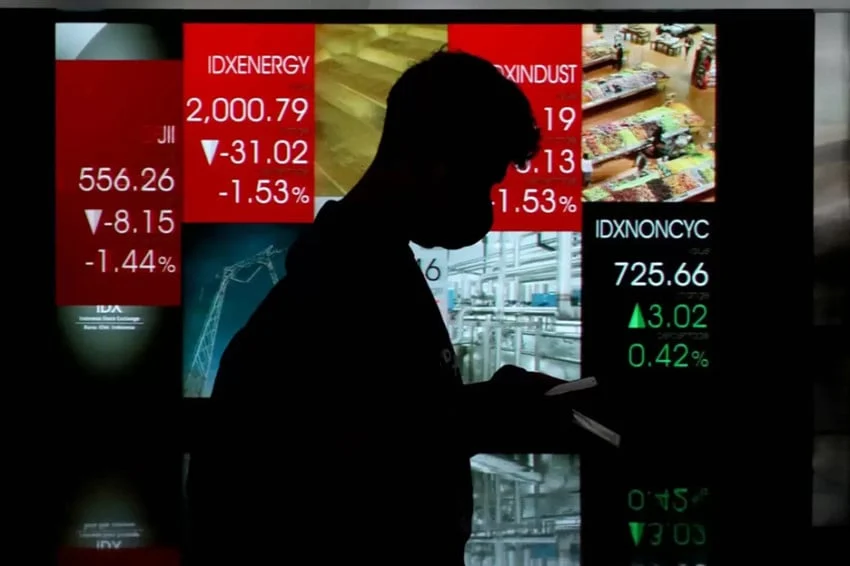
The Jakarta Composite Index (IHSG) concluded the final trading session of the week on Friday, September 25, 2026, in negative territory. The index experienced a notable contraction, shedding 56.72 points or 0.90%, to settle at the 6,241 level. This retreat reflects a broader sense of caution permeating the Indonesian capital market as investors grapple with shifting macroeconomic indicators and global volatility that have increasingly influenced domestic sentiment throughout the third quarter of 2026.
Market breadth on this particular Friday was significantly tilted toward the downside. Out of the total securities traded, 587 stocks recorded price declines, dwarfing the 122 stocks that managed to secure gains. Meanwhile, 254 stocks remained stagnant, reflecting a lack of buying conviction among institutional and retail participants. The total volume of shares traded reached 26.2 billion, with a total transaction value amounting to Rp9.3 trillion, indicating a high level of liquidity despite the bearish trend.
Breakdown of Major Indices and Sectoral Performance
The downward momentum was not confined to the main index but was broadly mirrored across major benchmark indices. The LQ45 index, which tracks the 45 most liquid stocks on the Indonesia Stock Exchange, retreated by 0.34% to 621. Similarly, the Jakarta Islamic Index (JII) saw a more pronounced decline of 0.92%, closing at 372. Other key indicators also succumbed to selling pressure, with the IDX30 index falling 0.33% to 344, and the MNC36 index sliding 0.44% to 269.
The sectoral performance was arguably the most telling indicator of the day’s sentiment. A comprehensive sell-off was observed across almost every major sector. Energy, consumer non-cyclicals, financials, property, raw materials, transportation, industrial, consumer cyclicals, infrastructure, healthcare, and technology sectors all closed in the red. The synchronicity of these declines suggests that the selling pressure was not driven by sector-specific news, but rather by a systematic withdrawal of capital or a rebalancing of portfolios by major investors heading into the weekend.
Top Performers and Laggards Amid Market Volatility
Despite the pervasive bearish environment, specific stocks managed to buck the trend, providing pockets of opportunity for traders. PT Martina Berto Tbk (MBTO) emerged as a standout, registering a significant gain of 34.64% to close at Rp206. This was followed by the Reksa Dana Syariah Indeks Simas ETF JII, which climbed 32.81% to reach Rp85. Additionally, PT Hotel Sahid Jaya International Tbk (SHID) recorded a strong performance, appreciating by 24.83% to finish the session at Rp905.
Conversely, the list of top losers highlighted the severity of the downward correction for certain mid-cap and small-cap stocks. PT Citatah Tbk (CTTH) and PT Wahana Inti Makmur Tbk (NASI) both faced heavy selling, with each shedding 14.96% to close at Rp108 and Rp199, respectively. PT Olympus Strategic Indonesia Tbk (NATO) also faced significant downward pressure, declining 14.92% to settle at Rp1,055. These movements underscore the heightened volatility currently characterizing the secondary tier of the Indonesian stock market.
Contextualizing the Market Sentiment
The performance of the IHSG on this Friday serves as a continuation of a volatile week. Earlier in the week, the index had shown signs of resilience, even opening higher at 6,315 on previous sessions, but the failure to maintain those levels suggests a lack of sustained buying support. Market analysts point to several factors that may have contributed to this decline. Global inflationary pressures, uncertainty regarding central bank interest rate policies, and fluctuations in commodity prices—which remain a critical pillar of the Indonesian economy—have all contributed to a "wait-and-see" approach among investors.
The psychological threshold of the 6,300 level has proved difficult for the index to consolidate above. When the market fails to break through resistance levels, it often triggers algorithmic stop-loss orders, which exacerbates the decline. Furthermore, as we approach the end of the third quarter, institutional investors often engage in "window dressing" or profit-taking to secure gains before the quarter-end reporting period, which can lead to increased turnover and price volatility.
Economic Implications and Future Outlook
The decline of the IHSG to 6,241 raises pertinent questions regarding the short-term outlook for the Indonesian equity market. While the domestic economy has shown signs of recovery in various sectors, the stock market remains highly sensitive to global liquidity conditions. If the current trend of outflows continues, it may signal that foreign investors are rotating capital toward more stable or higher-yielding markets in the region or in developed economies.
From a macroeconomic perspective, the broad-based decline in sectors such as finance and infrastructure is particularly noteworthy. As these sectors are closely tied to domestic economic growth and infrastructure development, their underperformance may reflect concerns regarding the pace of national economic expansion or potential headwinds in consumer spending. However, it is essential to view these daily fluctuations within the context of long-term economic cycles. Indonesia’s fundamentals—including a young demographic dividend, a robust commodity export sector, and ongoing digital transformation—remain intact despite temporary market corrections.
Reactions from Market Observers
While official statements from market regulators regarding specific daily moves are rare, financial analysts generally view such corrections as a necessary recalibration. Market observers note that the high number of stocks declining (587) compared to those gaining (122) is indicative of a market-wide correction rather than isolated incidents.
"The market is currently testing its support levels," remarked a senior analyst in Jakarta. "Investors are cautious, and the lack of a strong catalyst to drive the index higher has left it vulnerable to external pressures. However, the high transaction value of Rp9.3 trillion suggests that there is still significant participation and that the market remains liquid, which is a positive sign for the long term."
Strategy for Investors in a Bearish Climate
For retail investors, the current market environment necessitates a shift in strategy. With the index failing to hold key levels, risk management becomes paramount. Diversification across sectors that have shown relative stability, such as healthcare or select consumer staples, may help mitigate the impact of broad market declines. Additionally, investors are advised to focus on companies with strong balance sheets and consistent dividend payouts, as these stocks tend to be more resilient during periods of market uncertainty.
The events of September 25, 2026, will likely be analyzed in the coming week to determine if the 6,241 level will serve as a stable floor or if further testing of lower support levels is expected. As global markets continue to grapple with inflationary concerns and geopolitical shifts, the IHSG is likely to remain in a state of flux. Investors should keep a close watch on key economic data releases, including inflation reports and trade balance figures, which are expected to dictate the trajectory of the market in the fourth quarter.
In conclusion, the IHSG’s closing at 6,241 after a 0.90% decline marks a challenging end to the week. While the red ink across the boards may appear concerning, it is part of the ongoing evolution of the Indonesian capital market. Whether this represents a short-term dip or the start of a more sustained correction will depend on upcoming corporate earnings reports and the ability of the market to regain confidence in the face of prevailing macroeconomic challenges. For now, the market remains in a consolidation phase, with eyes firmly fixed on the next wave of economic data to provide direction for the months ahead.