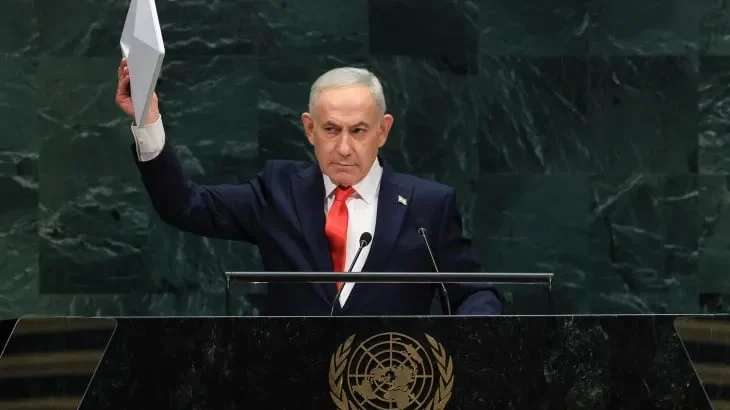
Israeli Prime Minister Benjamin Netanyahu departed the United States to return to Israel immediately following his highly controversial address at the 79th session of the United Nations General Assembly in New York City. According to reports from Israel’s public broadcaster Kan, the prime minister’s itinerary was substantially curtailed, leading him to fly back on the exact same day he arrived. While Netanyahu held brief consultations with a select group of international leaders in the wake of his speech, mounting security concerns and widespread international backlash heavily influenced the decision to abbreviate his stay in Manhattan.
The visit, which drew intense global media scrutiny, was characterized by unprecedented diplomatic friction inside the UN chamber and fierce demonstrations on the streets of New York. Netanyahu’s appearance at the international forum took place against the backdrop of escalating regional conflicts in the Middle East, involving military campaigns in the Gaza Strip and intensifying hostilities along the northern border with Lebanon. The dual pressures of maintaining security protocols abroad and managing a volatile domestic political landscape contributed to the rushed nature of the diplomatic mission.
Chronology of the New York Visit and Security Calculus
The sequence of events surrounding Benjamin Netanyahu’s brief New York trip underscores the precarious security environment accompanying his international travels. The prime minister arrived in the United States amidst heightened threat assessments compiled by both Israeli security agencies and local law enforcement in New York.
According to Israeli media reports, the decision to shorten the visit was primarily driven by security imperatives rather than purely scheduling constraints. The massive logistical footprint required to secure the Israeli delegation in a city experiencing intense civil unrest necessitated a swift exit. Immediately after delivering his address at the UN podium—where he defended Israel’s military actions and outlined the nation’s strategic objectives—Netanyahu engaged in brief diplomatic engagements before heading directly to John F. Kennedy International Airport for the trans-Atlantic flight back to Tel Aviv.
This rapid turnaround highlights the operational challenges facing Israeli leadership during wartime. Traveling abroad while directing active multi-front military operations places immense strain on both the prime minister’s office and the security details tasked with protecting him in hostile foreign environments.
Diplomatic Fallout: Walkouts Inside the UN General Assembly Hall
The tension surrounding Benjamin Netanyahu’s presence at the United Nations was palpable long before he stepped up to the podium. As the Israeli leader was introduced to deliver his address, dozens of diplomats and delegates from various member states stood up and walked out of the General Assembly hall in a coordinated act of protest.
The diplomatic boycott empty seats left in major sections of the auditorium served as a stark visual representation of Israel’s deepening isolation within multilateral organizations over its conduct in the ongoing Gaza conflict and broader Middle Eastern policies. Representatives from Arab nations, the Global South, and several European states participated in the walkout, signaling profound international discontent with the humanitarian toll of the military campaigns.
Despite the mass exodus, Netanyahu proceeded with his speech, utilizing the global platform to present Israel’s perspective. He reiterated the government’s stance on national security, the existential threats posed by hostile regional actors, and the imperative to dismantle militant infrastructure. However, the diplomatic optics of addressing a partially emptied chamber underscored the severe polarization defining current international relations regarding the Palestinian issue.
Street-Level Outcry: Protests and Demonstrations Across Manhattan
Outside the fortified perimeter of the United Nations headquarters, the atmosphere was defined by widespread outrage and mass mobilization. Hundreds of demonstrators had gathered hours before Netanyahu’s scheduled arrival, establishing a continuous and vocal presence that persisted throughout the duration of his speech.
The protests reflected a broad coalition of civil rights groups, pro-Palestinian organizations, and anti-war activists. Notably, Jewish community groups opposed to the current Israeli administration played a prominent role in the demonstrations, joining the "Free Palestine" march through the streets of New York to voice their condemnation of government policies. Protesters carried banners, chanted slogans demanding an immediate ceasefire, and called for an end to military assistance for Israel.
The New York City Police Department deployed substantial resources to manage the crowds, establishing barricades and maintaining heavy security cordons around the UN complex and surrounding hotel districts. While the demonstrations were largely peaceful, the high volume of traffic disruptions and the sheer scale of public mobilization highlighted the deep societal divisions the visit stirred within the United States.
Background Context of the UN General Assembly Address
The diplomatic tensions at the United Nations occurred during one of the most volatile periods in modern Middle Eastern history. The conflict, catalyzed by the October 7, 2023, attacks led by Hamas against southern Israel, has resulted in unprecedented casualties and widespread displacement across the Gaza Strip.
In the months preceding Netanyahu’s New York visit, the military theater expanded significantly. Israel intensified its operations along the northern border against Hezbollah forces in Lebanon, resulting in massive population displacements in both southern Lebanon and northern Israel. The risk of a wider regional war involving Iran and its regional proxies has kept international diplomacy on high alert.
Against this backdrop, the UN General Assembly served as a central forum for world leaders to address the crisis. Calls for an immediate ceasefire, adherence to international humanitarian law, and pathways toward a two-state solution dominated general debate statements. Netanyahu’s decision to address the assembly in person was viewed by analysts as a calculated effort to directly counter international criticism and articulate Israel’s security doctrines to a global audience, regardless of the predictable diplomatic pushback.
Official Responses and Stakeholder Positions
The events in New York triggered a wave of official responses from international stakeholders, human rights organizations, and political analysts.
Pro-Israel advocacy groups defended Netanyahu’s right to present the nation’s case at the United Nations, arguing that the prime minister was addressing a biased international body that disproportionately scrutinizes Israel while ignoring the actions of militant groups. These supporters emphasized that Israel faces existential threats from multiple fronts and requires robust defense measures to protect its citizenry.
Conversely, Palestinian representatives and international human rights organizations condemned the address as an attempt to justify violations of international law. Critics argued that the military strategies employed in Gaza and Lebanon have caused catastrophic civilian suffering and infrastructure destruction, making diplomatic justifications untenable for a significant portion of the international community.
The walkout by UN delegates was praised by various humanitarian and diplomatic missions as a necessary moral stance against ongoing violence, while opponents of the boycott labeled the action as counterproductive to the primary mission of the United Nations, which is designed to maintain open channels for dialogue among all member states, regardless of political disagreements.
Broader Impact and Geopolitical Implications
The abrupt conclusion of Benjamin Netanyahu’s New York visit and the dramatic scenes inside and outside the United Nations carry profound implications for international diplomacy and Israel’s foreign relations.
First, the incident demonstrates the hardening lines in global politics regarding the Israeli-Palestinian conflict. The willingness of numerous state delegations to openly boycott the address reflects a diminishing diplomatic tolerance for current Israeli military policies, potentially complicating future multilateral negotiations and consensus-building efforts at the UN Security Council and General Assembly.
Second, the intense domestic and international protests illustrate the transnational nature of the conflict’s fallout. Public opinion in Western democracies, including the United States, remains deeply fractured, with significant segments of the population actively organizing against government policies that support Israel’s military campaigns. This grassroots pressure increasingly influences political discourse and legislative debates in capitals around the world.
Finally, for the Israeli government, the visit underscores the complex balancing act required to navigate a hostile international environment while pursuing domestic security objectives. As the regional conflict continues to evolve, the ability of Israeli leadership to engage constructively with multilateral institutions will likely remain severely constrained, pointing toward a prolonged period of diplomatic friction and strategic isolation on the world stage.