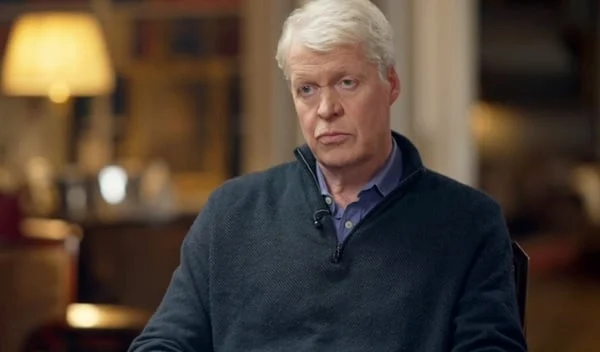
Nearly three decades after standing before a global audience at Westminster Abbey to deliver a searing, emotionally charged eulogy for his late sister, Princess Diana, Earl Charles Spencer has once again thrust the British Royal Family into a storm of public controversy. In his upcoming memoir, the 9th Earl Spencer exposes long-buried familial grievances, leveling explosive allegations against his former brother-in-law, now King Charles III. The revelations have reignited fierce debates across the United Kingdom regarding the treatment of Diana, the handling of her tragic 1997 death, and the enduring psychological toll placed upon her sons, Prince William and Prince Harry.
While Earl Spencer’s initial 1997 address was hailed as a courageous defense of his blood relatives—promising to shield William and Harry from the crushing pressures that drove their mother to despair—critics and royal commentators now suggest that his latest literary endeavor risks reopening old wounds. As excerpts of the book circulate in British media, the royal establishment and the Spencer family find themselves at loggerheads once again, reviving a decades-old narrative of institutional coldness versus familial loyalty.
Who Is Earl Charles Spencer? A Deep Dive Into His Royal Lineage and Background
Born in London on May 20, 1964, Charles Edward Maurice Spencer, the 9th Earl Spencer, occupies a unique space within the intersecting spheres of British aristocracy and the Windsor dynasty. Possessing deep-rooted ties to the British peerage, his connection to the Crown is historical and intimate; the late Queen Elizabeth II served as his godmother, binding his family’s legacy closely to the sovereign institution.
The Spencer family’s prominence is anchored by Althorp, a sprawling 500-year-old historic estate in West Northamptonshire, located roughly two and a half hours north of London. Purchased by the family in 1508, Althorp serves not only as the ancestral seat of the Spencer dynasty but also as the final resting place of Princess Diana, whose grave sits quietly on an island in the estate’s ornamental lake.
Spencer’s educational trajectory reflects his privileged aristocratic upbringing. He attended Eton College, the prestigious boarding school situated near Windsor Castle that has traditionally educated generations of British elites and royals. Following his secondary education, Spencer matriculated at Magdalen College, Oxford, where he read modern history, laying the academic foundation for a subsequent career in media and letters.
Before inheriting the earldom upon the death of his father, the 8th Earl Spencer, in 1992, Charles Spencer forged a successful path in journalism. He spent a decade working as a broadcast correspondent for the American network NBC News starting in 1986, reporting on international affairs before transitioning to historical writing. He has authored several acclaimed books exploring his family’s rich lineage, the histories of prominent British figures, and the reigns of monarchs such as Charles II. Throughout his life, Spencer has been married four times and is the father of seven children—five daughters and two sons.
The Bond Between Brother and Sister: Growing Up at Althorp
The foundation of Earl Spencer’s persistent defense of Princess Diana lies in their shared childhood. Separated by less than three years, Diana and Charles grew up together within the magnificent, yet emotionally complex, environment of Althorp House.
Their early years were marked by privilege, but also by domestic turbulence. Following the painful separation and bitter divorce of their parents—the 8th Earl Spencer and Frances Shand Kydd—the children experienced a fractured household. However, this shared emotional upheaval forged an unbreakable bond between Diana and her younger brother.
When Diana stepped onto the global stage through her engagement and marriage to the then-Prince Charles in 1981, Charles Spencer watched closely as his sister navigated the suffocating constraints, media scrutiny, and emotional isolation of royal life. Long before his famous funeral oration, Spencer had witnessed firsthand the toll that life within the House of Windsor took on his sister, fueling a protective instinct that has persisted well into his adulthood.
The 1997 Funeral Crisis: Allegations Against King Charles III
The most sensational revelations in Spencer’s new book center on the chaotic and emotionally fraught days immediately following Princess Diana’s fatal car crash in Paris on August 31, 1997. According to published excerpts, tensions between the grieving Spencer family and the royal household reached a boiling point behind closed doors.
Spencer claims that then-Prince Charles reacted with "uncontrolled anger" during a telephone conversation following Spencer’s insistence that young Princes William and Harry—then aged 15 and 12 respectively—should not be compelled to walk behind their mother’s coffin in the public funeral procession. Spencer argued that such an ordeal would inflict irreparable psychological damage upon the grieving boys.
Furthermore, the memoir alleges that during the heated exchange, Prince Charles dismissed the long-term impact of the tragedy by remarking that "we will soon forget about it." This specific claim has drawn an aggressive rebuttal from Buckingham Palace, which has categorically denied the assertion, labeling it as a distorted or fabricated account of a historically sensitive moment.
The Battle of Narratives: Gaslighting Accusations and Palace Retaliation
In response to the publication of the book’s excerpts, the royal establishment moved swiftly to counter the narrative, issuing statements that heavily implied Spencer’s judgment was clouded by unhealed grief and emotional bias. Representatives for the monarchy suggested that the enduring trauma of a sibling’s sudden death can distort objective memory decades after the event.
Rather than remaining silent, Earl Spencer fired back with characteristic bluntness. In interviews published over the weekend, he accused the royal apparatus of engaging in "gaslighting"—a psychological manipulation tactic intended to make an individual doubt their own perception of reality.
"It is not a normal occurrence to wake up and find yourself being gaslit by the King," Spencer remarked in an interview with the Mail on Sunday, underscoring the deep institutional hostility that persists between the Spencers and the Windsors.
Public reaction in the United Kingdom has been deeply polarized. Traditional royal commentators and monarchists have criticized Spencer for resurrecting historical friction, questioning the timing and motivation behind the publication. Some critics have accused him of capitalizing on his sister’s enduring global fame to generate commercial success for his memoir. Conversely, supporters have rallied to his defense, arguing that Spencer’s willingness to challenge the royal establishment demonstrates a steadfast commitment to preserving the authentic truth of Diana’s suffering, prioritizing family loyalty over institutional protectionism.
Broader Implications for the Modern Monarchy
The timing of Earl Spencer’s revelations presents a delicate public relations challenge for King Charles III and the broader British Monarchy. As the institution works tirelessly to modernize its image, maintain public affection, and navigate a period of generational transition involving King Charles, Queen Camilla, and the Prince and Princess of Wales (William and Catherine), reminders of past dysfunctions are unwelcome distractions.
For Prince William and Prince Harry, the book acts as an untimely reminder of the most traumatic chapter of their childhoods. Observers note that while Prince William has built a stable life centered around royal duty, Prince Harry has frequently spoken out about the profound psychological scars left by the loss of his mother and the rigid expectations of royal life—themes that closely parallel the assertions made by his uncle.
Ultimately, Earl Spencer’s memoir serves as a poignant reminder that the legacy of Princess Diana remains an open wound within both the Spencer dynasty and the House of Windsor. As history continues to be written and rewritten by those who lived through its most tumultuous moments, Spencer’s decision to break his silence ensures that the debate surrounding the humanity, cost, and inner workings of the British crown will endure for generations to come.