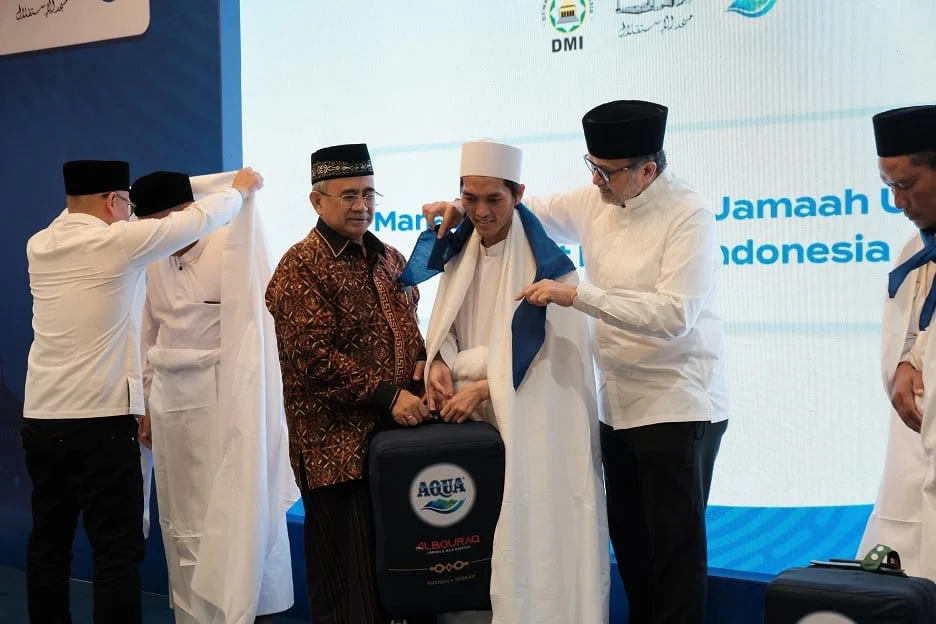
Jakarta — In a continued effort to honor the tireless contributions of grassroots religious workers, AQUA, in strategic collaboration with the Indonesian Mosque Council (Dewan Masjid Indonesia/DMI) and the Management Board of Istiqlal Mosque (Badan Pengelola Masjid Istiqlal/BPMI), has officially dispatched 27 marbot (mosque caretakers) and mosque administrators to perform the Umrah pilgrimage in the Holy Land.
Entering its third consecutive year, this philanthropic and community-focused initiative has successfully facilitated the sacred journey for a total of 70 mosque caretakers hailing from diverse regions across the Indonesian archipelago. The program reflects a growing recognition of the vital, yet frequently overlooked, role that frontline mosque workers play in maintaining the spiritual and social fabric of local communities.
The Strategic Importance of Mosque Caretakers
According to data from the Ministry of Religious Affairs’ Mosque Information System (SIMAS), Indonesia is home to more than 710,000 registered mosques and musala (prayer rooms). Beyond serving strictly as houses of worship, these religious sanctuaries function as vital hubs for education, community empowerment, and the strengthening of social solidarity.
Operating behind the scenes of these massive community centers are the marbot and mosque administrators. These individuals dedicate their time, energy, and unwavering attention to serving congregations. They are responsible for maintaining the cleanliness and comfort of the facilities, ensuring that daily prayers and educational programs run smoothly, and transforming mosques into living, accessible spaces that benefit the broader public.
Despite working largely away from the public spotlight, their dedication serves as the bedrock that preserves the operational continuity of religious spaces. Their work fosters a culture of togetherness, empathy, and mutual assistance within neighborhoods throughout the country.
Insights and Perspectives from Institutional Leaders
During the departure ceremony, KH Bukhori Sail Al-Tahiri, Head of the Worship Implementation Division at BPMI, emphasized the profound significance of honoring these community servants. He noted that the program seeks to uplift the key drivers of mosque activities in Indonesia while reinforcing the function of mosques as centers for community guidance and public service.
"The devotion of marbot and mosque administrators is an inspiration that we should all emulate," KH Bukhori stated. "Through their sincerity, we are reminded that there is immense blessing in every effort to compete in bringing goodness to the community and society."
He further expressed his appreciation for the seamless synergy between private sector entities and religious organizations, highlighting a shared vision to prosper mosques and elevate those who maintain them.
Echoing this sentiment, DMI Secretary General Rahmat Hidayat underscored that the collaboration with AQUA forms part of a broader strategy to deliver direct, tangible benefits to the nation’s mosque ecosystem. DMI remains deeply committed to empowering mosques so they can maximize their community impact.
"We see that paying attention to marbot and mosque administrators is not only important as a form of appreciation, but also as part of efforts to maintain the sustainability of the mosque’s role as a space for service, coaching, and strengthening the ummah," Rahmat explained.
From the corporate perspective, AQUA views the partnership as a meaningful channel to deliver positive, lasting value to society. Agung Laksamana, General Secretary Director of Danone Indonesia, emphasized that sustainable community empowerment relies on genuine, long-term cooperation.
"We believe that the empowerment of the ummah requires sincere and sustainable collaboration," Agung remarked. "AQUA is committed to continuing our journey alongside various partners—including religious organizations, mosque institutions, and local communities—to present initiatives that strengthen the social role of mosques and provide a broader positive impact for the people of Indonesia."
Personal Reflections from the Pilgrims
For many participants, the journey represents a once-in-a-lifetime opportunity that transcends ordinary travel, offering deep spiritual fulfillment. Abdul Muaz, a mosque representative from Bogor, West Java, shared his overwhelming gratitude upon being selected for the pilgrimage.
He noted that the entire expedition was meticulously organized, noting that logistical elements—ranging from telecommunication needs to daily provisions—were handled with exceptional care.
"With all of this comprehensive support, we were able to depart with peace of mind and focus entirely on our worship in the Holy Land," Muaz said.
Beyond the Umrah Program: A Holistic Approach to Community Development
The partnership between AQUA, DMI, and BPMI extends far beyond annual religious travel delegations. The tripartite alliance has previously collaborated on a diverse array of social, economic, and environmental initiatives. These include economic development programs for the ummah, the Healthy and Green Mosque (Masjid Hijau dan Sehat) initiative, and mosque-based community empowerment projects designed to foster a healthier, more self-reliant population.
Organizers hope that the spiritual journey serves as a wellspring of renewed motivation for the caretakers upon their return.
"For us, this program is expected to maintain the spirit of goodness so that it continues to grow and provide benefits to more people," Agung Laksamana added. "We hope this experience becomes a strengthening spiritual provision, while presenting new inspiration for the participants in continuing their dedication amidst society."
As part of its broader corporate social responsibility and community engagement framework, AQUA maintains active partnerships with various prominent Islamic organizations across Indonesia. In addition to DMI and the Istiqlal Mosque Management Board, the company routinely collaborates with Nahdlatul Ulama (PBNU), Muhammadiyah (PP Muhammadiyah), and numerous Islamic boarding school (pesantren) networks throughout the country. These expansive alliances aim to maximize sustainable social and environmental outcomes, reinforcing the private sector’s role in supporting community-driven religious infrastructure.