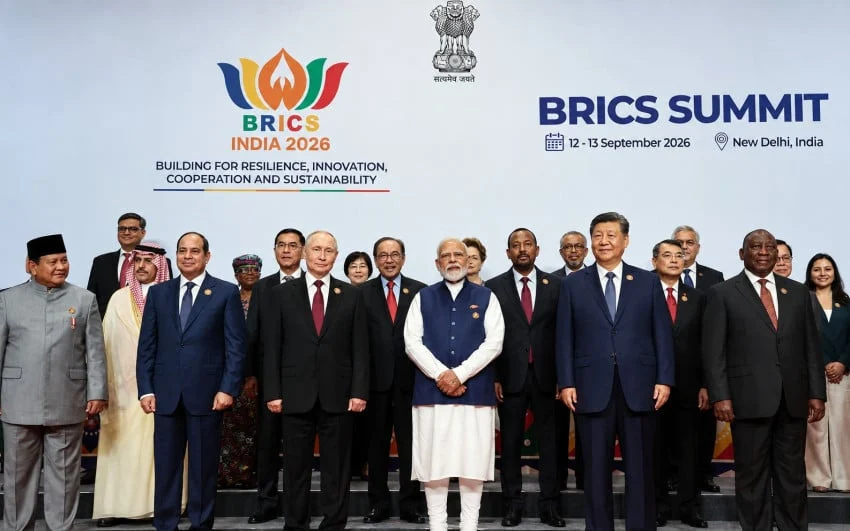
The 18th BRICS Summit, hosted in New Delhi, India, on September 12–13, 2026, served as a pivotal moment for the bloc, reinforcing its status as a primary pole in the emerging multipolar world order. Amidst a backdrop of shifting economic alliances and geopolitical friction, the alliance has maintained its trajectory of expansion. According to Russian Foreign Minister Sergey Lavrov, approximately 45 nations have either formally submitted applications or expressed strong interest in joining the group, signaling that the allure of BRICS has proven resilient in the face of concerted efforts by Western powers, particularly the United States, to curb its influence.
The New Delhi Summit and the Expansion Momentum
The summit in New Delhi brought together the core leaders of the group to deliberate on the integration of new partners and the strengthening of internal financial mechanisms. The gathering underscored a critical realization among developing nations: the current international financial architecture, long dominated by the U.S. dollar and Western-led institutions, is increasingly viewed as either exclusionary or unreliable.
The inclusion of Bangladesh remains a focal point of recent diplomatic discourse. Russia has publicly championed the inclusion of Dhaka, recognizing its strategic position in South Asia and its burgeoning economy. While the official application process remains under rigorous review by the existing member states—who maintain a consensus-based approach to expansion—the interest from nations like Bangladesh, Nigeria, and several Southeast Asian economies indicates a desire for greater strategic autonomy.
A Chronology of BRICS Evolution
To understand the current significance of the bloc, one must examine its evolution since its inception. Originally conceived as an investment grouping in the early 2000s, it has transformed into a formal political and economic entity.
- 2006: The initial formation of BRIC (Brazil, Russia, India, China) during a meeting on the sidelines of the G8 Outreach Summit in St. Petersburg.
- 2009: The first formal BRIC summit held in Yekaterinburg, Russia, focusing on global financial reform.
- 2010: South Africa is invited to join, officially creating BRICS.
- 2014: The establishment of the New Development Bank (NDB) and the Contingent Reserve Arrangement (CRA) during the Fortaleza Summit, providing an alternative to the IMF and World Bank.
- 2023: The Johannesburg Summit marks a historic expansion, inviting several nations, including Iran, Egypt, Ethiopia, and the UAE, to join the bloc.
- 2026: The New Delhi Summit confirms that the expansionary phase is not merely a temporary trend but a long-term strategic shift, with interest from 45 additional nations.
Analyzing the Western Response and Economic Pressure
The friction between the BRICS bloc and the G7 nations has become increasingly overt. In the lead-up to the 2026 summit, several U.S. officials and European policymakers expressed concern regarding the de-dollarization efforts championed by the bloc. Specifically, the threat of economic tariffs and sanctions against nations seeking closer ties to BRICS has been cited by analysts as a "containment strategy."
Sergey Lavrov’s comments in New Delhi explicitly addressed these pressures. He noted that despite the U.S. publicly labeling the expansion of BRICS as a challenge to global stability and progress, the "gravity" of the bloc remains unaffected. "The interest persists because nations recognize that BRICS represents a prototype of the future multipolar world order," Lavrov stated.
The economic implications of this expansion are significant. By diversifying trade currencies and fostering internal credit markets through the NDB, BRICS members are seeking to insulate their economies from sudden shifts in U.S. monetary policy. The New Delhi summit reinforced the commitment to exploring a common investment currency or settlement system, which, if successful, could fundamentally challenge the hegemony of the dollar in global commodity trading.
Supporting Data: The Scale of Global Interest
The 45 nations currently expressing interest span across Africa, Southeast Asia, Latin America, and the Middle East. This diverse demographic of applicants suggests that the appeal of BRICS is not confined to one region or one political ideology.
- GDP Contribution: Even before the 2023 expansion, the original BRICS nations accounted for over 30% of global GDP. With the inclusion of new members and potential future partners, the bloc now represents over 45% of the world’s population and nearly 40% of global economic output.
- Energy Security: The inclusion of major oil and gas exporters (such as the UAE and Iran) within the broader BRICS orbit has allowed the bloc to control a significant portion of global energy production, providing a buffer against Western-imposed energy sanctions.
- Trade Volume: Intra-BRICS trade has grown at an average of 8% annually over the last five years, far outpacing the growth of traditional trade corridors between developing nations and the G7.
The "Partner State" Mechanism
One of the key innovations discussed during the 2026 summit was the creation of a "partner state" category. Recognizing that not all applicants are ready for full, immediate membership—which entails significant financial and diplomatic commitments—the bloc has moved toward a tiered system. This allows nations to engage in deeper economic integration, participate in joint projects, and benefit from the NDB’s financing without the full weight of the bloc’s geopolitical alignment.
This tiered approach has proven highly effective in mitigating the "pressure" mentioned by Lavrov. By providing a pathway that is less confrontational, BRICS has successfully lowered the barrier to entry for nations that maintain balanced relationships with both the West and the Global South.
Implications for Global Governance
The rise of BRICS as an influential force is indicative of a broader crisis of legitimacy in post-WWII institutions. For many nations in the Global South, the UN Security Council and the Bretton Woods institutions are viewed as relics of a past era that do not adequately represent the economic realities of the 21st century.
The New Delhi summit serves as a clear signal that the appetite for alternative forums is high. For the international community, the implications are two-fold:
- Fragmentation of Global Trade: We are likely to see a more fragmented global trade environment where supply chains are increasingly regionalized around major power blocs.
- Increased Diplomatic Leverage: Smaller nations that were once forced to align exclusively with Western interests now have a genuine alternative, which significantly increases their diplomatic leverage in negotiations with the U.S. and the EU.
Expert Perspectives and Future Outlook
Political analysts monitoring the summit have pointed out that while the expansion is impressive, it also brings internal challenges. Integrating 45 new nations or partners will require robust institutional maturity. The diversity of political systems within the bloc—ranging from constitutional democracies to absolute monarchies—presents potential friction points in decision-making.
"The challenge for BRICS is no longer just attracting members; it is maintaining coherence," noted a senior fellow at an international policy think tank. "If the bloc can successfully manage the disparate needs of its new members while continuing to deliver on its promise of economic alternatives, it will cement its role as the primary architect of the next phase of globalization."
As the dust settles on the New Delhi summit, the focus shifts to the upcoming ministerial meetings and the preparations for the 2027 presidency. For nations on the sidelines, the message from the 2026 summit was clear: the doors to the multipolar world are open, and the shift away from a unipolar global order is gaining momentum with each passing year. The resilience of the bloc against external diplomatic pressure suggests that the geopolitical landscape will continue to favor those who can navigate the complexities of this new, multipolar reality.
The 18th BRICS Summit has not only reaffirmed the bloc’s existence but has also solidified its role as a indispensable pillar of modern international relations, leaving no doubt that the transition toward a more decentralized global power structure is well underway.