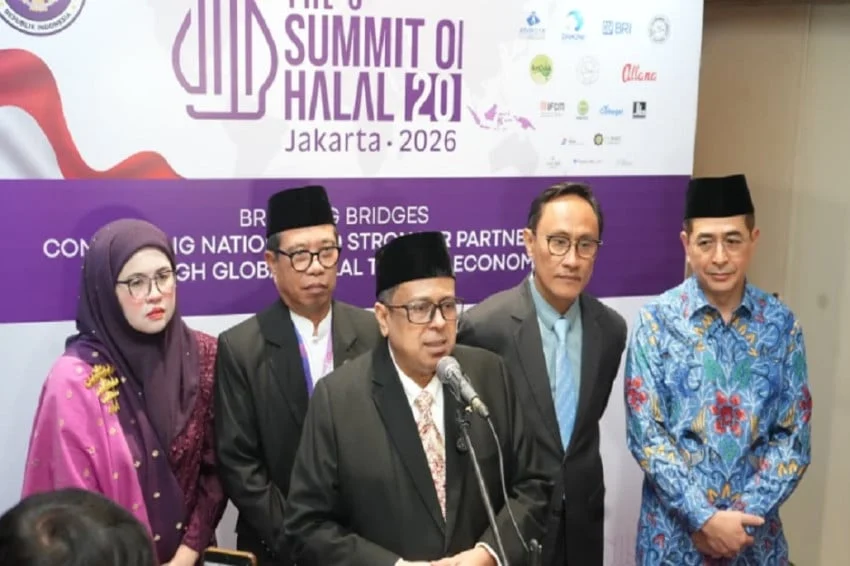
The Badan Penyelenggara Jaminan Produk Halal (BPJPH), operating under the auspices of the Indonesian government, has officially convened the prestigious 5th Summit of Halal 20 (H20) in Jakarta, marking a monumental milestone in the nation’s ongoing efforts to position itself at the epicenter of the global halal ecosystem. The high-profile international forum brought together 450 delegates representing 48 countries, establishing a robust platform for diplomatic engagement, cross-border commerce, and regulatory harmonization. This year’s summit, anchored by the overarching theme “Bridging Bridges: Connecting Nations & Stronger Partnerships through Global Halal Trade & Economy,” reflects a concerted push to dissolve trade barriers, foster mutual recognition agreements among international halal certification bodies, and build a more resilient, inclusive, and interconnected global halal supply chain.
The grand inauguration of the H20 summit drew an elite assembly of domestic and international dignitaries, underscoring the strategic geopolitical and economic importance that governments worldwide now attribute to the halal sector. High-ranking Indonesian officials in attendance included the Coordinating Minister for Human Development and Culture, Pratikno; the Minister of Creative Economy and Head of the Creative Economy Agency, Teuku Riefky Harsya; the Minister of Micro, Small, and Medium Enterprises (MSMEs), Maman Abdurrahman; and the Special Envoy of the President for MSMEs, Creative Economy, and Digital Affairs, Ahmad Ridha Sabana. The international profile of the event was significantly elevated by the presence of prominent foreign leaders, notably the Deputy Prime Minister of Malaysia, Dato’ Seri Ahmad Zahid bin Hamidi, and the Minister of Food and Drug Safety of the Republic of Korea, Yu-Kyoung Oh. Furthermore, the gathering saw robust participation from Arsjad Rasjid, Chair of B57+ Asia Pacific, alongside numerous foreign ambassadors, heads of international halal certification agencies, and key strategic partners from both the public and private sectors.
Strategic Vision and Background Context of the Halal 20 Forum
The genesis of the Halal 20 forum traces back to the growing realization that while the global Muslim population—and by extension the consumer base for halal-compliant goods—is expanding exponentially, the international trade architecture governing these products remains fragmented. Historically, disparate national standards, non-standardized certification procedures, and a lack of mutual recognition agreements among various domestic accreditation bodies have created unnecessary bottlenecks for exporters and importers alike.
Recognizing these inefficiencies, BPJPH and its international counterparts conceived the H20 platform to serve as the premier multi-lateral dialogue for regulatory authorities, industry titans, religious scholars, and economic policymakers. The forum aims to transcend traditional trade boundaries by establishing universal benchmarks for product integrity, safety, and supply chain transparency. By convening in Jakarta—the capital of the nation with the largest Muslim population in the world and a rapidly maturing mandatory halal certification regime—the 5th Summit serves as both a policy laboratory and a networking nexus designed to streamline the flow of halal food, pharmaceuticals, cosmetics, and lifestyle goods across continents.
Over the course of the multi-day summit, delegates engaged in rigorous plenary sessions, bilateral ministerial meetings, and technical workshops focused on key pillars of the contemporary halal economy. Discussions centered on the digitization of traceability systems, the incorporation of blockchain technology to verify halal supply chain integrity from farm to fork, and the integration of micro, small, and medium enterprises (MSMEs) into multinational value chains.
Distinguished Insights and Ministerial Perspectives
The diverse array of speakers at the 5th Summit of Halal 20 highlighted the multifaceted nature of the modern halal economy, which has long outgrown its traditional classification as a strictly religious dietary framework to emerge as a dominant force in global commerce, sustainable investing, and ethical tourism.
In his keynote address, Coordinating Minister for Human Development and Culture Pratikno emphasized that the expansion of the halal economy must go hand in hand with human capital development and institutional capacity building. He noted that as global demand for ethical and wholesome products surges beyond traditional Muslim-majority markets, nations must invest heavily in research, development, and vocational training to ensure that the workforce supporting the halal sector is equipped with cutting-edge technical skills.
Minister of Creative Economy Teuku Riefky Harsya brought a dynamic perspective to the forum by linking the halal industry with the burgeoning creative economy. He pointed out that halal lifestyle products—encompassing modest fashion, Islamic design, digital media, and culinary innovations—represent a goldmine of economic potential. By infusing creativity, cultural heritage, and modern technology into halal commodities, developing nations can capture higher-value segments of the international market.
Meanwhile, Minister of MSMEs Maman Abdurrahman and Presidential Special Envoy Ahmad Ridha Sabana underscored the imperative of empowering grassroots enterprises. They argued that while large conglomerates often dominate export markets, the true backbone of the halal ecosystem lies in small businesses. Integrating MSMEs into the global halal trade network requires targeted financial inclusion, simplified regulatory compliance pathways, and robust digital transformation initiatives. The presence of international heavyweights, such as Malaysian Deputy Prime Minister Dato’ Seri Ahmad Zahid bin Hamidi, added substantial diplomatic weight to the discussions. Malaysia, possessing a mature and globally respected halal ecosystem, shared valuable insights into regulatory governance and Islamic finance integration. Similarly, South Korean Minister of Food and Drug Safety Yu-Kyoung Oh demonstrated the universal appeal and technical rigor of halal compliance, showcasing how non-Muslim-majority nations are successfully innovating to tap into the lucrative global halal market through stringent safety and quality standards.
The Economic Implications of Regulatory Harmonization and Sovereignty
A central theme woven throughout the 5th Summit of Halal 20 was the delicate balance between maintaining rigorous national regulatory standards and fostering seamless international trade. In recent years, Indonesia’s implementation of mandatory halal certification laws through BPJPH has sparked global discussions regarding economic sovereignty and consumer protection.
Proponents of robust national halal regulations argue that mandatory certification acts as a crucial pillar of economic sovereignty, ensuring that products entering domestic markets meet strict ethical, health, and religious criteria while empowering local regulatory bodies to safeguard consumers. However, stringent import requirements can occasionally pose challenges for foreign trading partners, making forums like the H20 essential for ironing out diplomatic and technical friction.
By hosting 48 nations and facilitating direct dialogues between certification bodies, BPJPH is actively working to establish mutual recognition agreements (MRAs). These agreements allow foreign halal certificates—issued by bodies accredited by BPJPH—to be seamlessly accepted in Indonesia, and vice versa. This reciprocal framework minimizes redundant testing and auditing processes, significantly reducing trade costs and accelerating customs clearance times.
Economists and trade analysts observing the summit have noted that successful implementation of H20 resolutions could trigger a paradigm shift in South-South and North-South trade relations. As supply chains become increasingly diversified in the post-pandemic era, multinational corporations are looking to stable, high-growth economies in Southeast Asia to anchor their regional operations. A unified halal standard reduces compliance risks for these global players, encouraging foreign direct investment (FDI) into halal industrial zones, logistics hubs, and processing facilities across Indonesia.
Broader Impact and Future Outlook for the Global Halal Landscape
The conclusion of the 5th Summit of Halal 20 in Jakarta signals a critical turning point for the international halal architecture. As the forum draws to a close, participating nations are tasked with translating high-level diplomatic consensus into actionable domestic policies and binding multilateral frameworks.
The implications of the Jakarta summit extend far beyond immediate trade volumes. By fostering closer cooperation between regulatory agencies such as Indonesia’s BPJPH and South Korea’s Ministry of Food and Drug Safety, the forum demonstrates that the halal economy is an inclusive global domain that transcends cultural and religious boundaries. Ethical consumption, product traceability, hygiene, and sustainability—core tenets of the halal philosophy—increasingly resonate with mainstream consumers worldwide who prioritize health, safety, and corporate social responsibility.
Moving forward, the success of the H20 initiative will be measured by the operationalization of its core objectives: the acceleration of digital integration in supply chains, the broadening of MSME market access, and the widespread signing of mutual recognition agreements among participating states. As Indonesia continues to assert its leadership on the global stage, hosting landmark events like the 5th Summit of Halal 20 reinforces the nation’s vision of becoming the undisputed global hub for halal trade, innovation, and ethical economic prosperity by the middle of the decade.