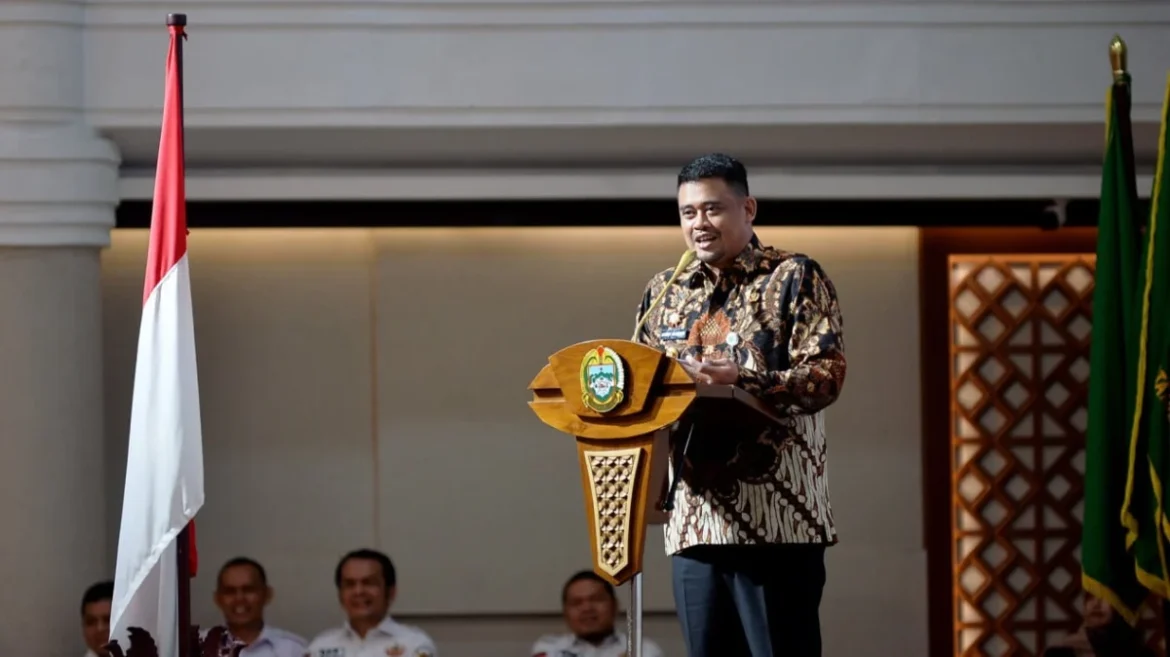
Governor of North Sumatra, Muhammad Bobby Afif Nasution, has formally called upon the Greater Minangkabau Family Association, or Ikatan Keluarga Minangkabau (IKM) of North Sumatra, to forge a robust strategic collaboration aimed at accelerating the growth of community-based economies and expanding the burgeoning halal industry across the region. This strategic invitation was extended during the official inauguration ceremony of the Regional Executive Board (DPW) of IKM North Sumatra for the 2024–2029 operational tenure. The high-profile event convened leaders, community figures, and prominent stakeholders at the Office of the Governor of North Sumatra, highlighting the pivotal role that diaspora communities play in shaping provincial economic landscapes.
The initiative underscores an ongoing regional push to harness collective community potentials, particularly among well-established migrant populations known for their entrepreneurial acumen. By integrating the commercial networks of the Minang diaspora with the economic development agenda of the provincial government, North Sumatra aims to position itself as a formidable hub for halal commerce and Islamic finance literacy in Indonesia.
Contextual Background and Economic Imperatives
The province of North Sumatra represents one of the most economically diverse and culturally pluralistic regions in the Indonesian archipelago. Within this dynamic demographic framework, the Minangkabau diaspora has historically maintained a profound presence, predominantly driving sectors ranging from culinary arts and textile trade to wholesale commerce, transportation, and small-to-medium enterprises (SMEs). Renowned for their cultural ethos centered on trade, mobility, and adaptability—often encapsulated by the philosophy of wandering and enterprise—Minang entrepreneurs constitute a vital engine of the local economy.
Despite Indonesia housing the largest Muslim population globally, domestic economic stakeholders frequently emphasize that the country’s vast potential in the halal value chain remains underutilized. Halal certification mandates, supply chain transparency, and Islamic financial literacy are critical areas where development has lagged relative to global demand. Governor Bobby Nasution explicitly addressed this structural gap during his address, framing the empowerment of the halal sector not merely as a religious compliance measure, but as an indispensable macroeconomic strategy to drive inclusive growth.
By engaging community-based organizations like IKM, the provincial administration seeks to bridge the gap between grassroots business operators and institutional support mechanisms. The collaboration is envisioned to encompass capacity-building programs, facilitation of halal certifications for micro-enterprises, and the expansion of Islamic trade networks that extend beyond provincial borders into regional and international markets.
Chronology and Highlights of the Inauguration Event
The inauguration proceedings unfolded over the course of an evening that combined formal governance protocols, organizational strategizing, and cultural camaraderie.
Late Afternoon to Evening Arrival: Distinguished guests, including members of the Regional Leadership Coordination Forum (Forkopimda), regional government officials, and prominent alumni of Universitas Andalas, began arriving at the official gubernatorial complex. The atmosphere reflected a blend of administrative solemnity and cultural celebration, marked by traditional greetings and networking among community leaders.
Formal Induction Ceremony: The core agenda commenced with the official reading of the leadership decrees, followed by the swearing-in ceremony. Delfitri Munir was officially inaugurated as the Chairperson of the DPW IKM North Sumatra for the 2024–2029 term. He was joined by Afrizal Chandra Piliang, who assumed the role of Secretary, and Gervan Abbas, appointed as Treasurer. The newly minted executive board members pledged their allegiance to the organization’s charter and committed to aligning their operational agenda with the developmental targets of the North Sumatra Provincial Government.
Gubernatorial Address and Strategic Challenge: Following the structural induction, Governor Bobby Nasution delivered a keynote address. He commended the historical contributions of the Minang community to North Sumatra’s economic resilience. Transitioning from appreciation to actionable policy, the Governor issued what he described as a constructive challenge—or a professional assignment—to the leadership of IKM. He urged the association to leverage its expansive commercial networks to elevate the standards of local enterprises through halal standardization and digital economic integration.
Endorsement from Central Leadership: Central IKM leadership echoed the sentiments of regional cooperation. The General Chairman of the Central Executive Board (DPP) of IKM, Andre Rosiade, took the podium to reaffirm the organization’s steadfast commitment to serving as a collaborative partner for local governments nationwide. Citing the traditional Minang maxim, "Di mana bumi dipijak, di situ langit dijunjung" (wherever one stands, one must uphold the local laws and customs), Rosiade emphasized that loyalty to the local administration is an intrinsic duty of the diaspora.
Cultural and Informal Engagement: True to the communal traditions of the gathering, the formal speeches were interspersed with lighter, culturally resonant moments. Andre Rosiade, who also serves in national sports management capacities, injected lighthearted optimism regarding national football dynamics, fostering a warm rapport with local officials. The evening culminated in a structured networking session, where executive board members, regional administrators, and community elders exchanged insights before concluding with a formal state dinner hosted by the North Sumatra Provincial Government.
Statements and Reactions from Key Stakeholders
The alignment between the provincial administration and the leadership of IKM elicited positive responses from various political, economic, and civic figures present at the venue.
Governor Bobby Nasution elaborated on the necessity of mobilizing communal economic forces to navigate global financial uncertainties. "Indonesia possesses the demographic advantage of being a majority-Muslim nation, yet our optimization of the halal ecosystem and Islamic financial literacy requires deliberate, collective intervention. By issuing this collaborative challenge to the Greater Minangkabau Family here in North Sumatra, we are not merely asking for participation; we are integrating core entrepreneurial assets into our regional master plan for sustainable economic expansion," the Governor stated during his address.
In response, DPP IKM General Chairman Andre Rosiade articulated the association’s readiness to operationalize the Governor’s directives. "Our members are embedded within the commercial fabric of North Sumatra. We view government policies not as external regulations, but as shared blueprints for prosperity. We invite the provincial government to utilize IKM as a strategic conduit for policy implementation, ensuring that our networks directly contribute to infrastructural, social, and economic milestones in the region," Rosiade remarked.
Delfitri Munir, the newly appointed Chairperson of DPW IKM North Sumatra, outlined immediate organizational priorities following his formal induction. Munir stressed that the primary objective for his tenure is institutional decentralization and grassroots mobilization. "Our immediate focus is twofold: expanding our structural presence by establishing Regional Executive Boards across all regencies and municipalities within North Sumatra, and actively integrating our members into social and economic welfare programs sponsored by the provincial government," Munir explained. He reiterated that the new board is fully mobilized to ensure that the Minang diaspora acts as a constructive force in local civic life.
The event also drew prominent figures such as Ade Jona Prasetyo, a Member of the House of Representatives (DPR RI) from the Gerindra Party faction and General Chairman of the Indonesian Young Entrepreneurs Association (BPP HIPMI). Prasetyo highlighted the intersection of youth entrepreneurship and ethnic business networks, noting that the synergy between established diaspora trade associations and modern corporate governance frameworks provides a vital catalyst for regional economic competitiveness.
Implications and Broader Economic Impact
The formal partnership between the North Sumatra Provincial Government and the Ikatan Keluarga Minangkabau carries significant implications for regional economic development, particularly within the domains of SME empowerment, halal industry standardization, and inter-ethnic social cohesion.
Catalyzing the Halal Value Chain: North Sumatra possesses a strategic geographic advantage as a trade gateway connecting western Indonesia to international maritime routes. By directing community-based business networks toward halal standardization, the provincial government can significantly increase the export capacity of local food products, cosmetics, and lifestyle goods. Compliance with international halal standards not only satisfies domestic consumer demands but also opens lucrative export markets in Southeast Asia and the Middle East.
Strengthening Grassroots Economic Resilience: The inclusion of migrant trade associations in formal economic planning helps mitigate the vulnerabilities often faced by informal sector workers and micro-entrepreneurs. Through structured mentorship programs, access to cooperative financing, and digital transformation initiatives championed jointly by the government and IKM, smaller enterprises can transition into formalized, scalable business entities.
Promoting Social Harmony and Collaborative Governance: In a diverse province like North Sumatra, active engagement between local authorities and prominent diaspora organizations reinforces social stability. When migrant communities are formally integrated into regional development agendas, the potential for socio-economic friction diminishes, replaced by a shared stake in regional prosperity.
Future Outlook for the Region
As the newly inaugurated board of DPW IKM North Sumatra transitions from ceremonial proceedings to operational execution, attention will shift toward the implementation of the specific economic initiatives discussed during the event. Observers note that the success of this collaboration will depend heavily on the establishment of transparent monitoring mechanisms, continuous capacity-building workshops for micro-entrepreneurs, and sustained institutional dialogue between regional administrative bodies and community stakeholders.
With regional leaders emphasizing inclusive growth and targeted industrial development, the partnership between the North Sumatra administration and the Minangkabau diaspora serves as a compelling model for leveraging cultural capital in the service of modern economic governance.