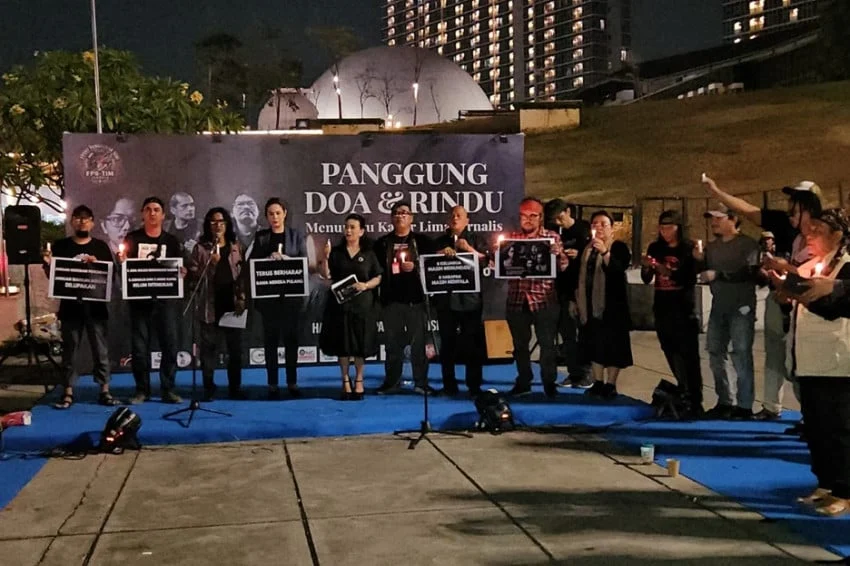
The front courtyard of the historic Taman Ismail Marzuki (TIM) cultural center in Central Jakarta transformed into a solemn space of reflection on Monday evening, September 14, 2026. Doomed by uncertainty yet united in hope, a collective of Indonesian artists, cultural figures, writers, and journalists gathered for an emotional event titled Panggung Doa dan Rindu, Menunggu Kabar Lima Jurnalis (Stage of Prayer and Longing, Awaiting News of Five Journalists). The vigil was organized to offer prayers, solidarity, and moral support for the safe recovery of five journalists and three vessel crew members who have remained out of contact in the treacherous waters of the Sunda Strait since Monday, September 7, 2026.
Among the missing media workers is Yudistiro Pranoto, a dedicated photojournalist representing the iNews Media Group, whose disappearance alongside his peers has sent shockwaves through the Indonesian journalistic community. The gathering at TIM underscored the deep professional and personal ties binding the nation’s creative and journalistic sectors, both of which frequently operate on the front lines of documentation, truth-seeking, and cultural preservation.
A Solemn Evening of Art, Prayer, and Collective Grief
The atmosphere at the cultural hub was heavy with quiet grief, punctuated by moments of defiant hope. Participants at the vigil engaged in a series of solemn rituals, beginning with interfaith prayers led by community representatives. Attendees formed a vast circle around flickering candles arranged on the pavement, symbolizing a guiding light meant to safely lead the missing individuals back to shore.
The program featured heartfelt poetry readings by prominent literary figures, accompanied by acoustic musical performances. As the evening deepened, the crowd joined in a collective, emotional rendition of Tanah Airku (My Homeland), the patriotic classic composed by Ibu Soed. Many participants held aloft placards and handmade posters bearing messages of encouragement, such as "Stay Strong, Return Safely," "The Truth Cannot Drown," and "Prayers for Our Colleagues at Sea."
David Karo-karo, the initiator of the Front Penggerak Seniman TIM (TIM Artists Movement Front), explained that the event materialized through an entirely spontaneous mobilization. Driven by fundamental human empathy and professional solidarity, the arts community felt compelled to act rather than remain passive observers of the ongoing maritime tragedy.
"This is not merely about professions; this is about our brothers, our sisters, and fellow citizens who were out there carrying out their duties to inform the public," Karo-karo stated during the vigil. "Through poetry, song, and prayer, we channel our collective energy to support the families left behind and to urge all elements involved in the search operations to keep pressing forward."
Chronology of the Sunda Strait Maritime Incident
The disappearance of the media crew unfolded against the backdrop of routine journalistic coverage combined with challenging maritime conditions. The timeline of events, reconstructed from initial reports and official updates, highlights the rapid escalation from a routine assignment to a major search-and-rescue (SAR) operation.
- Monday, September 7, 2026: A group of five journalists, including photojournalist Yudistiro Pranoto, embarked on a reporting assignment in the Sunda Strait region, accompanied by a vessel crew consisting of three local mariners. The team was documenting regional maritime developments and environmental conditions. Later that afternoon, contact with the vessel was abruptly lost as weather conditions in the strait deteriorated.
- Tuesday, September 8, 2026: When the vessel failed to check in at its designated reporting intervals, media management agencies, alongside families, alerted local maritime authorities. The National Search and Basarnas (Search and Agency) office initiated a preliminary tracking protocol, mobilizing local vessels and coastal monitoring stations.
- Wednesday, September 9 to Sunday, September 13, 2026: The official Search and Rescue operation scaled up significantly. Basarnas deployed specialized teams, including naval assets from the Indonesian Navy (TNI AL), marine police units, and aerial reconnaissance aircraft to comb the vast maritime corridor between Java and Sumatra. Despite recovering fragments of debris suspected to belong to the vessel, adverse weather, high waves, and strong underwater currents continually hampered the physical location of the missing persons.
- Monday, September 14, 2026: As the initial statutory seven-day search window drew to a close without locating the victims, authorities announced an official extension of the rescue operations. Simultaneously, artists and journalists in Jakarta staged the Panggung Doa dan Rindu vigil at Taman Ismail Marzuki to maintain public awareness and provide psychological support to the affected families.
Official Response and Extended Search Operations
The scale of the incident has prompted a coordinated multi-agency response, with government bodies and humanitarian organizations pooling resources to locate the missing crew and journalists. Following standard maritime protocol, the initial search window allocated for missing persons at sea spans seven days. However, due to persistent advocacy from media organizations, families, and civil society groups, Basarnas officially announced a three-day extension of the search operation.
Search and Rescue coordinators have utilized advanced sonar technology, high-speed patrol boats, and helicopters to sweep wider zones within the Sunda Strait. The strait, renowned for its unpredictable currents, heavy commercial maritime traffic, and proximity to the Anak Krakatau volcanic complex, presents immense logistical challenges for rescue divers and surface teams alike.
Representatives from the Alliance of Independent Journalists (AJI) and the Indonesian Journalists Association (PWI) have maintained a continuous presence at the operational command posts in Banten and Lampung. These organizations have coordinated closely with media corporations to provide psychological counseling and logistical assistance to the families of both the journalists and the vessel crew members.
In official statements, media management executives have expressed profound gratitude to the government agencies, local fishermen, and civilian volunteers who have volunteered their time and vessels to assist in the expansive sweep. They emphasized that the safety of media workers operating in high-risk environments remains an urgent systemic issue that requires renewed attention from both media outlets and regulatory bodies.
Broader Implications for Journalism and Maritime Safety in Indonesia
The tragic incident in the Sunda Strait serves as a sobering reminder of the physical perils journalists face in the line of duty. While public discourse frequently focuses on digital security, legal intimidation, or urban civil unrest, field reporting—particularly maritime, environmental, and investigative journalism—carries severe inherent risks.
Media analysts and safety advocates point out several broader implications stemming from the ongoing crisis:
1. Re-evaluating Standard Operating Procedures (SOPs) for Field Reporting
The disappearance is expected to trigger a comprehensive review of safety protocols across Indonesian media institutions. Organizations are being urged to strictly mandate safety training, compulsory life-saving gear, real-time satellite tracking devices, and rigorous risk assessments before dispatching reporters to high-risk environments, including open seas, disaster zones, and conflict areas.
2. Enhancing Inter-Agency Maritime Coordination
The complexities encountered during the Sunda Strait search highlight the critical need for seamless communication between civilian media entities, maritime transport authorities, and military defense assets. Faster emergency signaling infrastructure and streamlined reporting channels can drastically reduce response times during the critical first hours of a maritime emergency.
3. The Psychological Toll on Media Families and Newsrooms
Beyond the physical search efforts, events like the vigil at Taman Ismail Marzuki illustrate the immense psychological burden borne by newsrooms and families. The prolonged uncertainty exacts a heavy emotional toll, reinforcing the necessity for institutional mental health support frameworks within Indonesian media houses.
As the extended search operations continue across the choppy waters of the Sunda Strait, the collective gaze of the nation remains fixed westward. The poetry recited and candles lit at Taman Ismail Marzuki stand as a testament to a resilient community—one that refuses to let the names and faces of its missing storytellers fade into obscurity, maintaining a steady vigil in the dark while awaiting news from the sea.