PT Pertamina Patra Niaga through its dedicated tanker vessel, the MT Mauhau, successfully concluded a high-stakes humanitarian mission in the Java Sea, bringing relief and timely intervention to the victims of the sunken vessel MV Virgo Transport 8. The maritime tragedy, which unfolded in the unpredictable and heavily trafficked waters of the Java Sea, tested the operational readiness, rapid response capabilities, and humanitarian commitment of commercial maritime workers operating under the Indonesian flag. The successful handover of sixteen individuals—comprising fifteen survivors and one fatality—to the National Search and Rescue Agency (Basarnas) at Trisakti Port in Banjarmasin marks a critical milestone in a coordinated disaster response operation that highlights the intersection of corporate social responsibility, maritime safety protocols, and national emergency infrastructure.
The comprehensive operation, which concluded on Monday, September 14, 2026, began in the dead of night under challenging meteorological and navigational conditions. The swift actions taken by the master and crew of the MT Mauhau averted what could have been an even greater loss of life, underscoring the vital role that commercial vessels play as first responders in maritime emergencies where distance and response time dictate the boundary between survival and tragedy.
Chronology of the Disaster and Rescue Operation
The sequence of events leading up to the successful handover at Banjarmasin began in the early hours of Sunday, September 13, 2026. The MT Mauhau was underway, transiting the Java Sea on a routine commercial voyage toward its scheduled destination in Tuban, East Java. At approximately the time of the incident, the vessel was navigating waters known for dynamic weather patterns and heavy commercial maritime traffic.
At a critical juncture during the voyage, the radio room of the MT Mauhau intercepted a distress signal transmitted via Very High Frequency (VHF) radio. The distress call originated from the MV Virgo Transport 8, a vessel that was rapidly taking on water and facing imminent structural failure due to flooding in the open sea. Recognizing the immediate gravity of the situation, the captain of the MT Mauhau acted in accordance with international maritime law, which mandates that vessels render assistance to those in distress at sea regardless of commercial schedules.
The master immediately altered the tanker’s course, steering toward the coordinates provided in the initial distress broadcast, which placed the sinking vessel approximately 10 nautical miles (NM) from the MT Mauhau’s position. Simultaneously, the ship’s command initiated emergency communication protocols, establishing contact with Basarnas and relevant maritime authorities to coordinate an integrated search and rescue (SAR) response.
Operating in darkness, the crew of the MT Mauhau maintained heightened vigilance, scanning the dark horizon for visual markers. At approximately 03:00 local time (LT), the crew spotted a parachute flare launched by the stranded crew members of the MV Virgo Transport 8. Utilizing the flare as a navigational bearing, the tanker maneuvered safely toward the survivors who had abandoned ship and were drifting in life rafts or using personal flotation devices.
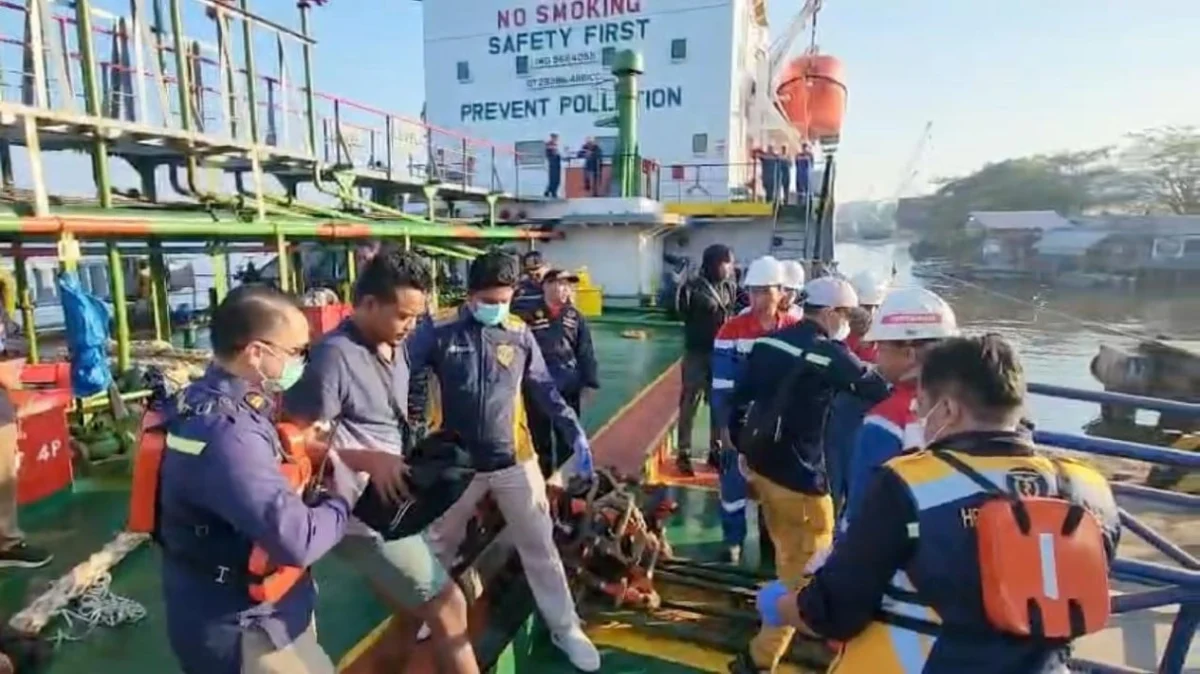
Through precise seamanship, the crew of the MT Mauhau executed a complex rescue operation in open water, successfully bringing sixteen individuals aboard the tanker. Among those rescued was the master of the ill-fated MV Virgo Transport 8. Once safely on deck, the survivors were immediately subjected to triage. The ship’s crew provided emergency medical first aid, dry clothing, blankets, and fundamental physiological necessities such as food and hydration to stabilize their physical and psychological conditions.
Despite the rapid extraction, the ordeal had exacted a heavy toll on the ship’s complement. One of the rescued individuals, who had sustained severe traumatic injuries during the sinking and the subsequent abandonment of the vessel, deteriorated despite onboard medical interventions. This individual was officially pronounced dead at approximately 10:16 LT while under the care of the shipboard personnel.
Following the successful rescue and stabilization phase, the MT Mauhau charted a course for the nearest safe port with adequate medical and logistical infrastructure to handle mass casualty arrivals. The vessel steamed toward the Port of Trisakti in Banjarmasin, South Kalimantan, arriving safely on Monday, September 14, 2026, at approximately 06:10 WITA.
Official Handover and Demobilization at Trisakti Port
Upon berthing at the Port of Trisakti in Banjarmasin, a seamless transfer of authority and care took place between the maritime operators and land-based emergency services. The sixteen individuals brought ashore by the MT Mauhau were officially disembarked and handed over to the local Posko SAR and Basarnas representatives.
The multi-agency response team established at the port was primed to handle the arrivals, ensuring that survivors received immediate ambulatory care, psychological counseling, and logistical support for repatriation to their respective home regions. The mortal remains of the deceased crew member were simultaneously transferred under proper protocols to local authorities for forensic examination and subsequent return to the grieving family.
This meticulous coordination minimized delays in post-rescue care. The operational handoff represented the culmination of a tightly managed emergency workflow that bridged open-sea rescue tactics with structured onshore disaster management. Once the paperwork and custody transfers were formally concluded, the MT Mauhau was cleared to resume its commercial responsibilities.
According to operational manifests released following the event, the MT Mauhau departed from the offshore anchorage (OB) in Banjarmasin later that same day, Monday, September 14, at 13:30 LT. The vessel resumed its interrupted voyage toward Tuban, where it was scheduled to dock on Tuesday, September 15, 2026, at 16:00 LT. Corporate communications confirmed that all twenty-one regular crew members of the MT Mauhau remained safe, unharmed, and in good health throughout the duration of the detour and rescue operation.
Corporate Statements and Human-Centric Maritime Values
The successful execution of the rescue mission drew high-level praise from the corporate leadership of PT Pertamina Patra Niaga. Company officials emphasized that the incident serves as a poignant reminder of the inherent hazards of seafaring and the unwritten code of the sea that places human life above all commercial metrics.
In an official statement released on Monday, September 14, 2026, Vice President of Corporate Communication at PT Pertamina Patra Niaga, Kitty Andhora, expressed deep gratitude and professional admiration for the dedication displayed by the ship’s master and crew.
"As soon as we received information regarding the emergency condition, the crew of the MT Mauhau immediately moved to assist in the rescue of the victims. This morning, all victims have been handed over to Basarnas to receive further handling," Kitty stated.
She underscored the foundational philosophy guiding the state-owned enterprise’s operational directives, noting that corporate benchmarks are fundamentally anchored in humanitarian responsibility. "The safety of human life is our top priority, and this is a manifestation of the humanitarian spirit of Pertamina personnel to always be present when the community requires assistance," she added.
Maritime analysts point out that actions of this nature require not only moral resolve but also rigorous compliance with the International Convention for the Safety of Life at Sea (SOLAS). The willingness of a commercial tanker carrying hazardous or flammable liquid cargo to alter its voyage, conduct nighttime search operations, and bring unmanifested persons aboard presents distinct operational and security challenges. The ability of the MT Mauhau crew to balance these risks while executing a textbook rescue reflects high standards of professional training and emergency preparedness.
Broader Implications for Maritime Safety and Regional Logistics
The sinking of the MV Virgo Transport 8 and the subsequent rescue operation by the MT Mauhau highlight several critical themes within the broader context of Indonesian maritime logistics and safety infrastructure. Indonesia, as the world’s largest archipelagic nation, relies extensively on domestic shipping lanes spanning vital maritime choke points such as the Java Sea, Makassar Strait, and Sunda Strait. Ensuring the safety of these lanes requires constant vigilance from both regulatory bodies and commercial fleet operators.
-
The Critical Role of Commercial Fleets as First Responders: In vast maritime zones where dedicated government search and rescue vessels may take hours to reach remote coordinates, commercial ships traversing the same waters are often the actual first responders. The prompt interception of the distress call by the MT Mauhau prevented survivors from enduring extended exposure in open waters, which drastically reduces mortality rates associated with hypothermia, dehydration, and drowning.
-
Inter-Agency Coordination and Preparedness: The seamless transition from open-ocean rescue to port-side reception at Trisakti Port demonstrates the efficacy of established protocols between commercial operators and state agencies like Basarnas. Effective communication channels—such as standard VHF radio distress monitoring and satellite tracking—remain the backbone of maritime safety networks.
-
Mental and Physical Toll on Rescuers: Beyond the logistical success, maritime rescues impose significant psychological and physical burdens on the rescuing crew. Providing immediate triage in confined spaces, managing loss of life onboard, and altering strict delivery schedules test the resilience of merchant mariners. Recognizing these efforts through public commendation reinforces a culture of safety and empathy across the national maritime sector.
As maritime traffic continues to grow in density across Indonesian waters, the lessons learned from the MV Virgo Transport 8 incident reaffirm the necessity of continuous training, robust communication equipment, and an unwavering commitment to the humanitarian ethos that binds the global seafaring community together. The prompt and decisive actions of the MT Mauhau crew stand as a testament to these enduring values, transforming a potential maritime catastrophe into a story of resilience, professional excellence, and shared human solidarity.