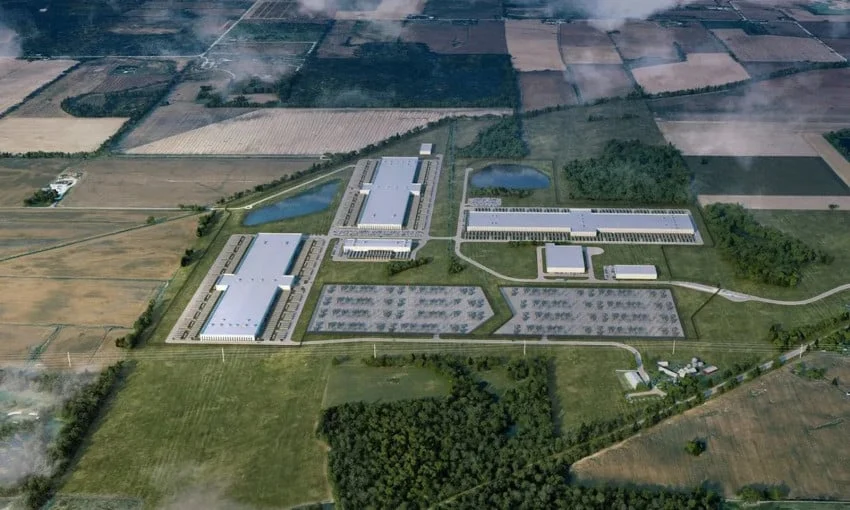
The serene atmosphere of Dowagiac, a tight-knit community nestled in the southwest region of Michigan, has been fundamentally shattered over the past two years, culminating in a legal battle that could establish a landmark precedent across the United States. For 730 days and nights, approximately 1,300 residential properties situated within a critical one-mile radius of a sprawling industrial facility have been subjected to an unremitting, high-pitched acoustic assault. Originating from a local data center operated by Hyperscale Data, this relentless industrial hum has transformed idyllic suburban lives into a daily exercise in psychological endurance.
On May 26, the grievances of these beleaguered residents materialized into formal judicial action when two local property owners, backed by the prominent Detroit-based law firm Liddle Sheets P.C., filed a sweeping class-action lawsuit in the U.S. District Court for the Western District of Michigan. The legal complaint marks a watershed moment in American jurisprudence, widely recognized as the nation’s very first class-action lawsuit specifically targeting persistent, structural noise pollution generated by a modern data center. As the digital economy rapidly expands to support artificial intelligence, cloud computing, and blockchain technology, this Michigan case brings to the forefront a glaring friction point: the heavy physical toll that digital infrastructure imposes on the analog communities forced to host it.
The Chronology of a Crisis: From Industrial Evolution to Acoustic Nightmare
To understand the depth of the current crisis in Dowagiac—a tranquil municipality with a population hovering around 5,700 residents, located roughly 30 miles inland from the shores of Lake Michigan—one must examine the evolutionary timeline of the facility at the center of the controversy. The physical infrastructure that now houses the hyperscale data operations was originally developed in 2018, serving initially as a relatively modest industrial site before transitioning in 2021 into an intensive cryptocurrency mining facility.
During its early operational phases as a crypto-mine, the site generated standard industrial activity, but the acoustic profile remained within tolerable limits for the surrounding neighborhood. However, the operational character of the facility shifted dramatically leading up to 2024. As the servers were upgraded, expanded, or reconfigured to handle heavier computational loads, massive industrial cooling systems were brought online to prevent overheating. These cooling arrays—comprising hundreds of high-powered industrial exhaust fans operating simultaneously—unleashed a piercing, high-frequency whine that quickly became a permanent fixture of the local soundscape.
By early 2024, residents living adjacent to the facility realized that the noise was not a temporary byproduct of maintenance, but a permanent condition. Unlike standard urban background noise, which fluctuates with traffic patterns and business hours, the Hyperscale Data facility operates on a continuous, unyielding schedule. Day and night, winter and summer, weekday and weekend, the high-pitched drone cuts through triple-pane glass windows, penetrates exterior insulation, and invades the most private spaces of family homes.
Living Inside the Soundscape: Human Toll and Vivid Testimonies
The psychological and physiological impact of continuous high-frequency noise is well-documented in acoustic engineering and public health literature. Prolonged exposure to low-level, high-frequency industrial hums is known to trigger chronic stress, elevate blood pressure, disrupt REM sleep cycles, and induce severe anxiety. In Dowagiac, these clinical realities are manifesting as deeply personal human tragedies.
Lindy Valenzuela, a homeowner whose property sits directly across the street from the offending facility, offered a stark analogy to local news station WXYZ-TV to describe the surreal nature of her daily existence. "Bunyinya seperti ada orang memasang penyedot debu di ruang tamu Anda. Filternya tersumbat, jadi melengking. Lalu dibiarkan menyala dan ditinggal pergi," Valenzuela stated, painting a vivid picture of a broken, oversized vacuum cleaner screeching inside an enclosed living space with no one around to turn it off. For Valenzuela and her neighbors, the sound is omnipresent, inescapable, and mentally exhausting.
Another resident, Billy Finn, invoked imagery associated with psychological interrogation to articulate the severity of the disturbance. Finn compared the acoustic environment to cinematic depictions of torture techniques, where captive individuals are subjected to sustained, inescapable audio frequencies within confined cells to break their psychological resilience. While hyperbolic on the surface, Finn’s comparison underscores the profound sense of helplessness experienced by homeowners who find themselves legally and financially trapped in properties that have plummeted in value due to environmental degradation.
The legal representation leading the class-action suit emphasizes that the plaintiffs are not merely complaining about minor inconveniences associated with industrial neighbors. Rather, they argue that the continuous acoustic emission constitutes a private nuisance, diminishes property values, and breaches local environmental and zoning protections. The inclusion of roughly 1,300 properties in the initial filing illustrates the sheer geographic scope of the acoustic footprint, proving that the disruption extends far beyond an immediate boundary line to affect an entire quadrant of the municipality.
Municipal Intervention and Regulatory Deadlock
Prior to the escalation in federal court, local municipal authorities in Dowagiac attempted to address the burgeoning crisis through traditional regulatory mechanisms. The city government maintains explicit industrial noise ordinances designed to protect residential zones from commercial encroachment. Under municipal codes, permissible noise levels are capped at 65 decibels during daytime hours, dropping to a stricter limit of 55 decibels during the night.
To contextualize these figures within everyday life, a sustained sound level of 65 decibels is roughly equivalent to the volume of a normal, face-to-face conversation or the ambient murmur of a busy modern office space. However, high-frequency industrial noise—such as the whine produced by failing or overloaded server cooling fans—possesses tonal qualities that make it significantly more intrusive and psychologically grating than broad-spectrum white noise at the same decibel level.
As complaints flooded City Hall throughout 2024, Dowagiac officials deployed acoustic monitoring equipment, recorded violations of the local noise ordinance, and subsequently levied municipal fines against the operators of the facility. The local government’s intervention signaled a clear institutional recognition that the facility was operating outside the bounds of acceptable community standards.
Despite the issuance of municipal citations and fines, the management of Hyperscale Data contested the legitimacy of the local government’s findings. Representatives for the company have openly questioned the methodology employed by city inspectors, challenging the accuracy of the acoustic measurements and disputing the calibration standards of the equipment used. This defensive posture created a regulatory stalemate: while the city asserted that the facility was in clear violation of the law, the corporate operators dismissed the citations as methodologically flawed, leaving residents caught in the crossfire between municipal authority and corporate intransigence.
Broader Industry Implications: The Rise of Data Center Acoustic Conflicts
The unfolding legal drama in Dowagiac is far from an isolated local dispute; rather, it serves as a bellwether for a rapidly growing national conflict. Across the United States, the explosive growth of artificial intelligence, cloud-computing infrastructure, and decentralized finance has triggered an unprecedented land rush for data center construction. Driven by cheap land, accessible power grids, and favorable tax incentives, tech companies and infrastructure developers have increasingly sited massive server farms near or even directly within smaller suburban and rural communities.
However, the rapid pace of development has frequently outstripped municipal planning frameworks and environmental impact assessments. Modern hyperscale facilities consume staggering amounts of electrical power, generating immense heat loads that require industrial-scale HVAC and cooling systems operating at maximum capacity around the clock. While economic development boards often welcome the influx of tax revenue and high-tech branding, local residents frequently bear the unseen environmental costs—chief among them being massive water consumption, visual blight on rural horizons, and unrelenting acoustic pollution.
Legal experts tracking the Dowagiac class-action suit note that the outcome of the litigation could establish a critical legal precedent for how American courts balance industrial rights against residential quality of life in the digital age. If the plaintiffs represented by Liddle Sheets P.C. successfully demonstrate that Hyperscale Data is liable for maintaining a private nuisance, it could open the floodgates for similar litigation across the country. Data center operators nationwide may be forced to radically overhaul their acoustic engineering practices, invest heavily in expensive sound-mitigation baffles, or face crippling class-action liabilities.
Furthermore, the case highlights the urgent need for updated municipal zoning laws that specifically anticipate the unique environmental signatures of modern digital infrastructure. Traditional noise ordinances drafted decades ago for factories, manufacturing plants, or standard commercial enterprises often fail to account for the continuous, high-frequency, tonal characteristics of server cooling arrays.
As the legal proceedings in the U.S. District Court for the Western District of Michigan move forward, all eyes will be on the federal judiciary to see how it navigates the competing demands of technological expansion and community welfare. For the 1,300 households in Dowagiac, the lawsuit represents more than a quest for financial compensation or regulatory compliance; it is a desperate battle to reclaim the basic human right to peace and quiet within their own homes, putting an end to two long years of living inside an unyielding mechanical scream.