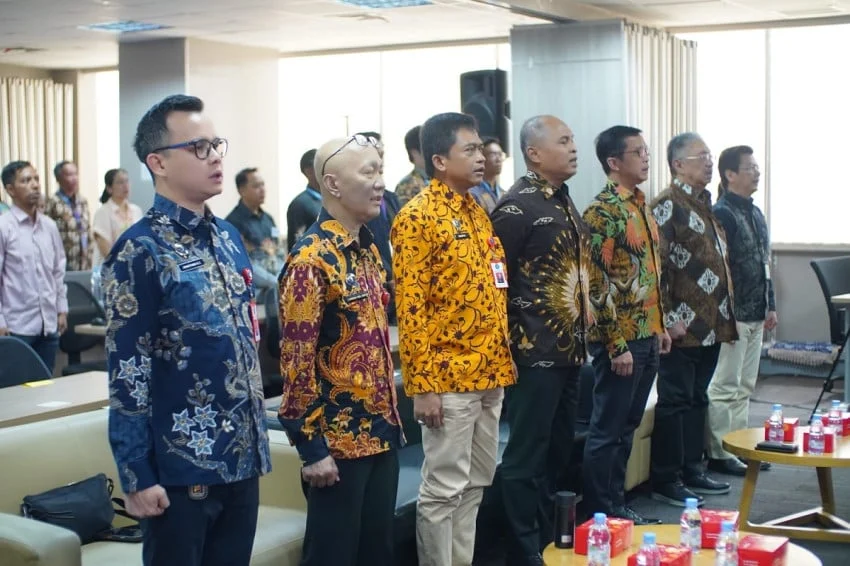
JAKARTA — Swiss German University (SGU) has reaffirmed its strategic commitment to delivering graduate education aligned with modern industrial demands, technological advancements, and professional landscape requirements by hosting the SGU Master Orientation Day 2026. Held in a hybrid format on Saturday, September 12, 2026, the academic event served as both a formal welcome ceremony for incoming master’s degree students and a high-level intellectual forum addressing contemporary global challenges.
A centerpiece of the orientation program was an exclusive Public Seminar featuring Lieutenant General (Ret.) Nugroho S. Budi, the Head of Indonesia’s National Cyber and Crypto Agency (Badan Siber dan Sandi Negara – BSSN). Drawing on his extensive military and cybersecurity background, the BSSN chief delivered a comprehensive keynote address highlighting the intersection of national security, digital resilience, and advanced technological integration in the professional sphere.
The hybrid event attracted a diverse audience of postgraduate scholars, faculty members, industry practitioners, and university leadership, reflecting SGU’s ongoing emphasis on bridging academic theory with practical, real-world application. Through an interactive talk show format, the seminar facilitated deep intellectual exchanges concerning the rapid evolution of cyberspace and the shifting paradigms of modern warfare and governance.
Chronology and Event Background
The SGU Master Orientation Day 2026 was meticulously structured to introduce incoming graduate students to the rigorous academic ecosystem of the university while simultaneously exposing them to macro-level socio-technological trends. The proceedings commenced early Saturday morning with administrative onboarding, followed by academic briefings from various heads of postgraduate departments.
The afternoon session transitioned into the highly anticipated Public Seminar led by the BSSN Head. The choice of BSSN leadership as the primary keynote speaker underscores SGU’s strategic vision to integrate digital security awareness across all master’s disciplines—ranging from information technology and engineering to business administration and sustainable development. As organizations globally navigate complex digital landscapes, understanding cybersecurity is no longer confined to technical specialists but has become an essential competency for modern leaders and decision-makers.
Core Themes: Emerging Technologies and Strategic Vulnerabilities
The dialogue session between Lieutenant General (Ret.) Nugroho S. Budi and the SGU academic community delved deeply into critical topics shaping the contemporary digital economy. Key thematic areas discussed during the interactive talk show included:
- Cybersecurity and Emerging Digital Threats: The discussion addressed the increasing sophistication of cyberattacks targeting critical infrastructure, financial institutions, and government databases. Speakers emphasized that modern threats are increasingly automated, persistent, and difficult to detect using legacy security frameworks.
- Digital Transformation and Human Capital Readiness: A recurring theme was the widening talent gap in the cybersecurity sector. While organizations heavily invest in software and hardware infrastructure, the human capital component—skilled professionals capable of anticipating and neutralizing threats—remains critically understaffed, both globally and within Indonesia.
- Asymmetric Warfare and National Security: The seminar provided profound insights into how geopolitical conflicts increasingly manifest in the digital domain. Cyber espionage, disinformation campaigns, and infrastructure disruption represent modern forms of asymmetric warfare that require robust national defensive and offensive cyber postures.
- Frontier Technologies (AI, Quantum Computing, and PQC): The panel explored the dual-use nature of emerging technologies. While Artificial Intelligence (AI) enhances threat detection and automated response mechanisms, it is simultaneously weaponized by malicious actors to scale cyberattacks. Furthermore, the horizon of Quantum Computing poses an existential threat to current cryptographic standards, necessitating immediate migration strategies toward Post-Quantum Cryptography (PQC).
Broader Context: Indonesia’s Cybersecurity Landscape
The insights shared during the SGU Master Orientation Day 2026 resonate deeply with Indonesia’s broader national development and security trajectories. In recent years, Indonesia has experienced exponential growth in digital adoption, accelerated by government initiatives such as "Making Indonesia 4.0" and widespread digital financial inclusion. However, this rapid digital expansion has concurrently exposed the nation to elevated cyber risks.
Data from national and international cybersecurity monitors frequently highlight Indonesia as one of the primary targets for malware, ransomware, and data breaches in Southeast Asia. In response, national agencies like BSSN have actively pursued multi-stakeholder collaborations—partnering with international technology firms, defense contractors, and academic institutions—to bolster the country’s cybersecurity posture.
By engaging directly with academic institutions like Swiss German University, BSSN aims to foster a culture of cybersecurity awareness from the grassroots level of higher education, ensuring that future industry leaders graduate with a security-first mindset. SGU’s proactive integration of these contemporary issues into its master’s orientation program demonstrates an institutional awareness that technical proficiency alone is insufficient without a robust ethical and security-oriented framework.
Implications for Graduate Education and Industry Readiness
The collaboration between SGU and BSSN during the 2026 orientation event signals a broader evolution in Indonesian postgraduate education. Universities are increasingly recognizing that traditional curricula must be continuously updated to reflect geopolitical and technological shifts.
For master’s students at SGU, exposure to high-level strategic briefings provides a distinct competitive advantage. Postgraduate education is designed not merely to impart specialized technical knowledge, but to cultivate critical thinking, strategic planning, and leadership capabilities. By examining real-world security dilemmas and technological disruptions, students are better prepared to formulate innovative solutions within their respective industries.
Furthermore, the emphasis on cross-disciplinary understanding—such as the intersection of business administration, artificial intelligence, and regulatory compliance—prepares graduates to navigate complex regulatory environments. As data privacy laws, such as Indonesia’s Personal Data Protection (PDP) Law, become more strictly enforced, organizations across all sectors require leaders who understand both the commercial benefits and legal liabilities of digital operations.
Conclusion and Future Outlook
The SGU Master Orientation Day 2026 successfully established an academic tone centered on resilience, innovation, and strategic foresight. By bringing national cybersecurity leadership directly into the academic fold, Swiss German University has underscored its dedication to producing graduates who are not only academically proficient but also socially and nationally responsible.
As the academic year commences, the insights imparted by Lieutenant General (Ret.) Nugroho S. Budi will undoubtedly serve as a guiding framework for incoming master’s students. In an era defined by continuous technological disruption and evolving security threats, academic institutions that successfully merge rigorous technical training with strategic awareness will remain vital pillars in shaping Indonesia’s future digital sovereignty and economic resilience.