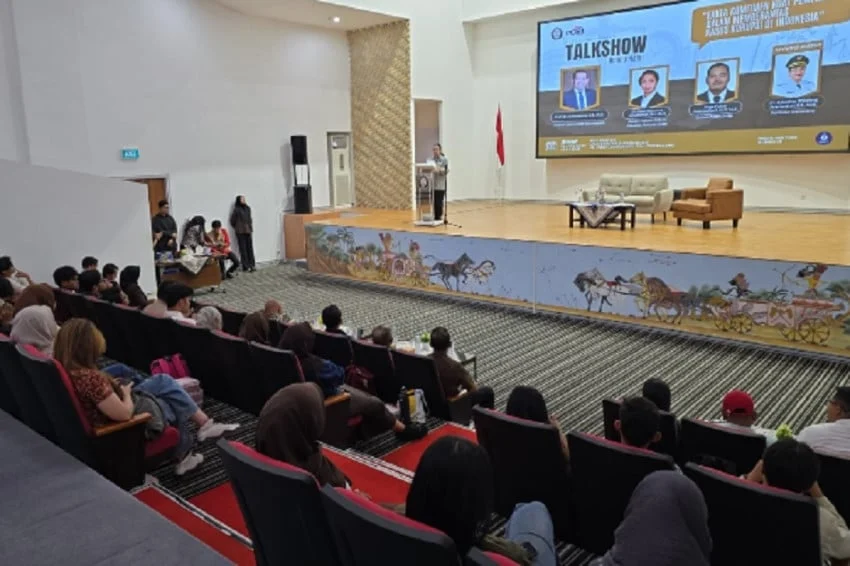
Semarang Mayor Agustina Wilujeng Pramestuti has unequivocally stated that corruption acts as a significant impediment to human resource development and critically diminishes the quality of public services. Addressing a pivotal forum, the Mayor emphasized that confronting this pervasive issue necessitates a robust, collective commitment to fostering clean, transparent, and accountable governance across all levels. This firm stance was articulated during the "Ruang Nalar" talk show, aptly titled "The Facts of the Government’s Strong Commitment to Eradicating Corruption Cases in Indonesia," held at the Aula Gedung Art Center of Universitas Diponegoro (Undip) in Semarang on Friday, July 24, 2026. The event brought together policymakers, academics, and civil society representatives to deliberate on strategies and challenges in the ongoing fight against corruption, highlighting the critical nexus between good governance and societal progress.
The Mayor’s address resonated with the growing national concern over the insidious effects of corruption, which not only siphons public funds but also erodes public trust and distorts equitable resource allocation. Pramestuti elaborated on how such malpractices directly undermine investments in education, healthcare, and infrastructure, all of which are foundational to nurturing a skilled and healthy populace. When public services are compromised by corrupt practices, citizens face undue delays, exorbitant costs, and a general decline in the efficiency and accessibility of essential government functions. This, in turn, disproportionately affects vulnerable communities, exacerbating social inequalities and hindering overall national development goals, including those outlined in Indonesia’s long-term vision for sustainable growth and improved Human Development Index (HDI).
The Core Message: Corruption’s Dual Threat to Progress
Mayor Agustina Wilujeng Pramestuti’s remarks at the Undip event served as a stark reminder of the dual threat corruption poses to Indonesia’s aspirations. Firstly, it directly cripples human resource development (SDM). Resources earmarked for education, vocational training, and public health initiatives are often diverted or misused, leading to subpar facilities, unqualified personnel, and ultimately, a less competitive workforce. This systemic erosion prevents individuals from reaching their full potential, thereby stunting national productivity and innovation. According to the United Nations Development Programme (UNDP), countries with higher perceived levels of corruption often exhibit lower HDI scores, indicating a direct correlation between governance quality and human well-being. Indonesia, while making strides in its HDI, still faces significant challenges in equitable access to quality education and healthcare, areas particularly susceptible to corrupt practices.
Secondly, corruption significantly degrades the quality of public services. From obtaining essential permits and licenses to accessing healthcare or social welfare programs, citizens frequently encounter bureaucratic hurdles, illicit fees, and preferential treatment for those willing to pay bribes. This not only burdens individuals and businesses but also breeds cynicism and mistrust in government institutions. The integrity of infrastructure projects, public procurement processes, and regulatory enforcement all suffer, leading to substandard roads, unreliable utilities, and an unfair business environment. Such inefficiencies repel foreign investment, stifle local entrepreneurship, and ultimately hinder economic growth, creating a vicious cycle that perpetuates underdevelopment and dissatisfaction among the populace.
A United Front: The "Ruang Nalar" Platform for Dialogue
The "Ruang Nalar" talk show provided an essential platform for this critical discourse. Organized by Universitas Diponegoro, a leading academic institution known for its commitment to public service and intellectual discourse, the event aimed to foster a multi-stakeholder dialogue on the pressing issue of corruption. The choice of title, "The Facts of the Government’s Strong Commitment to Eradicating Corruption Cases in Indonesia," signaled an intention to move beyond mere rhetoric and delve into tangible actions and challenges. The talk show convened experts from various fields, including law, public administration, and economics, alongside government officials and representatives from civil society organizations. Such forums are crucial for bridging the gap between policy formulation and practical implementation, allowing for direct feedback and collaborative problem-solving.
Held at the state-of-the-art Aula Gedung Art Center, the venue itself symbolized a commitment to fostering intellectual and creative solutions to societal problems. The July 24, 2026, date placed the event within a broader national context of ongoing anti-corruption campaigns and policy reviews. Discussions likely covered not only the direct impacts of corruption but also preventative strategies, the role of technology, and the importance of public participation. These platforms are vital for shaping public opinion, encouraging civic engagement, and galvanizing collective action towards a cleaner and more accountable public sector, aligning with Indonesia’s broader agenda for good governance and national integrity.
Semarang’s Proactive Stance Against Graft
In her address, Mayor Pramestuti outlined the concrete steps being taken by the Semarang City Government to fortify its defenses against corruption. "The Semarang City Government continues to strengthen corruption prevention through supervision, joint mentorship with the Corruption Eradication Commission (KPK) and the Inspectorate, and the digitalization of public services to narrow the scope for deviations," she stated. This multi-pronged approach underscores a strategic commitment to systemic change rather than merely reactive measures.
The emphasis on enhanced supervision involves internal audits and monitoring mechanisms designed to identify and address potential vulnerabilities within city departments. By collaborating closely with the KPK, Indonesia’s premier anti-graft agency, and the Inspectorate, the local government benefits from expert guidance, best practices, and capacity building programs. This partnership is crucial for developing robust internal controls, conducting thorough investigations, and ensuring that accountability frameworks are effectively implemented. The KPK often provides training to local government officials on risk assessment, ethics, and compliance, helping to embed a culture of integrity from the top down.
Furthermore, the digitalization of public services represents a transformative strategy. By moving various administrative processes online – such as permit applications, tax payments, and public information dissemination – the city aims to reduce face-to-face interactions, which are often fertile grounds for illicit demands and transactions. Digital platforms enhance transparency by creating an auditable trail for every transaction, minimize human discretion, and streamline processes, making services more accessible and efficient for citizens. Examples include e-permitting systems, online complaint mechanisms, and digital procurement platforms. These technological interventions not only curb corruption opportunities but also significantly improve the overall efficiency and responsiveness of the city administration, fostering greater trust between the government and its constituents.
The Academic Perspective: Pillars of Anti-Corruption
Adding an invaluable academic dimension to the discussion, Gaza Carumna Iskadrenda, an academic from the Faculty of Law at Undip, elaborated on the foundational pillars supporting effective anti-corruption efforts. According to Iskadrenda, the fight against corruption rests on three critical foundations: strong legal and regulatory frameworks, effective and independent law enforcement institutions, and a robust culture of integrity within society. These pillars are interdependent, with weaknesses in one potentially undermining the strength of the others.
Strong regulations are essential to clearly define corrupt acts, prescribe appropriate penalties, and establish clear guidelines for ethical conduct in public office. This includes laws on bribery, embezzlement, conflict of interest, and asset declaration. However, laws alone are insufficient without robust institutions to enforce them. Iskadrenda emphasized the need for law enforcement agencies—the Police, the Prosecutor’s Office, and particularly the KPK—to operate with consistency, impartiality, and without fear or favor. Their effectiveness hinges on their independence from political interference, sufficient resources, and specialized expertise in investigating complex financial crimes.
Moreover, Iskadrenda stressed the importance of a societal culture that unequivocally rejects corruption. This involves public awareness campaigns, ethics education, and the promotion of moral values that prioritize honesty and integrity. A strong culture of integrity empowers citizens to demand accountability and actively participate in anti-corruption efforts. "Consistency and synergy among the Police, Prosecutor’s Office, KPK, and society are vital factors in enforcing the law fairly and without discrimination," Iskadrenda stated, highlighting the necessity of a unified approach. He also underscored a critical, often overlooked aspect: "Protection for members of the public who report alleged corruption also needs to be continually strengthened." Whistleblower protection is paramount to encouraging reporting and ensuring that those who expose wrongdoing are not subjected to retaliation, thereby enhancing the overall efficacy of detection and prosecution.
The Broader Context: Indonesia’s Anti-Corruption Landscape
Indonesia has made significant strides in its anti-corruption journey since the fall of the New Order regime, marked by the establishment of the KPK in 2002. The KPK has since become a formidable force, prosecuting numerous high-profile cases involving government officials, politicians, and business figures. However, the battle remains ongoing and complex. Transparency International’s Corruption Perception Index (CPI) consistently places Indonesia in the lower-middle ranks globally, indicating persistent challenges despite dedicated efforts. While Indonesia’s CPI score has shown some fluctuations, it underscores the need for continuous and intensified reform. The nation’s legal framework, including Law No. 31 of 1999 on the Eradication of Corruption Crimes, provides the backbone for these efforts, but consistent implementation and adaptation to new forms of corruption are crucial.
The fight against corruption is not confined to the national level; it extends deeply into local governance, where direct interaction with citizens makes the impact of graft immediately felt. Regional autonomy, while empowering local administrations, also presents unique challenges for oversight and accountability. Therefore, the collaboration between central agencies like the KPK and local governments, as exemplified by Semarang, is indispensable. This partnership allows for the tailoring of anti-corruption strategies to specific local contexts, while also ensuring adherence to national standards and leveraging the expertise of specialized bodies.
The Economic and Social Costs of Corruption
The economic ramifications of corruption in Indonesia are profound. Estimates by various institutions, including the National Development Planning Agency (Bappenas) and the KPK, suggest that corruption costs the Indonesian economy billions of dollars annually, diverting funds that could otherwise be invested in critical sectors. This illicit outflow of capital reduces government revenue, discourages both domestic and foreign direct investment, and distorts market competition, creating an uneven playing field for honest businesses. The misallocation of resources through corrupt procurement processes leads to inflated project costs and substandard public infrastructure, ultimately burdening taxpayers and undermining long-term economic growth potential.
Beyond the purely economic, the social costs are equally devastating. Corruption exacerbates poverty and inequality by channeling resources away from social programs and public services that benefit the poor. It erodes trust in democratic institutions, fostering cynicism and disengagement among citizens. When justice can be bought, and accountability is elusive, the rule of law is weakened, leading to a breakdown in social cohesion. The impact on human development is evident in compromised education and healthcare systems, which directly affect the quality of life and opportunities available to the population. A society plagued by corruption struggles to achieve equitable development and social justice, threatening its long-term stability and progress.
Digitalization as a Game Changer in Public Services
The Semarang City Government’s commitment to the digitalization of public services is a forward-thinking approach that aligns with global best practices in anti-corruption. Technology offers a powerful antidote to traditional forms of corruption by minimizing human interface, enhancing transparency, and creating auditable trails. E-government initiatives, such as online permit applications, digital payment systems, and integrated service platforms, significantly reduce opportunities for bribery and extortion. By automating processes, discretion is removed, making it harder for officials to demand illegal fees or provide preferential treatment.
Indonesia, as a whole, has been embracing digital transformation in government. The national ‘Satu Data Indonesia’ (One Data Indonesia) policy aims to consolidate government data, making it more accessible and transparent, which in turn can aid in identifying irregularities and combating corruption. Similarly, the implementation of e-procurement systems across various government levels has increased the fairness and transparency of public tenders, reducing collusion and price inflation. These digital tools not only serve as a deterrent to corrupt acts but also enhance efficiency, reduce bureaucratic red tape, and improve the overall user experience for citizens seeking government services. The success of digitalization, however, hinges on robust cybersecurity measures, continuous training for both officials and the public, and a strong political will to embrace technological solutions fully.
The Crucial Role of Whistleblower Protection
Gaza Carumna Iskadrenda’s emphasis on strengthening whistleblower protection is a critical insight often highlighted by international anti-corruption bodies. Whistleblowers, individuals who report wrongdoing from within an organization, are often the first line of defense against corruption. Their disclosures can provide invaluable evidence that might otherwise remain hidden, enabling authorities to investigate and prosecute corrupt officials. However, whistleblowers frequently face significant risks, including retaliation, job loss, social ostracization, and even threats to their personal safety.
In Indonesia, while legal frameworks such as Law No. 13 of 2006 on Witness and Victim Protection exist, their practical implementation and effectiveness in fully safeguarding whistleblowers remain an ongoing challenge. Strengthening protection entails not only legal provisions for anonymity and immunity from prosecution for good-faith reporting but also practical support mechanisms. These can include secure reporting channels, psychological support, and legal aid. A robust whistleblower protection system signals a genuine commitment to transparency and accountability, encouraging more individuals to come forward and thus significantly enhancing the capacity of anti-corruption agencies like the KPK to detect and combat corruption effectively. Without adequate protection, fear can silence crucial voices, allowing corrupt practices to persist unchecked.
Multi-Stakeholder Collaboration: A Path Forward
The discussion at Undip reinforced the notion that the fight against corruption cannot be won by the government alone. It requires a concerted, multi-stakeholder effort involving not just government agencies but also academia, civil society organizations, the media, and the private sector. Academia plays a vital role in research, policy analysis, and educating future generations on ethics and integrity, as demonstrated by Undip’s hosting of the "Ruang Nalar" event. Civil society organizations act as watchdogs, advocating for reforms, monitoring government actions, and providing channels for public grievances. Independent media is crucial for investigating and exposing corruption, keeping the public informed, and holding power accountable.
The private sector also has a significant role to play, not just in adhering to anti-bribery laws but in promoting ethical business practices, implementing internal compliance programs, and refusing to participate in corrupt schemes. Collective action initiatives, where businesses collaborate to uphold ethical standards, can create a more level and transparent playing field. This holistic approach ensures that anti-corruption efforts are comprehensive, inclusive, and sustainable, embedding a culture of integrity throughout society.
Future Outlook and Sustained Commitment
The insights shared by Mayor Agustina Wilujeng Pramestuti and academic Gaza Carumna Iskadrenda at the "Ruang Nalar" talk show paint a clear picture: the fight against corruption in Indonesia, and specifically in Semarang, is a continuous journey requiring unwavering commitment and adaptable strategies. While significant progress has been made, the evolving nature of corruption demands constant vigilance, innovation, and strengthened collaboration. The year 2026 serves as a marker for these ongoing efforts, underscoring that the challenge persists and future-oriented solutions are necessary.
Sustaining the momentum requires not only the continued implementation of robust legal and institutional frameworks but also a deep-seated cultural transformation. Educating the youth, promoting ethical leadership, and empowering citizens to demand accountability are long-term investments that will yield lasting dividends. As Semarang leverages digitalization and strengthens its partnerships with national anti-graft bodies, it sets an example for other local governments in Indonesia. The ultimate goal remains a nation where human development flourishes, public services are exemplary, and the specter of corruption is banished, paving the way for a more just, prosperous, and equitable society for all Indonesians.