
Jakarta Governor Pramono Anung has issued a stern directive to law enforcement agencies to take decisive action against the driver of a Toyota Alphard who was caught on camera violating traffic regulations and acting aggressively toward a security officer at the Bundaran Hotel Indonesia (HI) intersection. The incident, which quickly went viral across various social media platforms, has sparked widespread public indignation, highlighting ongoing issues regarding traffic discipline and the perceived arrogance of luxury vehicle owners in the capital city. Governor Pramono emphasized that no individual, regardless of their social or economic status, is above the law, particularly when their actions endanger others and undermine public order.
The Governor’s statement, delivered at the Jakarta City Hall on Friday, July 24, 2026, underscored the gravity of the situation. According to the Governor, the driver not only disregarded a red light at a high-traffic pedestrian crossing but also allegedly utilized falsified vehicle identification plates to evade regulations. This dual violation—traffic disobedience and document forgery—has prompted the provincial government to call for a comprehensive investigation and the application of the maximum legal penalties available under Indonesian law.
Detailed Chronology of the Bundaran HI Incident
The confrontation occurred during a busy period at the Bundaran HI area, one of Jakarta’s most iconic and heavily monitored landmarks. The intersection is equipped with a "pelican crossing" system designed to prioritize pedestrian safety in an area known for heavy foot traffic and proximity to major shopping malls and public transportation hubs.
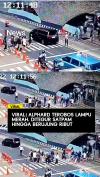
According to eyewitness accounts and video footage that circulated online, the traffic signal for vehicles had turned red to allow a group of pedestrians to cross. While other vehicles halted, the black Toyota Alphard attempted to force its way through the crossing. A security guard (satpam) stationed in the area to assist with traffic flow and pedestrian safety stepped forward to intercept the vehicle, signaling for the driver to stop.
Rather than complying with the officer’s instructions, the driver reportedly accelerated slightly before coming to a halt and then engaged in a heated verbal altercation with the security guard. The driver’s behavior was described by onlookers as "arrogant," as he appeared to challenge the authority of the guard despite being clearly in the wrong. The tension escalated as the driver exited the vehicle, leading to a standoff that disrupted the flow of both pedestrians and following traffic. The incident was captured by several bystanders, whose videos provided the basis for the subsequent police investigation and the Governor’s public response.
The Controversy of Falsified License Plates
A critical development in the case emerged when initial checks into the vehicle’s registration suggested discrepancies. Governor Pramono Anung confirmed that his administration received reports indicating the license plates displayed on the Alphard did not match the vehicle’s official registration data in the national database.

"It is evident from the footage that the Alphard was the party in violation," Governor Pramono stated during his press briefing. "Furthermore, we have received reports that the vehicle was utilizing falsified plates. This is a serious offense that goes beyond a simple traffic ticket. It suggests a premeditated attempt to circumvent the law."
In Jakarta, the use of fake license plates is often linked to attempts to bypass the "Odd-Even" (Ganjil-Genap) traffic rationing system or to avoid detection by Electronic Traffic Law Enforcement (ETLE) cameras. The use of falsified government or "special" plates (formerly known as RF plates) has been a point of contention for years, leading to multiple crackdowns by the Metro Jaya Regional Police. If proven, the driver could face criminal charges under Article 263 of the Indonesian Penal Code (KUHP) regarding document forgery, which carries a maximum sentence of six years in prison, in addition to violations of the Law on Traffic and Road Transportation (UU LLAJ).
Official Responses and Law Enforcement Mediation
Following the viral incident, the parties involved were brought to the Thamrin Traffic Police Post (Pospol) for mediation and initial questioning. While social media rumors suggested that a physical altercation had taken place, police officials clarified the situation to prevent further misinformation.
The police stated that while the verbal exchange was intense, there was no physical battery or assault during the confrontation. "We have conducted a mediation session between the security guard and the driver. At this stage, we can confirm that no physical violence occurred at the scene," a spokesperson for the Central Jakarta Metro Police noted. However, the police emphasized that the mediation regarding the personal dispute does not absolve the driver of the legal consequences related to the traffic violations and the alleged use of illegal license plates.
Governor Pramono Anung reiterated that "peaceful mediation" should not be a shortcut to avoiding justice for systemic violations. "If this cannot be resolved properly through the legal process, it sends the wrong message—that those who feel powerful can act as they please even when they are wrong. That must not happen. They must be sanctioned," the Governor added.
Broader Implications for Jakarta’s Traffic Culture
This incident at Bundaran HI is not an isolated case but rather a symptom of a larger cultural challenge within Jakarta’s transportation ecosystem. Despite the implementation of sophisticated ETLE systems and increased fines, "traffic arrogance"—particularly involving luxury vehicles or those with perceived "special" status—remains a frequent grievance among the city’s residents.
Data from the Metro Jaya Regional Police suggests that while general traffic violations have seen a slight decline due to automation, the complexity of violations, such as plate forgery and the use of illegal strobes or sirens on private vehicles, has risen. In 2025 alone, Jakarta recorded over 1.2 million traffic violations captured via ETLE, with a significant percentage involving attempts to obscure or fake vehicle identities.
The Governor’s firm stance is seen by analysts as an effort to restore public confidence in the fairness of the law. For a "Global City" like Jakarta, maintaining order at its most prominent landmarks is essential for its international image and the safety of its citizens. The Bundaran HI area, as a hub for the MRT, TransJakarta, and major international hotels, serves as a litmus test for the city’s ability to enforce its own regulations.
Legal Framework and Potential Penalties
Under Law Number 22 of 2009 concerning Traffic and Road Transportation (UU LLAJ), the driver faces several potential charges:
- Violation of Traffic Signals (Article 287, Paragraph 1): Any person driving a motorized vehicle who violates the rules of traffic commands or signals can be punished with a maximum of two months in prison or a maximum fine of IDR 500,000.
- Improper License Plates (Article 280): Driving a vehicle that is not equipped with a valid Vehicle Number Certificate (TNKB) or using plates that are not issued by the National Police is punishable by up to two months in prison or a fine of IDR 500,000.
- Endangering Pedestrians (Article 284): Drivers who do not prioritize the safety of pedestrians or cyclists are subject to a maximum of two months in prison or a fine of IDR 500,000.
Beyond these administrative fines, the Governor’s mention of "falsified plates" brings the case into the realm of the Indonesian Penal Code (KUHP). Article 263 and Article 266 of the KUHP deal with the falsification of authentic deeds and the use of forged documents, which are treated as felonies rather than simple misdemeanors.
Public Sentiment and the Role of Social Media
The role of "citizen journalism" in this incident cannot be understated. In the digital age, the "court of public opinion" often moves faster than official investigations. The viral nature of the video forced a rapid response from both the Governor and the police. While this ensures accountability, it also puts pressure on authorities to ensure that the investigation is transparent and not influenced by the socio-economic standing of the offender.
Urban planning experts suggest that the "arrogance" displayed in such incidents often stems from a sense of entitlement associated with luxury vehicle ownership. "There is a psychological barrier where some drivers feel that the rules of the road are suggestions rather than mandates, especially when they are in a high-end vehicle," says Dr. Ridwan Hakim, a sociologist specializing in urban behavior. "The Governor’s intervention is crucial because it addresses the ‘mental revolution’ needed in our traffic culture."
Future Preventative Measures
In response to this incident, the Jakarta Provincial Government and the Jakarta Transportation Agency (Dishub) are considering several measures to enhance security at major pedestrian crossings:
- Increased Presence of Joint Task Forces: Deploying more teams consisting of Dishub officers and Police at "pelican crossings" to support private security guards who may lack the legal authority to issue citations.
- Enhanced ETLE Integration: Upgrading cameras at Bundaran HI to include facial recognition and advanced plate-reading technology that can cross-reference vehicle types with registered plate numbers in real-time.
- Public Education Campaigns: Launching a city-wide campaign titled "Equal Before the Law on the Road" to remind drivers that luxury does not grant immunity.
Governor Pramono Anung’s demand for "strict sanctions" serves as a warning to all motorists in Jakarta. As the city continues to modernize its infrastructure, the enforcement of the law must keep pace with physical developments. The resolution of the Alphard case at Bundaran HI will likely be watched closely by the public as a barometer for the city administration’s commitment to justice and public safety in the nation’s capital.