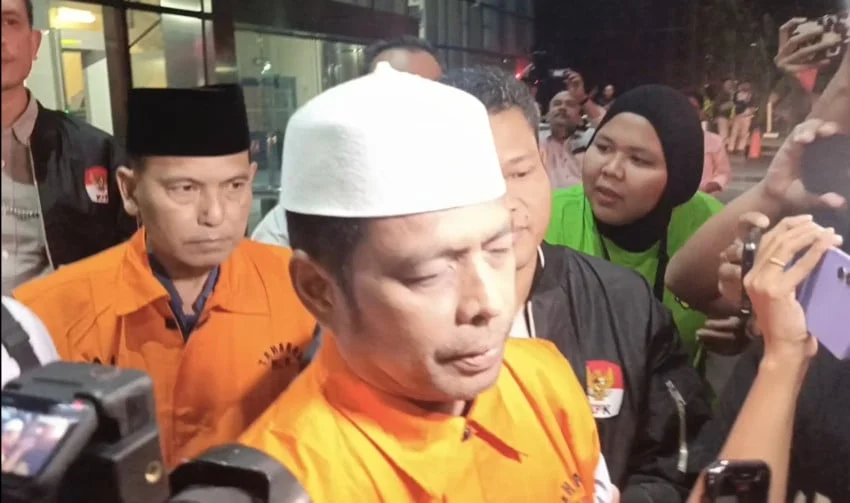
The Corruption Eradication Commission (KPK) has officially moved to detain three prominent individuals from the private sector in connection with an expansive investigation into the alleged bribery of grant fund management for Community Groups (Pokmas) within the East Java Provincial Budget (APBD) for the 2021-2022 fiscal years. This enforcement action marks a significant escalation in a case that has already sent shockwaves through the regional legislative landscape, highlighting the persistent vulnerabilities in the distribution of public welfare funds. The three suspects—identified as Achmad Yahya (AY), M. Fathullah (MF), and Ra. Wahid Ruslan (RWR)—are accused of orchestrating a bribery scheme totaling Rp6.9 billion aimed at securing lucrative grant allocations for their respective regions.
According to official statements from the anti-graft agency, the funds were allegedly funneled to a high-ranking official identified by the initials AS, who served as a member of the East Java Provincial Legislative Council (DPRD) during the period in question and has since ascended to a position within the Indonesian House of Representatives (DPR RI). The detention of these three suspects follows a series of rigorous investigations and evidence-gathering phases that suggest a systemic effort to "buy" access to public funds intended for grassroots community development.
The Suspects and the Alleged Bribery Mechanism
The three suspects represent specific geographic interests within East Java, illustrating how regional grant funds were allegedly carved up through illicit agreements. Achmad Yahya and M. Fathullah are private sector actors operating out of Pasuruan Regency, while Ra. Wahid Ruslan is a private sector figure from Bangkalan Regency. Their involvement underscores a common "middleman" or "broker" role in Indonesian corruption cases, where private individuals act as conduits between legislative decision-makers and the eventual recipients of government contracts or grants.
During a press conference held at the KPK headquarters in Jakarta, the Acting Director of Investigations, Achmad Taufik Husein, detailed the nature of the transaction. He explained that the suspects allegedly paid the Rp6.9 billion to AS to ensure that their specific regions would receive a predetermined portion of the grant funds allocated to the legislator. This practice, often referred to in Indonesian legal circles as the "ijon" system—a term borrowed from agriculture meaning to sell a crop before it is harvested—involved paying kickbacks in advance to secure future budget commitments.
"Following the allocation of the grant fund quota to AS, the suspects AY, RWR, and MF performed ‘conditioning’ maneuvers to ensure that a significant portion of those funds was directed to their designated areas," Husein stated. This "conditioning" typically involves administrative manipulation, the creation of fictitious community groups, or the inflation of project costs to facilitate the return of the bribe money to the donors and the enrichment of the involved parties.
Background: The Evolution of the East Java Grant Fund Scandal
To understand the gravity of the current detentions, one must look back at the broader context of the East Java grant fund scandal. This case is an extension of a massive investigation that began with a dramatic sting operation (Operasi Tangkap Tangan or OTT) in December 2022. That initial operation led to the arrest and subsequent conviction of Sahat Tua Simandjuntak, the former Deputy Speaker of the East Java DPRD. Sahat was found guilty of accepting billions of rupiah in exchange for facilitating the distribution of grant funds to various community groups.
The "Pokmas" (Kelompok Masyarakat) grants were originally designed as a mechanism for legislators to fulfill their "aspiration" duties—allowing them to direct funds toward small-scale infrastructure, social programs, or economic development at the village level. However, the KPK’s investigations have revealed that these funds frequently became a "cash cow" for corrupt officials. In the 2021 and 2022 budgets, the East Java provincial government allocated trillions of rupiah toward these grants. The sheer volume of transactions and the decentralized nature of the recipients made the system ripe for exploitation.
In mid-2024, the KPK expanded its investigation into what is now referred to as the "development case" of the grant fund bribery. The agency named 21 new suspects, including four members of the East Java DPRD and 17 private sector or community group representatives. The detention of AY, MF, and RWR is a direct result of this expanded probe, as the KPK seeks to hold accountable those who participated in the supply side of the bribery equation.
Investigative Timeline and Legal Process
The timeline of this case reflects the KPK’s "follow the money" strategy, which has slowly unraveled the network of legislative and private interests involved in the East Java budget.
- December 2022: The KPK conducts an OTT in Surabaya, arresting Sahat Tua Simandjuntak and several associates.
- 2023: Sahat is tried and sentenced to 12 years in prison. During the trial, evidence emerges regarding the involvement of other legislators and dozens of private sector brokers.
- Early 2024: The KPK begins a new round of summons and interrogations, focusing on the 2021-2022 budget cycles. Investigators conduct searches at various locations, including the East Java DPRD office and private residences.
- July 2024: The KPK officially announces the status of 21 suspects in the "development case."
- Wednesday, July 22, 2026 (Projected Date per source): The KPK moves to detain AY, MF, and RWR following a intensive questioning session. The suspects are seen wearing the iconic orange KPK detention vests as they are escorted to the agency’s holding facility.
The suspects are currently being held under a 20-day initial detention period for the purpose of further investigation. This period is often extended as prosecutors finalize the indictment files (P-21). They are expected to be charged under the Law on the Eradication of Corruption Crimes (UU Tipikor), specifically articles pertaining to the bribery of state officials, which carry significant prison sentences and heavy fines.
Data Analysis: The Scale of Grant Fund Mismanagement
The East Java provincial budget (APBD) is one of the largest in Indonesia, often exceeding Rp30 trillion annually. Within this budget, the allocation for "Grant Funds" (Belanja Hibah) has historically been a point of contention. Data from budget watchdogs suggests that between 2020 and 2023, the East Java DPRD managed billions in "aspirational funds" (Dana Aspirasi) that were funneled through the grant system.
In the specific case of the Rp6.9 billion bribe involving AY, MF, and RWR, the amount represents only the "fee" paid to the legislator. Under typical corruption patterns in this sector, the bribe or "kickback" usually ranges from 10% to 30% of the total project value. This suggests that the actual amount of public funds being manipulated or diverted in this specific sub-case could range from Rp20 billion to over Rp60 billion.
Furthermore, the KPK has previously noted that many of the "Pokmas" groups receiving these funds are "fictitious" or "paper-only" organizations. These groups are often registered shortly before the budget cycle and dissolved or abandoned once the funds are disbursed and the kickbacks are paid. The lack of rigorous auditing at the provincial level allowed this cycle to continue for several budget years.
Implications for Governance and Legislative Integrity
The detention of these suspects and the involvement of a current member of the DPR RI (AS) raises serious questions about the integrity of Indonesia’s legislative recruitment and oversight. The transition of "AS" from a regional lawmaker to a national one while allegedly carrying the baggage of a multi-billion rupiah corruption case highlights a potential failure in the vetting processes of political parties.
Political analysts suggest that the "East Java Grant Scandal" serves as a microcosm of a larger national issue where regional budgets are treated as political assets rather than public resources. The "conditioning" of funds mentioned by the KPK implies that the distribution of wealth was based on the ability to pay bribes rather than the actual needs of the community groups in Pasuruan or Bangkalan.
"This case demonstrates that the ‘cost of politics’ in Indonesia remains dangerously high, driving legislators to seek illicit income through the manipulation of the very budgets they are supposed to oversee," said a legal analyst familiar with KPK proceedings. "When private sector actors like AY, MF, and RWR become the gatekeepers for community funds, the social contract is fundamentally broken."
Official Responses and Public Sentiment
The KPK has reiterated its commitment to pursuing all parties involved in the East Java grant fund network, regardless of their current political status. A spokesperson for the commission emphasized that the investigation is ongoing and that more detentions may follow as the evidence points toward other collaborators.
While the suspects and their legal representatives have yet to issue a comprehensive public defense, the usual legal trajectory involves challenging the KPK’s evidence or seeking "Justice Collaborator" status to mitigate sentencing. For the public, particularly in East Java, the news has been met with a mixture of fatigue and demand for systemic reform. Civil society organizations in Surabaya and Malang have called for a total overhaul of the "Pokmas" grant mechanism, suggesting that funds should be managed by professional bureaucratic agencies rather than being at the discretionary disposal of individual legislators.
Conclusion: The Path Forward
The detention of Achmad Yahya, M. Fathullah, and Ra. Wahid Ruslan is a crucial step in cleaning up the remnants of the 2021-2022 East Java budget corruption. However, legal experts argue that arrests alone will not solve the problem. As long as the "aspirational fund" system remains opaque and the oversight mechanisms within the DPRD are weak, the temptation for bribery will persist.
As the KPK continues to build its case against the 21 suspects and the legislator AS, the eyes of the nation remain on the judicial process. This case serves as a stern warning to both the private sector and public officials that the era of treating regional grant funds as personal or political capital is under intense scrutiny. For the people of East Java, the hope remains that the billions of rupiah recovered or protected from these schemes will eventually find their way to the genuine community groups they were intended to serve, fostering real development rather than lining the pockets of corrupt brokers and politicians.