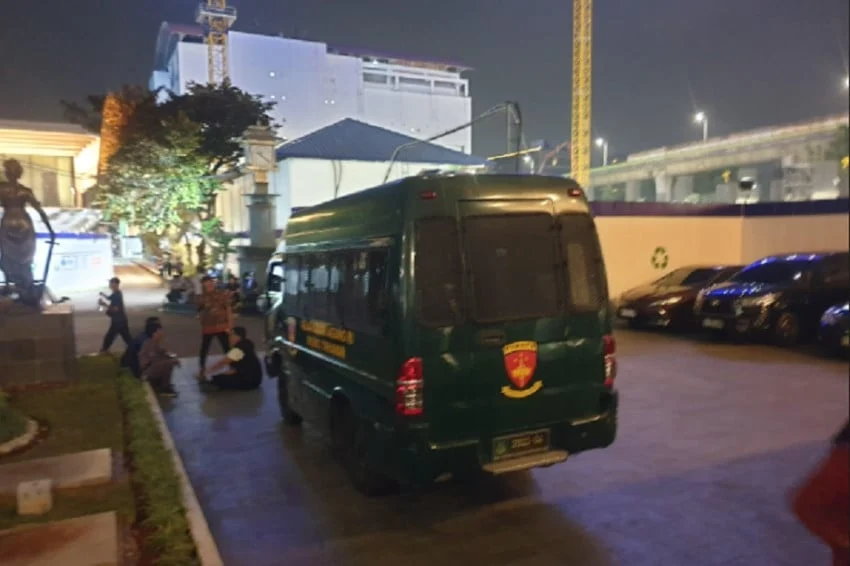
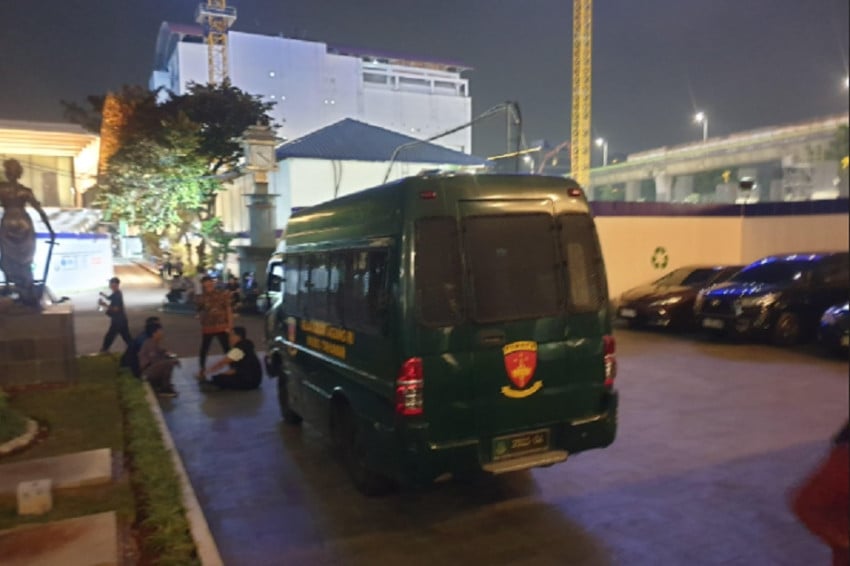
The atmosphere at the Attorney General’s Office (AGO) headquarters in South Jakarta grew increasingly tense on Friday night, July 24, 2026, as investigators continued their intensive questioning of the former Junior Attorney General for Extraordinary Crimes (Jampidsus), Febrie Adriansyah. The high-profile examination, which began earlier in the day, stretched late into the evening without any official sign of concluding. Speculation regarding the potential outcome of the session intensified among the press corps and legal observers following the arrival and positioning of two prisoner transport vehicles within the AGO compound.
According to direct observations at the scene, the two vehicles were strategically placed at separate access points of the main building. One transport van was seen idling in front of the upper lobby of the main building, while a second vehicle was stationed near the lower lobby entrance. In the protocol of Indonesian law enforcement, particularly within the AGO’s "Gedung Bundar" (Round Building) operations, the presence of such vehicles during the late-stage questioning of a high-ranking official often precedes a formal detention order. However, as of midnight, the AGO’s Legal Information Center (Puspenkum) had not issued a formal statement regarding the legal status of the former Jampidsus.
The Stealthy Arrival and the Persistence of the Investigation
The arrival of Febrie Adriansyah at the AGO earlier on Friday was notably discreet. Unlike typical high-profile summons where subjects are seen entering through the main gates, Adriansyah managed to enter the premises without being captured by the phalanx of cameras stationed at the primary entry points. This "stealthy" entry sparked initial confusion among the media until sources within the building confirmed that the former top prosecutor was indeed inside and undergoing a marathon interrogation session.
The duration of the questioning—now exceeding several hours—suggests a complex inquiry. Investigators from the Junior Attorney General for Oversight (Jamwas) or potentially the Special Crimes division itself are believed to be probing matters related to Adriansyah’s previous tenure. Despite the presence of the media, the AGO has maintained a strict "no comment" policy throughout the evening, with security personnel maintaining a perimeter around the investigation wing.
Background: The Career and Influence of Febrie Adriansyah
To understand the gravity of this development, one must look at the significant role Febrie Adriansyah played during his time as the Junior Attorney General for Extraordinary Crimes. As the head of the Jampidsus division, Adriansyah was the tip of the spear in Indonesia’s fight against high-level corruption. He was responsible for overseeing some of the largest financial scandal investigations in the nation’s history, including the multi-trillion rupiah corruption cases involving state insurer Jiwasraya, the social security fund ASABRI, and the massive illegal tin mining case that shook the commodities sector.
During his leadership, the Jampidsus division was lauded for its aggressive pursuit of state loss recovery. Adriansyah was often seen as a formidable figure who did not shy away from targeting "untouchable" corporate tycoons and high-ranking officials. However, his tenure was also marked by significant friction. In early 2024, reports surfaced of alleged surveillance of Adriansyah by members of other law enforcement agencies, a move that highlighted the intense pressure and inter-agency rivalries often present in Indonesia’s anti-corruption landscape.
His transition from being the lead investigator of the nation’s most sensitive cases to being the subject of an investigation himself represents a dramatic shift in the judicial narrative. The current inquiry is reportedly focused on ensuring accountability within the prosecution service, though specific charges or allegations have not yet been publicly disclosed by the Attorney General, ST Burhanuddin.
Chronology of the Day’s Events
The events of July 24, 2026, unfolded in a series of calculated movements that kept the public and the press on edge:
- 09:00 AM: Rumors began circulating within the AGO that a high-profile figure was scheduled for a "clarification" session. Security at the gates was visibly tightened.
- 10:30 AM: Media outlets confirmed that the summons was issued for Febrie Adriansyah. Reporters gathered at all major exits and entrances of the AGO headquarters.
- 02:00 PM: Sources inside the Gedung Bundar confirmed that the examination had commenced. Adriansyah had reportedly entered the building through a restricted access point, bypassing the main press area.
- 07:00 PM: As evening fell, the questioning showed no signs of stopping. Food deliveries and legal counsel were seen entering the investigation wing.
- 09:30 PM: The two prisoner transport vehicles were spotted moving into their standby positions at the upper and lower lobbies. This move immediately shifted the tone of the reporting from a routine examination to a potential detention watch.
- 11:00 PM – Midnight: Lights remained on in the interrogation rooms. Reporters continued to wait for a spokesperson, but the AGO remained silent.
Legal Context and the Implications of Potential Detention
The presence of prisoner transport vehicles is a significant procedural indicator in the Indonesian legal system. Under the Criminal Procedure Code (KUHAP), investigators have the authority to detain a suspect if there is sufficient evidence and a concern that the individual might flee, destroy evidence, or repeat the offense.
In cases involving the AGO, detention usually occurs at the Class I Salemba Detention Center’s AGO branch. If Adriansyah is indeed detained, it would send a powerful message regarding the "Clean Sweep" policy currently being promoted by the government. It demonstrates that the principle of "equality before the law" applies even to those who once wielded the power of the state to prosecute others.
Legal analysts suggest that the AGO is likely being extremely cautious. Given Adriansyah’s deep knowledge of the institution’s internal workings and his previous role in handling sensitive evidence, any procedural misstep could be exploited in a pre-trial motion (Praperadilan). Therefore, the marathon nature of the questioning is likely an attempt to ensure that every statement is verified against existing digital and documentary evidence.
Supporting Data: The AGO’s Performance and Public Trust
The Attorney General’s Office has recently enjoyed high public approval ratings, often surpassing other law enforcement agencies in surveys regarding the eradication of corruption. Data from late 2025 and early 2026 indicated that the AGO’s success in handling "Mega-Corruption" cases—those involving losses exceeding 1 trillion IDR—had significantly bolstered public confidence.
However, this trust is contingent on the institution’s ability to police its own ranks. The investigation into a former Jampidsus is a double-edged sword. On one hand, it could be perceived as internal instability or corruption within the upper echelons of the prosecution service. On the other hand, a transparent and rigorous investigation could reinforce the AGO’s image as a truly independent and professional body capable of self-correction.
According to data from the Indonesian Corruption Watch (ICW), the involvement of high-ranking law enforcement officials in legal cases requires a higher degree of transparency to prevent public skepticism. The ICW has previously called for the AGO to provide regular updates on internal investigations to ensure they are not merely "political theater" or the result of internal power struggles.
Official Responses and Institutional Silence
As of the latest update, the current Junior Attorney General for Extraordinary Crimes and the Head of the Legal Information Center have remained unreachable for direct quotes. This silence is typical during the sensitive "examination" phase of a high-profile case. In previous instances, the AGO has preferred to hold a formal press conference only after a definitive legal status—such as "Suspect" (Tersangka)—has been determined and the subject is ready to be escorted to the detention vehicle.
Waiters and staff at the AGO headquarters noted that the atmosphere inside is "business as usual" but with a palpable sense of gravity. "The protocols are being followed strictly," a source whispered on the condition of anonymity. "The Attorney General has given the investigators full independence to follow the evidence wherever it leads."
Broader Impact on the Judicial System
The outcome of this investigation will undoubtedly have far-reaching implications for the Indonesian judicial system. If a figure as prominent as Febrie Adriansyah is processed legally, it will mark a turning point in the accountability of the "law enforcers" themselves.
For the Jampidsus division, which is currently handling several ongoing high-priority cases, the investigation into their former chief could serve as a distraction or a catalyst for reform. There are concerns that defendants in cases previously handled by Adriansyah might attempt to use his current legal troubles to cast doubt on the integrity of their own prosecutions.
Furthermore, this event highlights the ongoing evolution of the AGO. Since the enactment of the new Prosecution Law, the AGO has gained broader powers, including the ability to conduct more comprehensive wiretapping and asset recovery operations. With these increased powers comes increased scrutiny. The current proceedings are a litmus test for whether the AGO can handle such power responsibly and apply it inward when necessary.
Conclusion: A Night of Uncertainty
As the clock ticks past midnight in Jakarta, the fate of Febrie Adriansyah remains uncertain. The two prisoner vans, with their engines occasionally idling to keep the air conditioning running, stand as silent sentinels of the potential change in his status. Whether he will emerge as a free man or be escorted into one of those vehicles is a question that has kept the nation’s attention fixed on the Attorney General’s Office.
What is clear is that the "Gedung Bundar" is currently the site of one of the most significant legal dramas of 2026. The pursuit of justice, often described as a long and winding road, has tonight led back to the very halls where that pursuit was once directed by the man now under the microscope. The public awaits a formal announcement, which is expected to be delivered in the early hours of Saturday morning or during a scheduled press briefing later in the day. Until then, the presence of the transport vehicles remains the most potent symbol of the high stakes involved in this investigation.