JAKARTA – As the Indonesian political landscape prepares for the critical 2029 general election cycle, the People’s Conscience Party (Partai Hati Nurani Rakyat, or Hanura) has announced a significant rebranding initiative. During its 20th-anniversary celebration scheduled for January 2027, the party will officially unveil a new logo featuring a lion, marking a departure from its traditional visual identity. This strategic shift is intended to symbolize a reinvigorated commitment to strength, agility, resilience, and the militant spirit required to navigate the complex electoral challenges of the coming years.
The unveiling ceremony is set to take place on January 8, 2027, at the Hotel Sahid in Jakarta. This event will coincide with the party’s National Working Meeting (Rakernas), serving as a cornerstone for Hanura’s roadmap toward the 2029 polls. The lead-up to this milestone will involve a series of intensive organizational activities, starting with a Technical Guidance (Bimtek) session for all Hanura members serving in regional legislative bodies (DPRD) across Indonesia, scheduled for January 6–7, 2027.
Strategic Rebranding and Organizational Readiness
The decision to adopt the lion as a symbol is widely viewed by political analysts as an effort to cultivate a more assertive and formidable image. For two decades, Hanura has positioned itself as a party of the "people’s conscience." By introducing the imagery of a lion, the party leadership aims to project a more aggressive stance in policy advocacy and political competition.
Patrice Rio Capella, Deputy Chairman of the Hanura Central Executive Board (DPP), who has been appointed as the event’s organizing committee chairman, confirmed that the preparations are in the final stages. He emphasized that the anniversary event is not merely a ceremonial affair but a massive mobilization effort aimed at synchronizing the party’s agenda from the national level down to the regency and municipal levels.
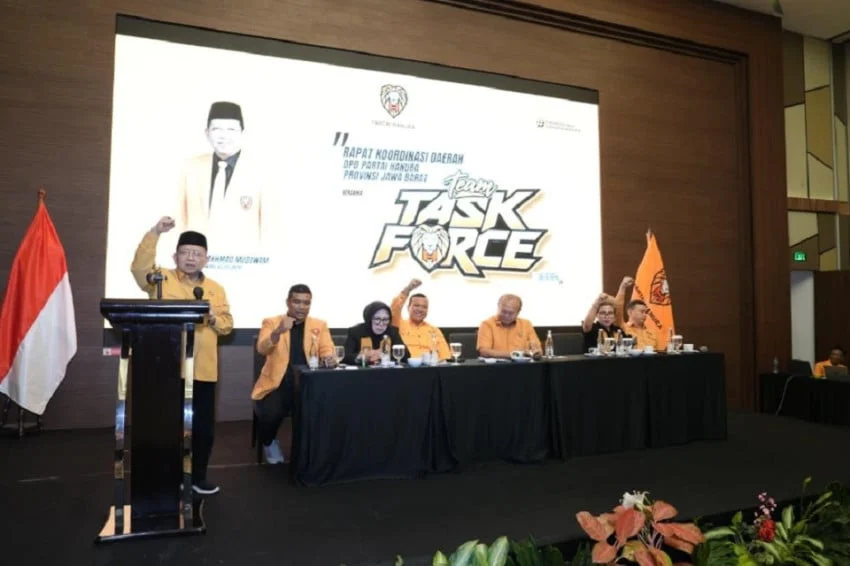
"We are currently in the midst of intensive coordination to ensure that the 20th-anniversary celebration acts as a springboard for our 2029 campaign," Rio stated during the Technical Meeting and Task Force Consolidation session for the West Java region, held at the Holiday Inn in Bandung on Saturday, November 28, 2026. "The event will bring together all facets of the party. We are inviting representatives from all 514 regency and city-level branches (DPC) and all 38 provincial-level branches (DPD) to ensure total institutional alignment."
A Timeline of Mobilization
The road to the 2027 anniversary reflects a calculated effort to solidify the party’s grassroots structure before the formal start of the 2029 election season. The chronology of these events highlights a bottom-up approach to political consolidation:
- November 2026: Regional technical meetings and task force consolidations (e.g., the West Java session) are held to ensure that regional leaders are aligned with the central command’s vision for the rebranding.
- January 6–7, 2027: Technical Guidance (Bimtek) for all DPRD members, focusing on legislative performance and communication strategies for the upcoming election cycle.
- January 8, 2027: The peak event, featuring the official launch of the lion-themed logo, the National Working Meeting, and the celebration of the party’s two-decade existence.
The inclusivity of the event is underscored by the planned guest list. Hanura has extended invitations to the leadership of other major political parties, foreign ambassadors, and key government ministers. Furthermore, the party has expressed its hope for the presence of the President and Vice President of the Republic of Indonesia, signaling the party’s intent to remain a relevant stakeholder in the national executive discourse.
Contextualizing Hanura’s Political Trajectory
Hanura, founded in 2006 by former military commander Wiranto, has experienced a varied history in Indonesian politics. Over the past twenty years, the party has navigated the fluctuating dynamics of parliamentary thresholds and coalition politics. The introduction of a new logo in 2027 serves as a visual marker of a "new era" for the party, which has been working to re-establish its relevance after the 2024 elections.
Political observers note that parties often undergo rebranding when they feel a need to distinguish themselves from a crowded political field. With a younger generation of voters expected to dominate the 2029 electorate, a shift toward more modern, iconic, and symbolic branding is a standard tactic to boost brand recognition and psychological appeal.
Legislative Focus and Policy Stance
Beyond the branding exercise, Hanura has been actively working on substantive policy issues to prove its legislative utility. The party has recently championed the cause of regional autonomy, with leadership—including Chairman Oesman Sapta Odang (OSO)—advocating for the passage of legislation such as the Regional Bonds Bill (UU Obligasi Daerah). This push is intended to provide local governments with more financial flexibility to accelerate regional development.
By linking its rebranding to a platform of regional empowerment, Hanura is attempting to frame itself as a party that does not just "roar" symbolically but acts as a functional bridge between regional needs and national legislative power. The upcoming Bimtek for DPRD members is specifically designed to train party officials to better articulate these policy goals to their constituents.
Analytical Implications: Strength and Sustainability
The shift to a lion emblem carries significant weight in the context of Indonesian political semiotics. Historically, Indonesian parties have favored symbols rooted in nature, such as the banyan tree or the star, or abstract shapes. The choice of a predatory, apex animal like a lion suggests a move toward "militant branding."
However, branding alone does not guarantee electoral success. Analysts suggest that the efficacy of this move will depend on whether the party can demonstrate internal unity and a clear value proposition for the 2029 voter. The "Task Force" structure mentioned by Rio Capella indicates that the party is aware of the need for improved coordination, as internal fractures have previously hindered its performance in national elections.
Moreover, the invitation of high-level government officials to the anniversary event serves a dual purpose: demonstrating the party’s current political clout and facilitating networking opportunities that could prove vital for future coalition building. If the party can successfully transition from its old identity to this new, more aggressive persona, it may be able to capture a larger share of the swing vote in the next cycle.
Challenges Ahead
Despite the optimism within the party’s ranks, Hanura faces substantial challenges. The electoral threshold in Indonesia remains a significant hurdle for smaller parties. As the political landscape becomes increasingly dominated by large coalition blocks, the ability of a party like Hanura to maintain its independent identity while still securing parliamentary seats is a delicate balancing act.
The 2027 anniversary serves as a critical stress test for the party. If the launch of the new logo fails to generate the intended momentum, the party may struggle to maintain its status as a relevant legislative player. Conversely, if the rebranding is accompanied by strong, populist policy initiatives and a successful regional mobilization, the "lion" may indeed signal a resurgence for the party.
Conclusion
The January 2027 anniversary is set to be a defining moment for Partai Hanura. By consolidating its internal structure through regional task forces, providing technical training for its representatives, and unveiling a new symbolic identity, the party is making a deliberate attempt to shed the weight of its past and move toward a more assertive future.
As the Indonesian public looks toward the 2029 elections, all eyes will be on how this rebranding effort translates into actual policy advocacy and electoral strength. Whether the lion logo becomes a symbol of a renewed force in Indonesian democracy or remains a peripheral rebranding exercise will be determined by the party’s performance in the years following this landmark anniversary. For now, the focus remains on the logistics of January 8, as Hanura prepares to showcase its new face to the nation in the heart of Jakarta.