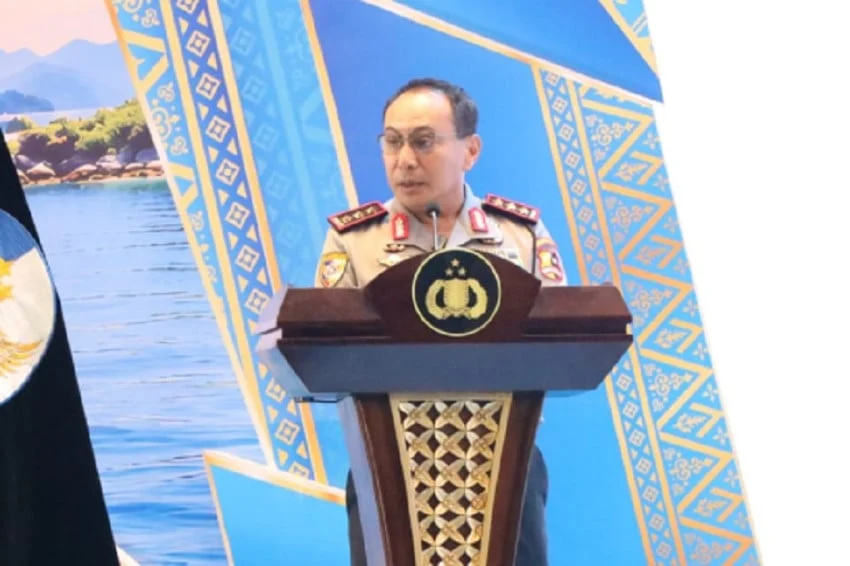
The Security Maintenance Agency of the Indonesian National Police (Baharkam Polri) is charting a profound institutional evolution, aiming to redefine its core operational identity by the year 2027. Speaking against the backdrop of strategic national developments, the Head of Baharkam Polri, Police Commissioner General Herry Heryawan, officially announced a comprehensive strategic pivot during the opening of the 2026 Baharkam Working Meeting (Rakernis) held in Batam, Riau Islands. This visionary initiative seeks to establish Baharkam Polri not merely as a traditional law enforcement apparatus, but definitively as the social face of the police, prioritizing community welfare, proactive engagement, and human-centric policing models.
The strategic mandate articulated by Commissioner General Herry Heryawan is deeply aligned with the overarching vision of the National Police Chief (Kapolri), which champions a collaborative ecosystem encapsulated by the philosophy of Polisi Bersama Masyarakat (Police Together with the Community). Furthermore, this transformation is explicitly designed to synchronize institutional performance with the national development agenda championed by the administration of the President of the Republic of Indonesia, specifically referencing the visionary framework of Asta Cita. By bridging the gap between security maintenance and social welfare, Baharkam Polri aims to position itself at the forefront of resolving multifaceted societal challenges ranging from economic vulnerabilities to educational disparities and environmental degradation.
Chronology and Strategic Context of the 2026 Rakernis in Batam
The formal unveiling of the 2027 transformation roadmap took place on Thursday, November 26, 2026, during the annual flagship gathering of Baharkam structural leaders in Batam, a strategically vital industrial and maritime hub in the Riau Islands province. The selection of Batam as the host city for the 2026 Rakernis carries symbolic and operational weight, reflecting the region’s dynamic demographic growth, economic significance, and unique security landscape characterized by cross-border dynamics and rapid urbanization.
The timing of this announcement coincides with a period of significant structural and personnel consolidation within the agency. Just weeks prior to the working meeting, the national police headquarters enacted a high-profile structural transition involving the reassignment of five Brigadier Generals to key positions within Baharkam Polri during the November 2026 tour of duty. This strategic injection of senior leadership—including former Deputy Regional Police Chiefs (Wakapolda)—was meticulously designed to fortify Baharkam’s command structure, enhance regional operational efficiency, and provide the intellectual capital required to spearhead the ambitious 2027 transformation agenda.
During the inaugural session, Commissioner General Herry Heryawan emphasized to the assembled high-ranking officers, regional directors, and operational commanders that the traditional paradigm of reactive law enforcement is no longer sufficient to address the complexities of modern Indonesian society.
"Baharkam in the coming year, insya Allah, will become the social face of police," declared Herry during his keynote address, setting an uncompromising standard for institutional accountability and grassroots community integration.
Operationalizing the Vision: Core Programs Driving the Social Face of Police
The transition toward becoming the social face of police is not merely a rhetorical aspiration; it is anchored in a suite of targeted, highly practical operational programs that directly intersect with the daily struggles of ordinary citizens. Baharkam Polri has systematically rolled out several cornerstone initiatives designed to tackle structural socio-economic vulnerabilities through localized police-community partnerships.
Among the flagship programs driving this paradigm shift are:
- POLIRAN (Polisi Peduli Pengangguran): A specialized police initiative focused on addressing unemployment by fostering localized vocational training, connecting job seekers with micro-economies, and creating collaborative community employment pathways.
- POLIDIK (Polisi Peduli Pendidikan): An educational outreach program aimed at mitigating educational inequalities, particularly in remote or marginalized regions, by facilitating learning resources, supporting school infrastructure, and deploying personnel as mentors and educators.
- Green Policing and Blue Policing: Dual environmental stewardship frameworks. Green Policing emphasizes ecological preservation, disaster mitigation, and sustainable land management, while Blue Policing focuses on marine conservation, protecting coastal communities, and safeguarding Indonesia’s vast maritime resources from illegal exploitation.
- Ngariung Kamtibmas: A culturally grounded, participatory forum derived from Sundanese tradition, adapted nationally to encourage communal dialogue, conflict resolution, and collaborative public safety maintenance at the neighborhood level.
These localized strategies represent a fundamental decentralization of security paradigms, moving away from top-down enforcement toward collaborative problem-solving. By embedding officers within the socio-economic fabric of local communities, Baharkam seeks to build deep-seated institutional trust, which remains the cornerstone of modern democratic policing.
Analytical Implications: Redefining Public Trust and Institutional Relevance
The push by Commissioner General Herry Heryawan to transform Baharkam Polri into the social face of police carries profound analytical implications for the future of civil-security relations in Indonesia. Security analysts and governance experts note that modern policing globally is undergoing a critical evolution, transitioning away from the historical legacy of paramilitary dominance toward community-oriented service models.
For Indonesia, an archipelago of immense cultural, geographic, and economic diversity, the challenge of maintaining public order has always been intrinsically linked to economic stability and social equity. When security forces actively engage in poverty alleviation (via POLIRAN), educational support (via POLIDIK), and environmental defense (via Green and Blue Policing), the traditional adversarial dynamic between law enforcement and the civilian population is fundamentally disrupted.
- Enhanced Early Detection of Conflict: By utilizing grassroots forums like Ngariung Kamtibmas, police units can identify social friction points, localized grievances, and potential conflicts long before they escalate into civil unrest or criminal activity.
- Bridging the Legitimacy Gap: Institutional trust is the currency of effective law enforcement. When citizens witness police officers acting as facilitators of education and economic opportunity, public perception shifts from viewing the police as an instrument of state control to recognizing them as essential partners in community development.
- Synergy with National Development Goals: By explicitly tying Baharkam’s operational metrics to the broader national framework of Asta Cita, the leadership ensures that internal security policy remains synchronized with the macroeconomic and social welfare targets set by the central government.
Institutional Challenges and the Road Ahead to 2027
Despite the visionary nature of the 2027 transformation roadmap, observers and internal planners acknowledge that significant operational hurdles lie ahead. Scaling localized successes—such as pilot projects in specific regions—into a uniform national standard requires robust logistical support, continuous personnel training, and a cultural shift within the ranks.
The traditional police academy curriculum has historically emphasized tactical response, criminal investigation, and statutory enforcement. Reorienting the mindset of thousands of active-duty personnel toward social work, mediation, community organizing, and environmental advocacy demands a sustained institutional commitment to human resource development. Furthermore, inter-agency coordination between Baharkam Polri, regional governments, ministries of social welfare, and educational institutions must be institutionalized through formal Memorandums of Understanding (MoUs) to ensure long-term sustainability beyond individual leadership tenures.
As Baharkam Polri steadily marches toward its 2027 benchmark, the leadership under Commissioner General Herry Heryawan remains steadfast in its conviction that the true measure of police effectiveness lies not just in crime statistics, but in the qualitative well-being and security of the communities they serve. The Rakernis in Batam has thus laid down the operational blueprints; the ensuing months will test the agency’s capacity to translate ambitious social policy into enduring institutional reality across the Indonesian archipelago.