agri Urges Regional Legislatures to Prioritize Job Creation, Education, and Healthcare in Policy-Making
The Ministry of Home Affairs (Kemendagri) has issued a firm directive to regional legislatures across Indonesia, calling upon the leadership and members of provincial and regency/city Regional House of Representatives (DPRD) to place employment generation, educational advancement, and healthcare accessibility at the absolute forefront of their legislative agendas and policy-making frameworks. This critical directive was conveyed during a high-level national coordination meeting aimed at evaluating the implementation of specialized duties assigned to regional legislators.
The call to action reflects a growing imperative within the central government to ensure that localized governance directly addresses the fundamental socio-economic challenges faced by constituents on a daily basis. By realigning legislative focus toward tangible community needs, the Ministry aims to bridge the gap between bureaucratic policymaking and the lived realities of citizens residing in various regions throughout the archipelago.
National Coordination Meeting and Legislative Capacity Building
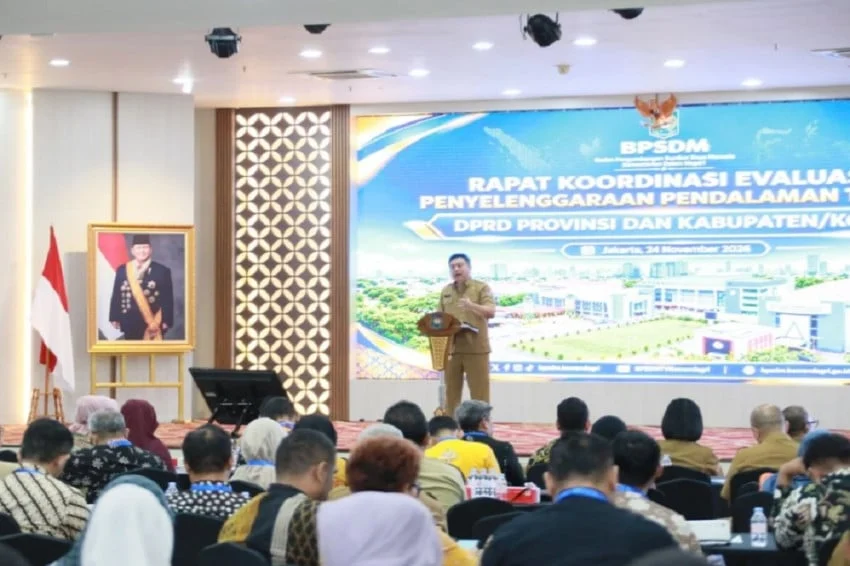
The directive was formally articulated during the Coordination Meeting for the Evaluation of the Implementation of Deepening Duties for Provincial and Regency/City DPRD Members, held at the Auditorium of the Human Resources Development Agency (BPSDM) of the Ministry of Home Affairs in Kalibata, South Jakarta. The event drew hundreds of key stakeholders, regional legislators, and administrative officials, serving as a vital platform to review and recalibrate the operational capacities of local legislative bodies.
This strategic gathering functioned as a formal implementation and review mechanism tied to Regulation of the Minister of Home Affairs (Permendagri) Number 6 of 2024, which outlines the comprehensive guidelines for conducting specialized task training and deepening duties for DPRD members. Through this forum, the central government sought to ensure that the ongoing capacity-building programs for local lawmakers do not remain abstract or purely theoretical, but instead evolve to become highly relevant, context-specific, and responsive to the distinct challenges emerging within individual regions.
Administrative Compliance Versus Real-World Impact
During the proceedings, Ministry of Home Affairs Secretary-General Tomsi Tohir emphasized that the curriculum and core focus of the deepening duties programs for DPRD members must transcend standard administrative comprehension. While procedural and regulatory literacy remains a fundamental baseline for governance, Tomsi argued that legislative competence must ultimately be measured by its ability to deliver practical, life-improving outcomes for the public.
Highlighting the paramount importance of economic security, Tomsi underscored job creation as the single most critical priority for regional policymakers. In his remarks, he pointed out the cascading benefits of employment on overall societal welfare, noting that economic participation serves as the foundational pillar for household stability, poverty alleviation, and community resilience.
"Number one is employment. Once a person has a job, they can secure a home," Tomsi stated firmly, illustrating the direct correlation between workforce participation and access to basic human necessities such as adequate housing, nutrition, and financial independence.
Broadening the Scope: Affordability, Health, and Education
Beyond employment generation, the Ministry’s directive outlines a holistic framework encompassing several other non-negotiable pillars of public welfare. Tomsi specifically drew attention to the ongoing challenges surrounding the affordability and stability of staple food prices—a pressing concern for lower- and middle-income households navigating inflationary pressures.
Furthermore, the directive mandates that regional legislatures exercise their budgetary, supervisory, and legislative authorities to actively expand and improve public access to quality healthcare services and educational institutions. By embedding these critical issues directly into the institutional training modules and regular deliberations of local councils, the Ministry expects regional policies to demonstrate a clear, measurable bias toward the public interest.
Background and Context of Regional Legislative Responsibilities
The timing of this directive aligns with a broader national evaluation of decentralized governance in Indonesia. Since the inception of regional autonomy, provincial and regency/city DPRDs have held expansive powers regarding local budgeting (APBD), regional regulation (Perda) formation, and the oversight of local executive branches (governors, regents, and mayors). However, recurrent challenges involving suboptimal budget allocations, low absorption rates for public welfare programs, and policy disconnects have prompted the central government to intervene through enhanced supervision and structured capacity-building initiatives.
Permendagri No. 6 of 2024 was specifically designed to rectify these structural inefficiencies by standardizing how regional legislators undergo continuous professional development. By focusing these training modules on pressing socioeconomic metrics—such as local unemployment rates, regional health facility ratios, and educational attainment levels—the Ministry aims to transform regional legislative bodies into proactive engines of human development.
Socio-Economic Data and the Urgency of Regional Intervention
To contextualize the Ministry’s emphasis on employment, healthcare, and education, recent statistical indicators underscore the complex socio-economic landscape confronting Indonesia’s regions. While national macroeconomic figures have demonstrated steady post-pandemic recovery, localized disparities persist regarding job formalization, regional underemployment, and the quality of basic public services.
Regional legislatures hold the constitutional mandate to scrutinize local government work plans (RKPD) and deliberate the annual regional budget (APBD). Consequently, their decisions directly influence infrastructure spending, social assistance distribution, and local economic stimulus packages. When regional parliaments prioritize capital-intensive projects over labor-intensive initiatives or social safety nets, communities often experience prolonged economic vulnerability. By redirecting legislative focus toward job creation, local councils can stimulate micro, small, and medium enterprises (MSMEs), attract sustainable local investments, and foster vocational training programs tailored to regional industrial needs.
Similarly, healthcare access in secondary and tertiary regions frequently encounters logistical and infrastructural bottlenecks. Regional legislatures possess the budgetary authority to ensure that district hospitals and community health centers (Puskesmas) are adequately funded, properly staffed, and equipped to serve vulnerable populations. The Ministry’s directive serves as a reminder that budgetary oversight must actively target these operational deficiencies rather than remaining confined to administrative compliance.
Implications for Regional Governance and Budgetary Allocations
The direct consequence of the Ministry of Home Affairs’ directive is a mandatory recalibration of how regional governments prepare their fiscal policies and legislative agendas. Moving forward, the effectiveness of a regional legislative body will increasingly be evaluated based on its alignment with national human development priorities.
-
Budgetary Realignment: Regional councils are expected to scrutinize executive budget proposals to ensure that expenditures on goods, services, and capital projects deliver high multiplier effects for employment and local enterprise growth. Allocations for education and health infrastructure must reflect realistic assessments of community demand rather than historical budgeting patterns.
-
Enhanced Oversight of Public Services: Beyond budget authorization, DPRD members must intensify their supervisory functions. This includes monitoring the distribution of subsidized goods, evaluating the quality of instruction in regional schools, and ensuring that healthcare facilities comply with universal service standards without imposing prohibitive financial burdens on low-income residents.
-
Responsiveness to Inflationary Pressures: With cost-of-living fluctuations remaining a persistent concern, local legislatures are urged to coordinate closely with regional inflation control teams (TPID) to implement market stabilization operations, support agricultural supply chains, and protect purchasing power at the grassroots level.
Stakeholder Reactions and Institutional Adaptation
The guidance provided by the Secretary-General of Kemendagri has elicited constructive dialogue among local government practitioners and legislative observers. Many governance experts note that while the responsibilities outlined by the Ministry fall well within the legal mandate of regional councils, bridging the gap between legislative rhetoric and actual policy implementation requires continuous institutional reform.
Regional legislative secretariats are now tasked with updating their internal working procedures, committee structures, and expert staffing to better support lawmakers in drafting evidence-based policies. Committees dealing with finance, economy, social welfare, and education are expected to collaborate more closely, breaking down traditional administrative silos to address multifaceted community challenges through integrated legislative solutions.
Conclusion and Future Outlook
The comprehensive directive issued by the Ministry of Home Affairs marks a significant step toward refining regional legislative performance in Indonesia. By insisting that employment, education, and healthcare occupy the epicenter of regional policymaking, the central government is reinforcing the fundamental purpose of decentralized governance: the tangible improvement of human welfare.
As regional legislatures integrate these priorities into their ongoing training frameworks and legislative calendars, the ultimate test will lie in the execution of the regional budget and the measurable reduction of socio-economic vulnerabilities across the provinces, regencies, and cities. Through sustained oversight, targeted budgeting, and an unwavering commitment to community needs, regional parliaments possess the potential to drive equitable and enduring development throughout the nation.