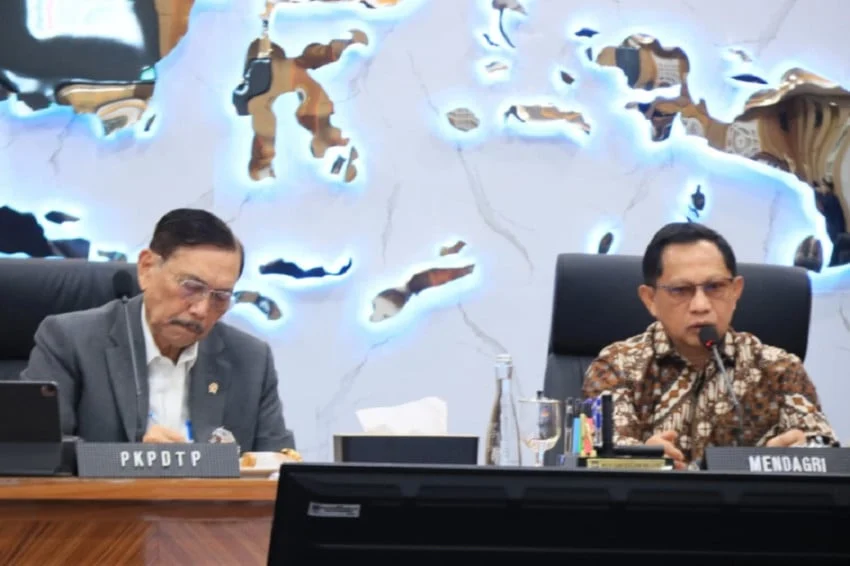
JAKARTA — Minister of Home Affairs Muhammad Tito Karnavian has officially called upon regional heads across Indonesia, including governors, regents, and mayors, to significantly accelerate the implementation and registration of the Digital Social Protection (Perlinsos Digital) system. The directive emphasizes that integrating population identities anchored by the National Identification Number (NIK) alongside advanced biometric verification mechanisms serves as the indispensable foundation for ensuring that state-funded social assistance programs reach the precise intended beneficiaries without leakage or misallocation.
The urgent instruction was formally conveyed during a high-level national coordination meeting focused on expediting the registration of Digital Perlinsos. The hybrid gathering brought together local government leaders from all corners of the archipelago, broadcasting directly from the Ministry of Home Affairs headquarters in Jakarta. Minister Tito underscored that migrating traditional social safety net administration into a streamlined digital framework represents a crucial stepping stone toward realizing President Prabowo Subianto’s grand vision of a fully integrated digital government ecosystem, commonly known as Government Technology or GovTech.
Strategic Alignment with National Digital Transformation
The push for digital social protection does not exist in a vacuum; it aligns directly with the broader administrative policies of the current administration. President Prabowo Subianto has consistently reiterated the necessity of eradicating data silos across various government ministries and agencies. By prioritizing data integration and digital transformation, the central government aims to dismantle bureaucratic red tape, eliminate redundant administrative processes, and consolidate diverse public services into a unified, highly efficient operational network.
During the coordination session, Minister Tito elaborated on how this overarching digital architecture will ultimately reshape public administration in Indonesia. At the heart of this transformation lies the Directorate General of Population and Civil Registration (Ditjen Dukcapil) under the Ministry of Home Affairs. Dukcapil is tasked with supplying a comprehensive, reliable, and up-to-date population identity database seamlessly integrated with verifiable biometric parameters.
In this ecosystem, the NIK functions as the universal single identifier, ensuring that every citizen possesses a distinct, unalterable digital footprint when interacting with state apparatuses. Meanwhile, biometric verification—such as facial recognition and fingerprint scanning—acts as a foolproof security measure, guaranteeing that the individual accessing a service or claiming a benefit is precisely the person registered in the database, thereby preventing identity fraud and duplicate claims.
A Unified Single Sign-On Ecosystem for Public Services
Expanding beyond the immediate scope of social welfare, Minister Tito outlined the long-term vision of interconnecting Indonesia’s vast array of public services through a synchronized technological pipeline. This ambitious integration strategy is designed to connect disparate sector-specific databases into a single, cohesive user experience for every citizen.
"Parallel to that, a system will be established that connects all public services—whether originating from the Ministry of Health, the education sector, motor vehicle administration services, or the Ministry of Agrarian Affairs and Spatial Planning/National Land Agency (ATR/BPN). Thus, a citizen will only need a single sign-on, utilizing a single unique identification number held by each individual citizen," Tito stated.
This single sign-on (SSO) approach is anticipated to revolutionize how Indonesians interact with the state. Instead of navigating separate bureaucratic channels, submitting physical documents repeatedly, and dealing with conflicting regional databases, citizens will navigate a centralized portal. For the government, this harmonization drastically reduces operational costs, minimizes administrative overhead, and provides policymakers with real-time analytical data regarding public needs, demographic shifts, and resource distribution.
Implications for Social Assistance Precision and Accountability
The historical execution of social assistance programs—commonly referred to in Indonesia as perlindungan sosial—has frequently encountered structural hurdles. Among the most persistent challenges reported by auditing bodies and local authorities are inclusion errors (where ineligible individuals receive assistance) and exclusion errors (where vulnerable families fall through the cracks due to outdated or fragmented data).
The integration of Digital Perlinsos directly addresses these systemic vulnerabilities. Within this enhanced framework, the government possesses the technical capacity to cross-reference population identities against multiple data repositories simultaneously. This includes evaluating socioeconomic indicators, employment status, utility consumption patterns, and real estate or asset ownership records.
By synthesizing these variables, state institutions can generate a highly accurate, dynamic assessment of a household’s eligibility for various forms of state intervention, whether distributed as cash transfers, non-cash food assistance, or subsidized utilities. Minister Tito emphasized, however, that while biometric verification and Dukcapil data matching provide the foundational identity checks, they operate in tandem with established statutory criteria and local verification mechanisms to preserve fairness and transparency in beneficiary selection.
Chronology and Background of the Digital Perlinsos Initiative
The genesis of Indonesia’s modern digital identity framework can be traced back to the rollout of the electronic ID card (e-KTP) program over a decade ago. However, the transition from static digital records to dynamic, interconnected government databases has accelerated dramatically in recent years. The COVID-19 pandemic exposed profound vulnerabilities in social assistance distribution, prompting the central government to prioritize data synchronization through the Integrated Social Welfare Data (DTKS) managed by the Ministry of Social Affairs, alongside Dukcapil’s population registry.
By late 2024 and moving into 2026, the mandate shifted from mere data collection to active digital integration under the GovTech umbrella, branded nationally under systems like InaDigital. The coordination meeting led by Minister Tito represents the operational enforcement phase of this policy, compelling regional governments—who serve as the frontline administrators of social welfare data at the village, sub-district, and municipal levels—to actively clean, verify, and upload local records into the centralized digital infrastructure.
Local Government Responsibilities and Implementation Challenges
The successful realization of Perlinsos Digital heavily relies on the proactive participation of local government units. Governors, regents, and mayors hold administrative command over local civil registration offices (Disdukcapil) and village administration officials who interact directly with communities.
During the hybrid briefing, regional leaders were instructed to audit their existing local databases, resolve discrepancies in citizen records, and expedite the collection of missing biometric data. Many remote and rural regions in Indonesia, however, continue to face infrastructure bottlenecks, including unstable internet connectivity, limited hardware availability, and a shortage of trained technical personnel capable of managing advanced biometric enrollment tools.
In response to these localized challenges, the Ministry of Home Affairs has pledged technical assistance and phased infrastructure deployment to support underdeveloped, frontier, and outermost (3T) regions. Central authorities have stressed that local executive leadership is crucial; regions that demonstrate administrative inertia risk delaying not only local social welfare disbursements but also the broader national timeline for GovTech integration.
Socioeconomic and Fiscal Implications
From an economic perspective, the acceleration of Digital Perlinsos carries profound fiscal implications for the state budget (APBN). Indonesia allocates significant portions of its annual expenditure to social protection programs designed to cushion low-income families against inflationary pressures, global economic volatility, and structural poverty.
When social assistance is distributed inefficiently, billions of rupiah are lost to misallocated funds, ghost beneficiaries, and administrative friction. By leveraging a biometric-backed NIK single sign-on system, the state anticipates notable fiscal savings. These optimized funds can be redirected toward expanding coverage for genuinely vulnerable populations, investing in human capital development, or enhancing public infrastructure.
Furthermore, economists and policy analysts note that a transparent and digitized social protection registry enhances public trust in state institutions. When citizens witness that government support is distributed fairly based on verifiable data rather than discretionary local patronage, civic engagement improves, and compliance with national tax and administrative policies generally increases.
Broader Impacts on National Security and Administrative Efficiency
Beyond social welfare, the centralization of population data through Dukcapil and its integration with biometric verification reinforces national security architecture. Law enforcement agencies, immigration services, and financial intelligence units gain a more robust mechanism to track illegal activities, prevent identity theft, and regulate financial transactions.
The integration of vehicle registration, land ownership (ATR/BPN), health services, and education databases under a single NIK-based profile creates a comprehensive digital ledger of civic life. While privacy advocates continually emphasize the necessity of stringent cybersecurity protocols and data protection legislation—such as the Personal Data Protection (PDP) Law—the government maintains that robust encryption and secure cloud infrastructure are being prioritized to safeguard citizen data against malicious breaches.
Future Outlook and Next Steps
As the Ministry of Home Affairs monitors the compliance of regional administrations following the nationwide coordination meeting, the coming months will serve as a critical testing ground for local bureaucratic readiness. Regional governments are expected to submit progress reports detailing their registration milestones, biometric capture rates, and technical hurdles.
Minister Tito Karnavian concluded the briefing by reiterating that digital transformation is no longer an optional modernization effort but a mandatory operational standard for modern governance in Indonesia. With the active cooperation of regional leaders, the central government remains optimistic that the Perlinsos Digital framework will achieve full operational capacity, transforming how the state protects, serves, and interacts with its citizens in the digital era.