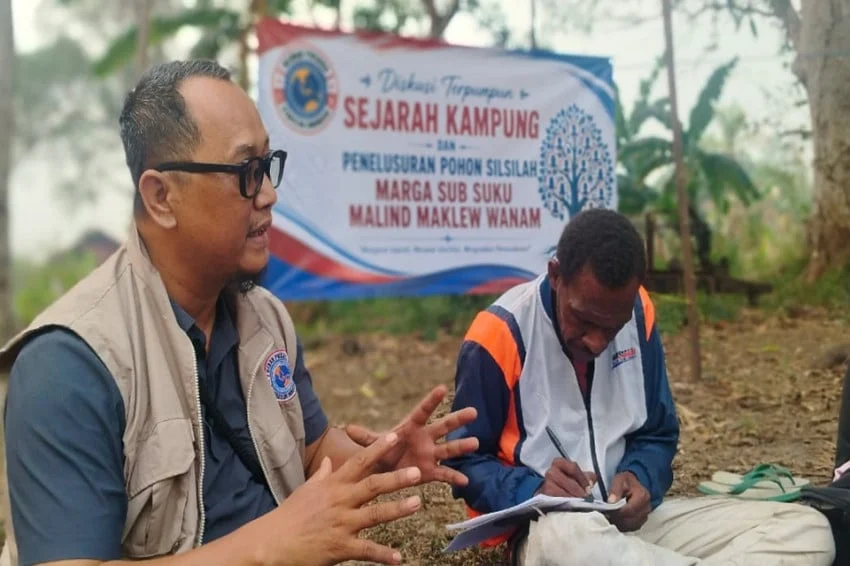
Merah Pusaka Stratejik Indonesia (MPSI), in close collaboration with the Village Government and the indigenous communities of Wanam, has officially initiated a comprehensive cultural preservation project aimed at reconstructing the history and clan genealogies of the Malind Maklew sub-ethnic group. The milestone effort kicked off through an intensive Focus Group Discussion (FGD) held in Wanam Village, located within the Merauke Regency, on Tuesday, September 8, 2026. This initiative represents a vital step toward safeguarding the rich oral traditions, ancestral lineages, and historical footprint of the indigenous populations of South Papua against the backdrop of rapid modernization and infrastructural development.
The newly launched documentation project seeks to address a critical vulnerability faced by many indigenous communities across Indonesia: the gradual loss of oral history as older generations pass away. By systematically gathering, verifying, and recording foundational historical narratives, the project ensures that the heritage of the Malind Maklew sub-tribe remains intact for future generations.
Unearthing Oral Histories and Kinship Networks
The core objective of the Focus Group Discussion in Wanam Village was to harvest deeply embedded oral accounts regarding family origins, intricate kinship networks, historical settlement patterns, and the generational migrations of the Malind Maklew people. For centuries, these narratives have been transmitted primarily through spoken word, preserved in memories, songs, and traditional ceremonies rather than written archives.
During the sessions, participants mapped out the complex migration routes and territorial expansions of their ancestors, shedding light on how various family branches established roots in the fertile lands of Wanam. This foundational documentation serves as a critical bridge connecting contemporary community members to their historical antecedents, fostering a profound sense of identity and collective memory.
Local stakeholders emphasized that the sheer diversity of the sub-ethnic group requires a methodical, step-by-step approach. The Malind Maklew community in the region comprises approximately 12 distinct clans (marga), each possessing unique historical trajectories, ancestral legends, and specific branch lineages. Consequently, the ongoing research demands extensive engagement with traditional elders, clan heads, and esteemed community leaders who hold authoritative knowledge of their respective family histories.
The Methodology of Community-Led Documentation
Addressing the participants during the forum, MPSI Executive Director Noor Azhari underscored the fundamental principle guiding the organization’s involvement in the region. He stressed that while external technical assistance is being provided, the community itself must remain the primary driver and absolute owner of the historical narrative.

"MPSI is here to facilitate the documentation process, not to dictate or define the community’s genealogy," Noor Azhari stated during the proceedings. "History is living and is inherently owned by the community itself. Therefore, every single piece of information gathered must be thoroughly cross-checked, confirmed, and validated collectively by each respective clan."
This participatory framework ensures that the resulting historical records are authentic, respectful of customary protocols, and completely free of external bias or misinterpretation. By placing the authority of validation back into the hands of traditional leaders, MPSI and the Wanam village administration are fostering an environment of trust and mutual respect.
Background and Broader Regional Context
The initiation of this cultural documentation project in Wanam occurs within a complex socio-economic landscape. In recent years, the Merauke Regency and the broader South Papua province have experienced heightened attention due to national strategic projects (Proyek Strategis Nasional or PSN) and large-scale agricultural and infrastructural developments. While these initiatives bring economic shifts, they also accelerate demographic changes and societal transformations, making the preservation of indigenous identity more urgent than ever.
Earlier dialogues in the region—such as community consultations regarding the continuation of regional PSN developments—have highlighted the local population’s desire for balanced progress that respects indigenous rights and cultural preservation. The Malind Maklew heritage project is a direct response to this need, ensuring that as physical infrastructure evolves, the spiritual and historical pillars of the indigenous inhabitants are simultaneously reinforced and protected.
Implications of Genealogical and Historical Preservation
The systematic recording of clan lineages and historical migrations carries profound implications for the Malind Maklew community and the governance of indigenous rights in South Papua.
- Strengthening Customary Land Rights: In many parts of Papua, land ownership is inextricably linked to ancestral lineage and clan history. A well-documented and verified genealogical record provides indigenous communities with stronger evidentiary foundations when engaging with government bodies and corporate entities regarding customary land rights (hak ulayat).
- Cultural Resilience: By transforming oral histories into structured archives, the youth of Wanam and surrounding villages gain accessible educational resources. This bridges the generational gap, ensuring that cultural identity remains resilient in the face of external globalizing influences.
- Informed Regional Planning: Policymakers and local government agencies can utilize these comprehensive anthropological insights to design more culturally sensitive regional development policies, ensuring that indigenous communities are genuine partners in the future growth of Merauke.
Chronology of the Initiative
- Early 2026: Preliminary discussions between MPSI representatives, local village authorities, and Wanam community leaders regarding the vulnerability of oral histories and the necessity of cultural preservation.
- Mid-2026: Formulation of a collaborative framework emphasizing community-led data collection, focusing specifically on the 12 primary clans of the Malind Maklew sub-ethnic group.
- September 8, 2026: Official convening of the Focus Group Discussion (FGD) in Wanam Village, bringing together traditional elders, clan heads, and executive directors to map out kinship networks and historical migration routes.
- Ongoing Phase: Systematic verification and cross-checking of gathered genealogical data under the direct supervision of traditional clan authorities, with continued facilitation by MPSI.
Outlook and Future Steps
As the verification phase progresses, MPSI and the Wanam village government plan to expand the documentation sessions to cover additional sub-branches of the 12 identified clans. The ultimate goal is to compile the verified accounts into a comprehensive cultural archive that can serve both as a heritage repository for the Malind Maklew people and as a reference document for educational and customary governance purposes.
Through this meticulous blending of traditional indigenous knowledge and structured modern facilitation, the ancestral heritage of Wanam is not only being preserved from fading into obscurity but is actively being restored as a living, dynamic foundation for the future of South Papua.