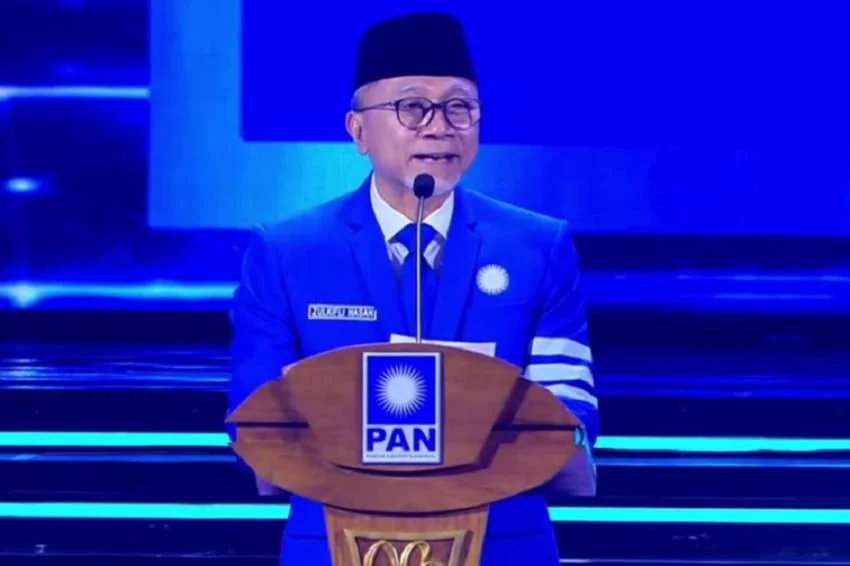
The political landscape in Indonesia remains firmly aligned with the current administration as the National Mandate Party (PAN) reaffirmed its unwavering support for President Prabowo Subianto. During the high-profile culmination of the party’s 28th anniversary celebrations, held at the Jakarta International Convention Center (JICC) in Senayan on Friday, September 18, 2026, General Chairman Zulkifli Hasan—familiarly known as Zulhas—delivered a definitive stance on the party’s strategic direction. Addressing a sea of party cadres, Zulhas emphasized that PAN’s commitment to the Prabowo-led government is not merely a political coalition arrangement but a reflection of shared ideological goals for the nation’s future.
A Renewed Commitment to National Ideals
The atmosphere at the JICC was charged with enthusiasm as thousands of PAN members gathered to mark the party’s nearly three decades of existence. In his keynote address, Zulhas explicitly posed a rhetorical question to the audience, asking whether the party should maintain its alliance with the President. The immediate, thunderous response of "Setuju!" (Agreed!) from the floor underscored the internal unity within the party regarding its support for the executive branch.
Zulhas elaborated on the philosophical underpinnings of this partnership, noting that the alliance is rooted in a collective vision for the Republic of Indonesia. He specifically highlighted Article 33 and Article 34 of the 1945 Constitution of the Republic of Indonesia as the foundational pillars that drive this cooperation. These articles mandate that the economy be structured as a collective effort based on the principle of kinship, and that the state is responsible for the welfare of the impoverished and orphaned children. By framing the support for President Prabowo within the context of constitutional mandates, Zulhas sought to elevate the political coalition from a tactical alliance to a mission-driven partnership aimed at long-term national development.
Historical Context: Three Decades of Political Evolution
To understand the significance of this declaration, one must examine the historical trajectory of PAN. Founded in the reform era of 1998, PAN has navigated various political climates, from being a part of the opposition to serving as a cornerstone of the ruling coalition. Its relationship with Prabowo Subianto, the current President, is characterized by a long-standing history that transcends the 2024 general election.
PAN has been one of the most consistent supporters of Prabowo Subianto throughout his political journey. This loyalty was evident across three consecutive presidential election cycles. Even when other political factions shifted their allegiances or remained hesitant, PAN maintained a consistent, albeit sometimes evolving, relationship with the Gerindra Party leader. This long-term alignment has solidified a level of mutual trust between the party leadership and the presidential office, making the current declaration a culmination of years of political investment.
Chronology of the 2026 Anniversary Event
The celebration of the 28th anniversary was meticulously planned to serve as both a commemorative event and a political signal.
- 19:00 WIB: Opening ceremonies featuring cultural performances highlighting the diversity of Indonesia.
- 20:30 WIB: The arrival of senior party officials and key figures from the Coalition for Indonesia Maju (KIM).
- 21:15 WIB: The keynote address by Zulkifli Hasan. The speech focused on the achievements of the current administration and the necessity of maintaining stability for the remainder of the presidential term.
- 22:00 WIB: A solemn prayer session, where the party collectively requested divine guidance and protection for the President, signaling the ideological and moral dimension of their support.
The inclusion of a collective prayer at the end of the event was a strategic move to soften the hard-edged political rhetoric, framing the support for the President as a national duty rather than a mere transactional political move.

Implications for the National Political Landscape
The firm commitment expressed by Zulhas carries significant implications for the broader political landscape in Indonesia. In a system characterized by shifting alliances and fluid party loyalties, a stable, long-term commitment from a major party like PAN provides the President with a solid legislative base.
- Legislative Stability: With PAN’s continued support, the government can expect a smoother passage of major policies and fiscal budgets in the House of Representatives (DPR). This stability is crucial as the government navigates economic challenges, global supply chain pressures, and the implementation of long-term infrastructure projects.
- Coalition Cohesion: The announcement serves as a benchmark for other parties within the governing coalition. It signals that the core members of the coalition are not looking for an early exit or a shift in political orientation, effectively curbing rumors of internal fragmentation.
- Policy Continuity: By aligning with the administration’s focus on the constitutional mandates of social and economic welfare, PAN is effectively signaling its support for the current government’s "downstreaming" policies and social safety net expansions, which are central to the current administration’s platform.
Analytical Perspectives: Why Loyalty Matters
Political analysts observing the event note that for a party like PAN, maintaining a close relationship with the President is a strategic necessity to ensure its relevance in the national executive branch. However, the intensity of the language used by Zulhas suggests more than just administrative convenience. It indicates an ideological convergence.
Historically, PAN has positioned itself as a party that balances religious values with modern democratic principles. President Prabowo’s approach, which emphasizes strong national defense, sovereignty, and state-led economic development, aligns well with the nationalist-religious synthesis often championed by PAN. The mention of Article 33—often cited in discussions about state-controlled resources and the protection of the national economy—is a clear nod to the populist-nationalist economic policies that both the party and the President support.
Responses and Future Outlook
While the event was primarily an internal party affair, the impact has resonated across the political spectrum. Observers from various think tanks have noted that this reaffirmation of support is a calculated move to ensure that the party remains a central stakeholder in the government’s policymaking process.
Opposition figures have yet to issue formal responses to the speech, but the alignment between the executive and the legislature suggests that the administration will face minimal resistance on core policy issues in the coming months. For the grassroots members of PAN, the message is clear: the party is not drifting away from its partner. This sense of certainty is expected to bolster morale among the party’s regional branches as they prepare for upcoming local and regional political cycles.
As Indonesia looks toward the latter half of the 2020s, the political alliance between PAN and President Prabowo appears increasingly cemented. The rhetoric at the 28th anniversary was not just about the past; it was a proactive statement regarding the future. By tying the party’s destiny to the success of the President, Zulhas has set a high bar for internal discipline and external cooperation. Whether this strategy will lead to long-term electoral dividends for PAN remains to be seen, but in the immediate term, it has successfully established a clear, unified, and decisive political narrative for the party.
The event concluded with a strong message of unity, signaling that as long as the administration adheres to the principles of the 1945 Constitution and works toward the welfare of the Indonesian people, PAN will remain a steadfast ally. As the nation faces global economic uncertainties and domestic social challenges, this political stability is likely to be a defining feature of the current administrative period.