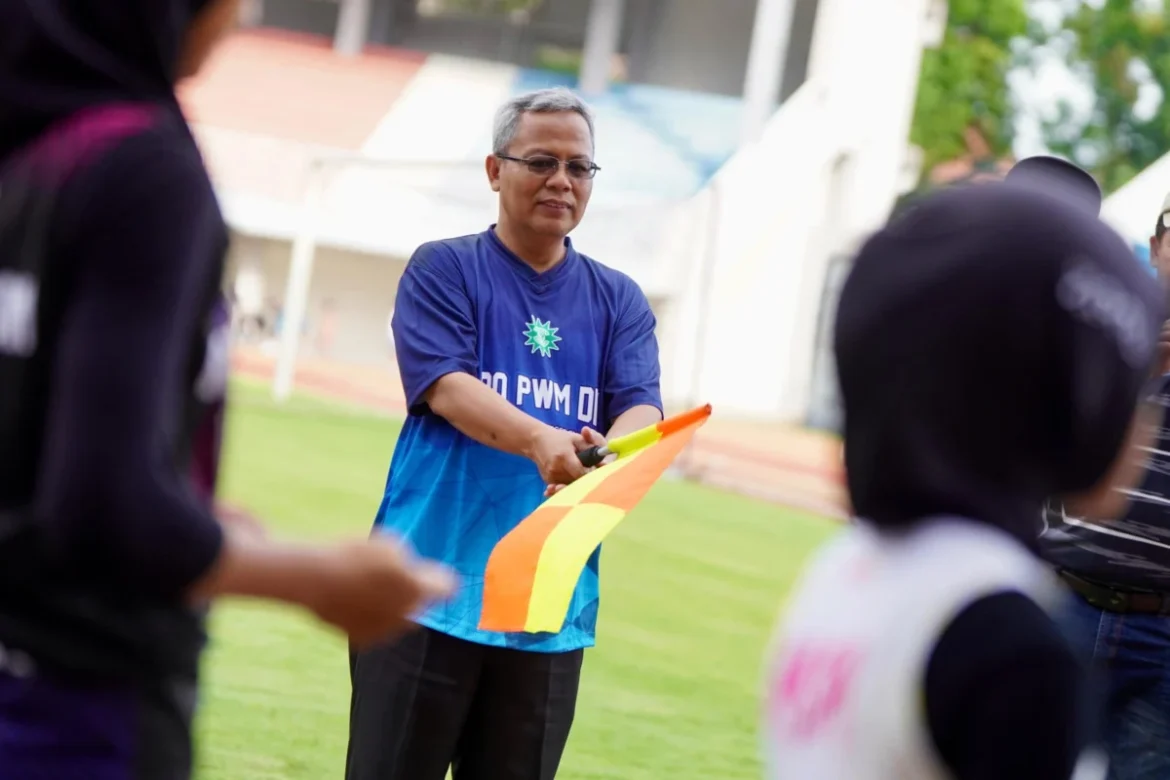
YOGYAKARTA — The historic Mandala Krida Stadium in Yogyakarta served as a vibrant hub of youthful athleticism and competitive spirit as 883 student-athletes from kindergarten to high school levels gathered for the opening of the 2026 Muhammadiyah Regional Student Track and Field Championship. Organized by the Sports Development Institute (LPO) of the Muhammadiyah Regional Leadership (PWM) of the Special Region of Yogyakarta (DIY), the tournament marks its third consecutive year of staging, steadily cementing its status as a premier developmental breeding ground for youth sports in the region.
The official opening ceremony, held on Saturday, drew a notable assembly of regional education and organizational leaders, underscoring the growing institutional importance placed on holistic youth development. Among the dignitaries present were PWM DIY Chairman Ikhwan Ahada, PWM DIY Vice Chairman overseeing the LPO Azman Latief, and LPO PWM DIY Chairman Edy Prajaka. Representing the local government was Arfi Hidananto, Head of the Youth and Sports Division (BPO) at the DIY Education, Youth, and Sports Office (Disdikpora), who attended on behalf of the agency’s head.
The championship encompasses a massive operational footprint, drawing participants across multiple educational tiers—from early childhood education up to senior and vocational high schools—competing across a rigorous slate of events designed to unearth raw athletic potential while instilling lifelong values of discipline, health, and mutual respect.
Holistic Development: Merging Physical Vigor with Spiritual Freshness
Addressing the assembled athletes, coaches, and spectators, PWM DIY Chairman Ikhwan Ahada emphasized that the primary objective of structured athletic training extends far beyond physical conditioning. According to Ikhwan, rigorous sports participation must serve as a vehicle for cultivating mental and spiritual well-resourced resilience. True athletic excellence, he argued, requires a harmonious balance between physical fitness and spiritual clarity.
"Spiritual freshness can be achieved through the spirit of sportsmanship," Ikhwan stated during his opening remarks. He elaborated that while securing victory and claiming the top spot remains a natural goal in any competitive arena, developing the mindset and mental fortitude of a true champion holds vastly greater significance. This resilient mindset, he noted, is forged not merely through physical repetition, but through intellectual maturity and a healthy perspective toward competition—specifically, viewing opponents not as adversaries to be crushed, but as essential partners in the pursuit of peak performance.
"There is no competition without opponents. Therefore, your actual opponent is your partner in demonstrating true achievement," Ikhwan added, reframing competitive rivalry as a collaborative endeavor toward mutual excellence.
The philosophical underpinnings of the Muhammadiyah movement heavily influence this approach to youth sports. When asked about recommendations from the DIY Regional Government to eventually expand the championship beyond Muhammadiyah-affiliated schools, Ikhwan confirmed that the LPO would give the proposal serious consideration. He explained that every civic and community initiative undertaken by Muhammadiyah is fundamentally rooted in altruism and public service.
"Spreading the values of goodness is not only for Muhammadiyah children, but for the children of the nation in general," Ikhwan affirmed.
A Three-Year Trajectory of Growth and Cross-Regional Participation
The operational scale of the championship has experienced a remarkable upward trajectory since its inception, reflecting increasing institutional capacity and a growing reputation within the broader educational landscape. Detailed metrics provided by LPO PWM DIY Chairman Edy Prajaka illustrate a consistent expansion in participation numbers year-over-year.
In 2024, the inaugural regional championship recorded 509 participants. By 2025, that figure rose to 809 student-athletes. For the current 2026 iteration, participation surged to 883 competitors, representing a diverse cross-section of academic institutions.
A closer examination of the participant demographic reveals a broad distribution across educational tiers:
- Kindergarten (TK): 33 participants
- Elementary School (SD): 462 participants
- Junior High School (SMP) or equivalent: 206 participants
- Senior High School (SMA/SMK) or equivalent: 182 participants
Geographically, the tournament maintained a strong core representation from within the Special Region of Yogyakarta, led by the City of Yogyakarta with 377 participants. This was followed by Bantul Regency with 204 competitors, Sleman Regency with 137, Gunungkidul Regency with 55, and Kulon Progo Regency with 51.
Significantly, the 2026 championship marked a notable milestone by expanding its geographical reach beyond the administrative boundaries of DIY, drawing 23 student-athletes from neighboring regions in Central Java. This external contingent included 8 participants each from Banjarnegara and Magelang, 4 from Batang, 2 from Surakarta, and 1 from Purworejo.
"This is the most interesting part; this year, we have participants coming from outside DIY," Edy noted, highlighting the event’s growing regional appeal. Across the entire championship, competitors vied for a total of 40 medals, evenly split into 20 categories for female athletes and 20 for male athletes.
Institutional Objectives and the Importance of Measurable Competition
The overarching mission of the championship, as outlined by the organizing committee, centers on elevating the standard of sports performance among Muhammadiyah students at both regional and national levels. By establishing a structured platform for talent scouting, the LPO aims to identify exceptional young track and field talents early in their athletic journeys, foster healthy social networks and camaraderie among students from diverse institutional backgrounds, and popularize track and field disciplines within school curricula.
Edy Prajaka expressed optimism regarding the safety and smooth execution of the multi-day event, offering a public appeal for community support and prayers to ensure all participants complete their respective events safely and without injury.
Echoing the organizers’ strategic vision, Arfi Hidananto of the DIY Disdikpora stressed that structured training regimens are fundamentally incomplete without the rigorous testing ground provided by official competitions. Without competitive pressure and formal evaluation, athletic progress remains abstract and unquantifiable.
"Training without competition will not produce measurable results," Arfi stated firmly during his address.
On behalf of the regional government, Arfi commended the perseverance and hard work of the LPO PWM DIY organizing committee for successfully sustaining the championship for three consecutive years. He expressed a strong desire to see the event institutionalized for the long term, suggesting that a future expansion to encompass all students across the entirety of DIY would significantly elevate the overall quality of regional sports competition and maximize the efficacy of talent identification initiatives.
Arfi concluded his remarks by reminding the young competitors of the ethical dimensions of athletic engagement, urging them to view character development as equally important to physical victories.
"The true champion is not only the one who returns home bearing a medal, but the one who respects and values their opponents," Arfi concluded.
Broader Implications for Regional Youth Development
The steady growth of the Muhammadiyah Regional Student Track and Field Championship reflects a broader trend within Indonesian regional sports governance: an increasing reliance on community-based and faith-based educational networks to supplement state-run athletic development pipelines.
In many regions across Indonesia, formal athletic scouting heavily depends on periodic events like the Olimpiade Olahraga Siswa Nasional (O2SN). However, municipal and provincial state budgets often face constraints in maintaining consistent, year-round localized developmental leagues for younger age brackets, particularly at the elementary and kindergarten levels. By stepping in to fill this gap, organizations like Muhammadiyah’s LPO provide vital competitive repetitions that are crucial for neurological and muscular development in pre-teen athletes.
Furthermore, the inclusion of participants from Central Java points to an emerging decentralized sports tourism and competitive circuit within central-southern Java. As school sports championships scale up their organizational professionalism, they attract out-of-province talent seeking high-stakes competitive environments outside of official state school sports calendars. This cross-pollination not only raises the competitive ceiling for the local DIY athletes but also fosters regional integration among youth from diverse cultural and institutional backgrounds.
Ultimately, initiatives like the Mandala Krida Stadium track meet do more than simply distribute 40 sets of medals. They establish accountability structures for physical education teachers, provide psychological resilience training for children facing high-pressure scenarios, and construct a transparent, merit-based talent pipeline capable of supplying future generations of national and international sports representatives for Indonesia.