
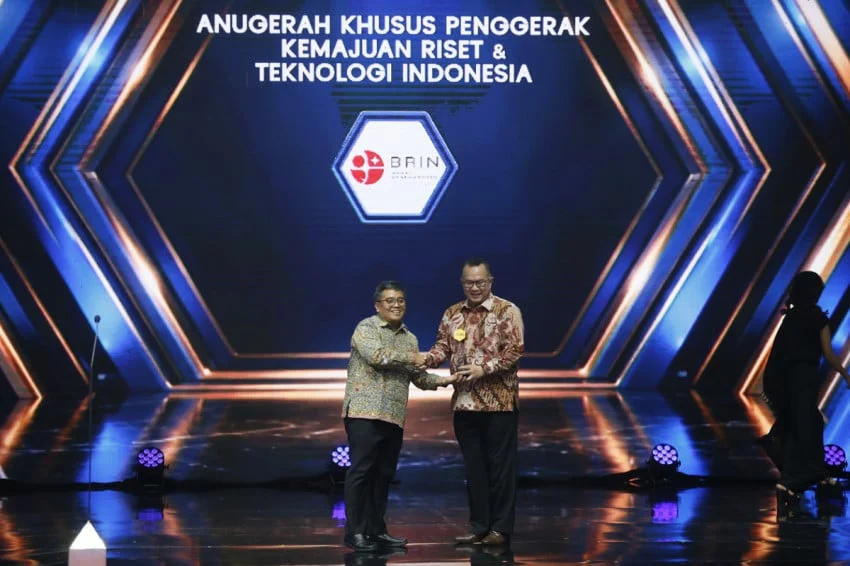
The National Research and Innovation Agency (Badan Riset dan Inovasi Nasional – BRIN) has officially been awarded the Special Award for Driving the Progress of Indonesian Research and Technology at the esteemed Anugerah Penggerak Nusantara 2026. The high-profile ceremony, orchestrated by the iNews Media Group, took place at the prestigious Jakarta Concert Hall on Thursday, November 12, 2026, drawing prominent figures from government, academia, industry, and the scientific community to celebrate organizations and individuals who have significantly contributed to the nation’s systemic development.
This recognition marks a pivotal milestone for BRIN as it continues to consolidate its position as the central engine of scientific inquiry, technological innovation, and empirical policymaking in Southeast Asia’s largest economy. The accolade underscores the agency’s relentless pursuit of excellence in fostering an ecosystem where rigorous research translates directly into tangible socio-economic benefits for the Indonesian populace.
A Dedicated Tribute to the Invisible Workforce of Science
Accepting the award on behalf of the agency, BRIN Head Arif Satria delivered a compelling address emphasizing that the honor does not belong to the leadership alone, but rather to the vast network of researchers, scientists, engineers, and academic communities operating across the archipelago. Arif articulated a deep sense of gratitude toward the individuals who often toil behind the scenes—frequently away from the public eye—yet produce groundbreaking research that fundamentally shapes the trajectory of the nation.
"Tentu, ini kami dedikasikan kepada seluruh periset dan sivitas BRIN yang telah bekerja keras, tekun, dan juga bekerja dalam senyap yang ternyata memberikan impact pada kemajuan, pada perubahan," stated Arif, acknowledging the quiet yet transformative labor of researchers who drive progress through meticulous experimentation and data analysis. He highlighted that scientific discovery rarely occurs in the spotlight; instead, it is built upon countless hours of laboratory testing, field research, theoretical modeling, and peer-reviewed analysis that ultimately culminates in national resilience and modernization.
The Dual Pillars of National Progress: Human Capital and Innovation
During his keynote remarks at the ceremony, the BRIN Head elaborated on the foundational elements required for a nation to transition from a developing economy into a global powerhouse. According to Arif, the destiny of any modern nation rests squarely upon two interdependent and mutually reinforcing pillars: the strength of its human capital and its capacity for continuous technological innovation.
Arif noted that investments in education, technical training, and institutional capacity-building form the bedrock of sustainable development. However, human potential must be systematically channeled into technological advancement and innovative problem-solving to address contemporary challenges such as climate change, food security, public health crises, and the digital divide. By aligning national research priorities with strategic industrial needs, BRIN aims to ensure that Indonesia’s intellectual output directly supports national self-reliance and global competitiveness.
Furthermore, Arif expressed his sincere appreciation to the iNews Media Group for organizing the Anugerah Penggerak Nusantara 2026 and for recognizing the critical role that research and technology play in national development. He expressed optimism that this accolade would serve as a powerful catalyst and motivational booster for the entire BRIN ecosystem, inspiring researchers to remain steadfast in delivering practical, science-based solutions to the complex challenges facing the country.
Background Context of Anugerah Penggerak Nusantara 2026
The Anugerah Penggerak Nusantara 2026 has rapidly established itself as one of Indonesia’s premier platforms for honoring exceptional contributions across various sectors, including public governance, technological innovation, cultural preservation, economic development, and social welfare. Organized annually
by the iNews Media Group—one of the country’s leading multi-platform media networks—the event embodies the overarching national spirit of "Indonesia Maju dan Terus Berkembang" (Advanced and Continuously Developing Indonesia).
The 2026 edition of the awards ceremony carried profound thematic significance, aligning closely with the national strategic roadmap leading toward the Golden Indonesia 2045 (Indonesia Emas 2045) vision. As the nation prepares to mark a century of independence, events like the Anugerah Penggerak Nusantara serve not only to celebrate current achievements but also to evaluate institutional readiness, spotlight best practices, and encourage cross-sector collaboration between public institutions, private enterprises, and civil society.
The selection process for the awards is notoriously rigorous. A panel of esteemed judges, comprising veteran journalists, academic scholars, industry leaders, and independent policy analysts, evaluates nominees based on pre-determined criteria, including measurable impact, institutional transparency, alignment with national development goals, and long-term sustainability. BRIN’s selection for the Special Award for Driving the Progress of Indonesian Research and Technology reflects the judges’ consensus regarding the agency’s irreplaceable role in orchestrating the nation’s scientific renaissance.
Chronology of BRIN’s Institutional Evolution and Milestones
To fully appreciate the significance of BRIN receiving this accolade in 2026, it is essential to examine the institutional chronology that preceded this milestone. Formally established through Presidential Decree No. 78 of 2021, BRIN was conceptualized as a sweeping structural consolidation designed to unify Indonesia’s fragmented research landscape. Historically, research and development (R&D) activities across the archipelago were decentralized, distributed among various ministries and distinct non-ministerial government institutions such as the Indonesian Institute of Sciences (LIPI), the Agency for the Assessment and Application of Technology (BPPT), the National Nuclear Energy Agency (BATAN), and the National Institute of Aeronautics and Space (LAPAN).
Between 2021 and 2023, BRIN underwent a massive consolidation phase. This period was characterized by the physical and administrative integration of thousands of researchers, the harmonization of disparate laboratories into centralized research facilities, and the restructuring of bureaucratic workflows to eliminate redundancy and maximize research output. While this transition phase presented formidable administrative and cultural challenges, it successfully established a unified national research repository and streamlined funding mechanisms.
By 2024 and 2025, the newly integrated agency began yielding tangible dividends. BRIN launched several flagship initiatives aimed at boosting local manufacturing capabilities, enhancing agricultural yields through biotechnology, developing renewable energy prototypes suited to tropical archipelagic conditions, and deploying early-warning systems for natural disasters. The year 2026 has thus emerged as a watershed moment—a period where the long-term structural investments made during the consolidation years are demonstrably translating into national technological self-reliance, culminating in external validations such as the Anugerah Penggerak Nusantara award.
Supporting Data and Empirical Analysis of Indonesia’s Research Landscape
An analysis of recent macro-level indicators highlights both the strides made by BRIN and the persistent challenges facing Indonesia’s research and development sector. According to data compiled by national statistical agencies and international bodies such as UNESCO, Indonesia’s Gross Expenditure on R&D (GERD) as a percentage of Gross Domestic Product (GDP) has historically hovered below the regional average of neighboring ASEAN nations like Singapore, Malaysia, and Vietnam.
However, under BRIN’s centralized coordination framework, targeted interventions have begun to shift these metrics. The agency has significantly expanded its competitive research funding schemes, notably the Research and Innovation Fund for Indonesia Forward (RIIM), which provides grants to academic institutions, startup incubators, and industry consortia. By the end of 2025, BRIN had facilitated collaborative research projects involving hundreds of domestic and international partners, spanning fields from marine biodiversity conservation to advanced artificial intelligence applications in public administration.
Furthermore, empirical data indicates an upward trajectory in scientific publications originating from Indonesian institutions indexed in globally recognized databases such as Scopus and the Web of Science. While quantity has visibly improved, BRIN’s current strategic focus—highlighted by leadership at forums like the Jakarta Concert Hall—is heavily weighted toward translational research. Translational research ensures that academic papers do not remain purely theoretical but are successfully commercialized, patented, or integrated into public policy frameworks.
Broader Implications for National Industry and Economic Competitiveness
The recognition of BRIN at the Anugerah Penggerak Nusantara 2026 carries profound implications for Indonesia’s economic competitiveness in an increasingly turbulent global market. As global supply chains undergo profound structural realignments and technological disruptions—driven by artificial intelligence, automation, and green energy transitions—developing economies must move beyond being mere consumers of foreign technology to becoming active producers and exporters of intellectual property.
Industry analysts note that BRIN’s proactive engagement with the private sector is crucial for bridging the proverbial "valley of death" that often separates academic research from commercial market entry. By providing startups and established manufacturing firms with access to state-of-the-art testing facilities, prototyping equipment, and top-tier scientific expertise, BRIN lowers the barrier to entry for domestic innovation. This collaborative synergy is vital for sectors such as electric vehicle (EV) battery production, pharmaceutical raw material independence, and digital infrastructure security.
Moreover, the international academic community has begun paying closer attention to Indonesia’s centralized research model. Collaborative agreements between BRIN and international scientific organizations—spanning oceanographic research in the Indo-Pacific, tropical rainforest biodiversity mapping, and space exploration tracking—position Indonesia not merely as an object of study, but as an equal partner in global scientific diplomacy.
Future Outlook and Strategic Priorities for BRIN
Looking ahead, the leadership at BRIN recognizes that receiving a prestigious award brings heightened public expectations and scrutiny. The agency is acutely aware that sustaining its momentum requires continuous institutional self-reflection, administrative agility, and an unwavering commitment to scientific integrity and meritocracy.
In the wake of the Anugerah Penggerak Nusantara 2026 ceremony, BRIN has outlined several key strategic priorities for the remainder of the decade. First, the agency aims to deepen its integration with regional universities and local governments, ensuring that research agendas address grassroots socio-economic challenges specific to various provinces across the archipelago. Second, BRIN plans to aggressively expand its talent retention and scholarship programs, aiming to reverse historical "brain drain" trends by offering competitive career pathways for young Indonesian scientists working both domestically and abroad.
Finally, the agency is committed to enhancing public science literacy. By demystifying complex scientific concepts and fostering a culture of evidence-based discourse among the general public, BRIN hopes to build a resilient society capable of navigating the disinformation challenges characteristic of the modern digital age.
Conclusion
The conferring of the Special Award for Driving the Progress of Indonesian Research and Technology upon BRIN at the Anugerah Penggerak Nusantara 2026 serves as a powerful testament to the transformative power of institutional perseverance and intellectual dedication. As Head Arif Satria aptly noted, the honor belongs fundamentally to the scientists, researchers, and academic support staff who work tirelessly behind the scenes to secure Indonesia’s scientific future. With human capital and technological innovation firmly established as the dual engines of national progress, BRIN stands uniquely positioned to guide Indonesia toward a prosperous, technologically sovereign, and globally respected future in the decades to come.
