
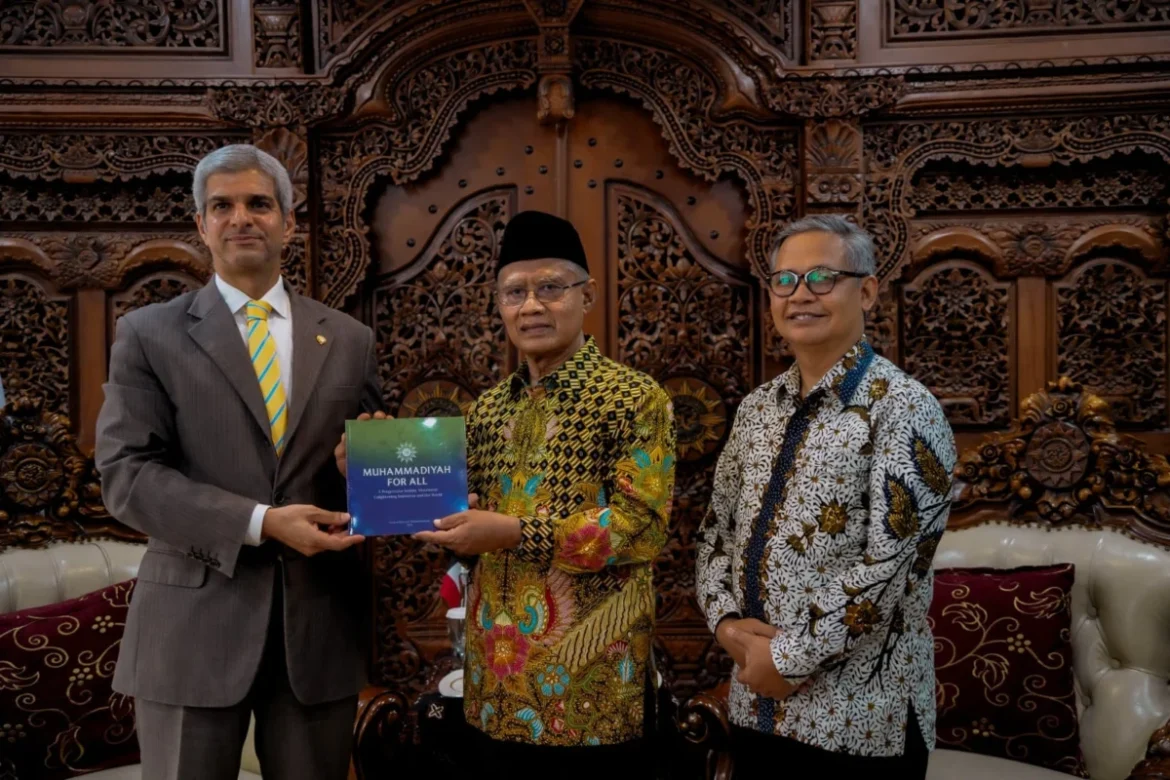
The Central Leadership of Muhammadiyah, one of Indonesia’s largest and most influential Islamic socio-religious organizations, has recently engaged in high-level strategic discussions with the Embassy of the State of Kuwait in Indonesia. The diplomatic meeting, aimed at strengthening and expanding bilateral cooperation across multiple critical sectors—including education, religious outreach, public health, and humanitarian assistance—marks a significant milestone in a decades-long relationship. Central to the dialogue was a prominent proposal for the construction of a state-of-the-art modern hospital in Bekasi, West Java, a collaborative initiative that received an enthusiastic and positive initial response from the Ambassador of Kuwait to Indonesia, H.E. Khalid Jassim Alyassin.
The high-stakes diplomatic encounter took place at the official headquarters of the Central Leadership of Muhammadiyah (Pimpinan Pusat Muhammadiyah) situated in the historic neighborhood of Menteng, Central Jakarta. The meeting brought together key decision-makers from both sides, fostering an environment of mutual respect, shared developmental goals, and a unified vision for sustainable community empowerment. Through this comprehensive dialogue, both parties underscored the importance of institutional synergy in addressing modern socioeconomic challenges in Southeast Asia’s largest economy.
High-Level Delegation and Diplomatic Presence
The meeting saw the convergence of top-tier leadership figures from Muhammadiyah alongside key diplomatic representatives from the Gulf nation. Representing the host organization was the Chairman of the Central Leadership of Muhammadiyah, Prof. Dr. Haedar Nashir, M.Si., whose visionary leadership has continuously steered the organization toward greater international engagement.
Accompanying Chairman Haedar Nashir were several esteemed members of the Muhammadiyah Central Leadership, including Prof. Dr. Anwar Abbas, M.M., M.Ag., a prominent cleric and economist known for his vocal advocacy on social justice and economic equality, and Dr. Agung Danarto, M.Ag., who oversees institutional coordination. Also present were Dr. Hilman Latief, M.A., Ph.D., the Treasurer General of Muhammadiyah—who brings extensive academic and practical expertise in international philanthropic development—and Izzul Muslimin, M.Si., the Secretary of the Central Leadership, who manages organizational governance and strategic communications.
On the opposing side, the Embassy of Kuwait was prominently represented by Ambassador H.E. Khalid Jassim Alyassin. Facilitating the complex diplomatic discourse was Muhammad Nahdi, who served as the official translator and cultural liaison, ensuring precision and clarity in communication between the Arabic-speaking diplomat and the Indonesian leadership. The presence of such a senior delegation from the Kuwaiti side underscores the gravity with which the Gulf state views its diplomatic, religious, and philanthropic ties with Indonesian civil society organizations.
A Three-Decade Foundation of Mutual Trust and Cooperation
During the extensive briefing and conversational exchanges, Chairman Haedar Nashir took the opportunity to reflect on the historical trajectory of the relationship between Muhammadiyah and various stakeholders within the State of Kuwait. He highlighted that institutional ties and developmental collaborations are by no means nascent; rather, they are built upon a robust, time-tested foundation spanning twenty to thirty years.
Over this extensive period, philanthropic organizations, governmental bodies, and private donors from Kuwait have consistently extended financial and logistical support to bolster Muhammadiyah’s expansive dakwah (religious propagation and community betterment) framework. This historical assistance has been particularly visible in the construction and rehabilitation of mosques, Islamic boarding schools (pesantren), and formal educational institutions across numerous regional and remote provinces in Indonesia.
"Kuwait has long been familiar with Muhammadiyah. For the past twenty to thirty years, Muhammadiyah and Kuwait have maintained a solid and enduring cooperative relationship. Kuwait has provided substantial assistance to Muhammadiyah, particularly in the construction of mosques and the development of our educational infrastructure," stated Haedar Nashir during the discussions.
This deep-seated familiarity has created a high degree of institutional trust. Unlike newer diplomatic overtures that require extensive vetting and exploratory phases, the engagement between Muhammadiyah and Kuwait benefits from a proven track record of transparency, efficient project execution, and tangible community benefits. This historical goodwill served as the primary springboard for introducing more ambitious, large-scale infrastructural projects during the Menteng meeting.
The Proposed Bekasi Hospital Project: A New Frontier in Healthcare Collaboration
While traditional areas of cooperation such as education and religious infrastructure remain vital, the focal point of the recent discussions shifted heavily toward the public health sector. In an era defined by post-pandemic recovery and the pressing need for equitable healthcare access, Muhammadiyah presented a strategic proposition to the Kuwaiti Ambassador: the establishment of a major modern hospital facility.
According to the details outlined during the meeting, the proposed healthcare facility is envisioned to be constructed in Bekasi, West Java—a densely populated urban and industrial corridor flanking the eastern border of Jakarta. Bekasi represents a strategic location characterized by rapid demographic growth, significant industrial workforce concentration, and a perpetual demand for high-quality, accessible medical services.
Under the preliminary operational framework discussed by the Muhammadiyah leadership, the organization is prepared to provide the land asset required for the hospital’s development. This provision of strategic real estate demonstrates Muhammadiyah’s institutional commitment and skin-in-the-game approach to the partnership. The financial backing, technical architectural planning, and medical equipment procurement would potentially be explored through collaborative investment or philanthropic funding channels involving Kuwaiti partners.
Ambassador Khalid Jassim Alyassin responded to the proposition with notable enthusiasm, recognizing the critical role that healthcare infrastructure plays in community welfare and national development. Rather than dismissing the idea as premature, the Ambassador actively encouraged the Muhammadiyah leadership to formalize the initiative by drafting a comprehensive, data-driven project proposal. This document is intended to serve as the baseline for subsequent, more detailed technical discussions with relevant Kuwaiti developmental funds, governmental agencies, and private philanthropic foundations.
Nonetheless, both parties exercised diplomatic prudence by emphasizing that the hospital project remains firmly in the exploratory and preliminary assessment phase. No legally binding agreements, final infrastructural blueprints, or financial disbursements have been formally finalized or approved. The immediate next steps rely entirely on the compilation of feasibility studies and the submission of the requested proposal by the Muhammadiyah technical team.
Broadening Horizons: Education, Humanitarian Aid, and Economic Empowerment
Beyond the prominent discussion surrounding the Bekasi hospital project, the bilateral dialogue encompassed a wide-ranging review of potential collaborative domains. Both sides recognized that the contemporary global landscape requires philanthropic organizations to adapt, innovate, and expand their mandates beyond traditional boundaries.
Ambassador Khalid Jassim Alyassin, speaking through translator Muhammad Nahdi, expressed profound admiration for the sheer scale, institutional maturity, and societal impact of Muhammadiyah. Acknowledging its status as one of the preeminent Islamic organizations not only in Indonesia but globally, the Ambassador emphasized that the avenues for partnership are virtually limitless.
"This meeting is anticipated to pave the way for even greater cooperative opportunities in the future. Muhammadiyah stands as one of the largest and most influential organizations in Indonesia and across the globe. Our cooperation can be systematically expanded into the fields of education, humanitarian response, and other sectors where collaborative initiatives are mutually viable," conveyed Muhammad Nahdi, channeling the sentiments of the Kuwaiti Ambassador.
Adding a crucial socioeconomic dimension to the conversation, Chairman Haedar Nashir elaborated on Muhammadiyah’s ongoing domestic initiatives geared toward poverty alleviation and grassroots economic empowerment. Across the archipelago, Muhammadiyah operates numerous micro-finance initiatives, cooperative networks, vocational training centers, and community-based enterprises specifically designed to uplift kaum duafa (the impoverished and vulnerable segments of society).
Haedar proposed that these grassroots economic empowerment programs could serve as an ideal, highly impactful platform for international collaboration. By integrating foreign philanthropic capital with Muhammadiyah’s extensive on-the-ground network, both entities could theoretically scale up income-generation programs, small-business grants, and community-based micro-enterprises, thereby multiplying the socioeconomic dividends returned to marginalized populations.
Broader Implications and Socioeconomic Analysis
The strengthening ties between Muhammadiyah and the Embassy of Kuwait carry significant analytical implications within the broader context of international Islamic philanthropy, developmental diplomacy, and civil society engagement in Indonesia.
First, the engagement highlights the growing trend of "para-diplomacy" and institutional international relations, wherein non-state actors—such as large religious NGOs—engage directly with foreign sovereign states to mobilize resources for public good. Muhammadiyah, with its vast network of over 170 higher education institutions, hundreds of hospitals and clinics, and thousands of primary and secondary schools, functions effectively as a quasi-governmental developmental engine. By securing strategic international partnerships with wealthy Gulf nations like Kuwait, Muhammadiyah is able to bypass bureaucratic bottlenecks and channel direct investments into critical social sectors.
Second, the potential development of a major hospital in Bekasi addresses a critical structural deficiency in Indonesia’s public health architecture. Despite continuous governmental efforts under the National Health Insurance scheme (BPJS Kesehatan), the ratio of hospital beds and advanced medical facilities to the total population remains below World Health Organization (WHO) recommended thresholds, particularly in high-density commuter zones surrounding the capital. A collaborative healthcare venture backed by international philanthropy could significantly alleviate the burden on public healthcare infrastructure in West Java.
Third, the emphasis on economic empowerment alongside healthcare and education reflects a modern maturation in international Islamic philanthropy. Historically, aid from Gulf nations to Southeast Asia was predominantly channeled into religious infrastructure, such as the construction of mosques and madrasas. While these remain important, the current dialogue signals a shift toward holistic human development—encompassing economic resilience, healthcare access, and formal education—which aligns closely with the United Nations Sustainable Development Goals (SDGs), specifically regarding poverty reduction (Goal 1), good health and well-being (Goal 3), and quality education (Goal 4).
Conclusion and Future Outlook
The strategic dialogue concluded on a high note of optimism, characterized by a shared commitment to translating decades of historical friendship into concrete, actionable contemporary programs. While the proposed hospital in Bekasi and the expanded economic empowerment initiatives remain subjects for subsequent technical evaluations and proposal submissions, the overarching trajectory of the Muhammadiyah-Kuwait partnership points toward heightened collaboration.
As the technical teams from both the Central Leadership of Muhammadiyah and the Embassy of Kuwait commence the rigorous process of drafting proposals, conducting feasibility assessments, and aligning developmental priorities, the international community will be watching closely. This prospective partnership serves as a testament to the enduring power of cross-border civil society cooperation in addressing complex humanitarian, educational, and healthcare challenges in the twenty-first century.
