
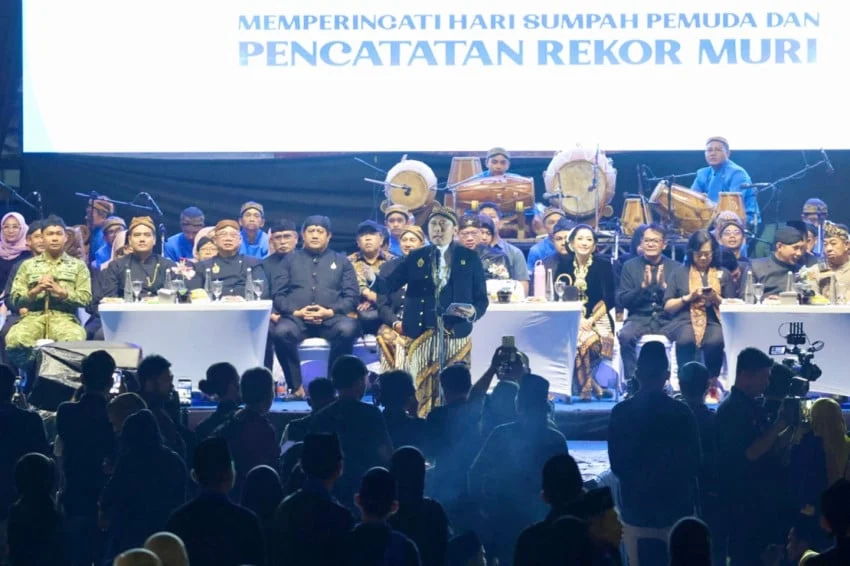
In a momentous celebration of national heritage, the Stadion Wijaya Krida in Pacitan, East Java, became the epicenter of cultural preservation on Wednesday, October 28, 2026. Synchronized with the 98th anniversary of the Youth Pledge (Sumpah Pemuda), the Gebyar Langen Tayub Pacitan 2026 served as a powerful testament to the endurance of Indonesian traditions. The event, which drew thousands of participants and spectators, was headlined by the Deputy Speaker of the People’s Consultative Assembly (MPR) of the Republic of Indonesia, Edhie Baskoro Yudhoyono, widely known as Ibas, who emphasized that the safeguarding of traditional arts is a fundamental pillar of Indonesia’s national identity.
A Record-Breaking Cultural Spectacle
The Gebyar Langen Tayub 2026 was not merely a local festive gathering but a record-setting exhibition of regional artistic dedication. The Indonesian World Records Museum (MURI) officially verified the event as the largest mass performance of the Langen Tayub dance ever documented. A staggering 5,288 dancers, representing 12 districts and 172 villages across the Pacitan Regency, performed in unison.
This massive orchestration was the result of a rigorous two-month preparation period. Local community leaders, cultural practitioners, and dance instructors collaborated to ensure that the choreography—which requires precise rhythmic movement and traditional grace—was mastered by participants ranging from grassroots community groups to seasoned local performers. The sheer scale of the performance underscores the logistical coordination required to mobilize thousands of citizens toward a single cultural objective, reflecting the strength of community bonds within the Pacitan region.
The Significance of Langen Tayub in Javanese Identity
Langen Tayub is a traditional dance form indigenous to Central and East Java. Historically, it is more than just entertainment; it is a ritualistic social expression that emphasizes togetherness, hospitality, and communal harmony. In the context of contemporary Indonesia, where globalization threatens to dilute local customs, the revitalization of such dances is seen by anthropologists and cultural historians as a vital defense mechanism against cultural erosion.
By choosing to perform this dance on the day of the Youth Pledge, the organizers linked the historical mandate of national unity—originally proclaimed in 1928—with the preservation of indigenous arts. The message conveyed was clear: the modern Indonesian identity is built upon the foundational diversity of its ancestral legacies.
Official Remarks and the Vision for Cultural Preservation
Edhie Baskoro Yudhoyono, accompanied by his wife, Aliya Rajasa Baskoro Yudhoyono, appeared in traditional Javanese formal attire, signaling his deep respect for the local customs of the region he represents. Addressing the crowd, Ibas framed the event as a mandatory act of national service.
"We are gathered here not merely to witness a dance, but to honor our heritage, maintain our collective memory, and ignite our sense of pride," Ibas stated. He further emphasized, "I love Indonesia, I love Pacitan, and I love the people of Pacitan."
His address highlighted the dual purpose of such events: to serve as a space for social cohesion and to ensure that the younger generation remains connected to their roots. From a political standpoint, Ibas’s participation reflects a broader policy interest within the MPR to promote "Cultural Diplomacy" at the domestic level, encouraging regencies across Indonesia to document and celebrate their unique intangible cultural heritage as a way to boost local tourism and civic pride.
Chronology of the Event
The success of the Gebyar Langen Tayub was the culmination of a strategic timeline developed by the Pacitan local government and supported by national stakeholders:
- Late August 2026: Initial planning and recruitment of dancers across the 172 villages in Pacitan.
- September 2026: Commencement of intensive training sessions held in local community halls and village squares.
- October 20, 2026: Final dress rehearsals and logistical coordination at the Stadion Wijaya Krida.
- October 28, 2026 (Morning): Official opening ceremony coinciding with the Sumpah Pemuda commemoration.
- October 28, 2026 (Afternoon): The record-breaking performance of 5,288 dancers followed by the official MURI verification ceremony.
Economic and Social Implications
The implications of this event extend beyond the cultural sphere. For a regency like Pacitan, which relies heavily on tourism and agricultural output, high-profile events of this magnitude act as a catalyst for economic development.
- Cultural Tourism: The recognition by MURI provides a global marketing tool for Pacitan. By establishing itself as a hub for traditional arts, the region can attract domestic and international visitors interested in cultural heritage, thereby supporting the local hospitality and culinary sectors.
- Social Capital: The effort required to mobilize 5,288 people reinforces the social capital of the region. It strengthens the networks between the village administration and the citizenry, creating a resilient community structure that is better equipped to handle collaborative projects in the future.
- Policy Advocacy: The presence of high-ranking officials like the Deputy Speaker of the MPR brings national attention to the needs of the region. It highlights the importance of providing state-level funding and administrative support for local cultural preservation programs, which are often under-resourced compared to other developmental priorities.
Expert Perspectives on Heritage Conservation
Cultural analysts suggest that the "bottom-up" approach observed in Pacitan—where thousands of villagers participate directly—is the most effective way to protect intangible heritage. According to UNESCO guidelines on the safeguarding of intangible cultural heritage, the active participation of the community is essential for ensuring that traditions are "living" rather than "museumized."
The performance of Langen Tayub by such a large, cross-generational group proves that the dance is not a relic of the past but a living practice. By integrating the event with a national day of significance (Sumpah Pemuda), the organizers successfully shifted the narrative of cultural preservation from a niche interest to a mainstream patriotic duty.
Challenges and Future Outlook
While the event was an undeniable success, the sustainability of such initiatives remains a topic of discussion among local policymakers. Maintaining the momentum generated by this record-breaking performance will require long-term infrastructure, such as dedicated arts training centers and consistent educational programs in local schools.
The local government of Pacitan has indicated that they intend to use this momentum to push for further cultural recognition, potentially seeking further collaboration with the Ministry of Education, Culture, Research, and Technology. The goal is to integrate Langen Tayub into the broader Indonesian cultural curriculum, ensuring that the legacy celebrated on October 28, 2026, continues to thrive for future generations.
Conclusion
The Gebyar Langen Tayub Pacitan 2026 stands as a benchmark for how local identity can be projected onto the national stage. Through the leadership of figures like Edhie Baskoro Yudhoyono and the unwavering enthusiasm of the people of Pacitan, the event demonstrated that the preservation of tradition is not an obstacle to progress, but a vital component of a nation’s strength. As Indonesia continues to navigate the complexities of the 21st century, the ability to look back at its diverse heritage while moving forward in unity will remain the definitive characteristic of its national identity. The 5,288 dancers at Stadion Wijaya Krida have ensured that for at least one day, the rhythm of the ancestors resonated louder than the noise of the modern world.
