
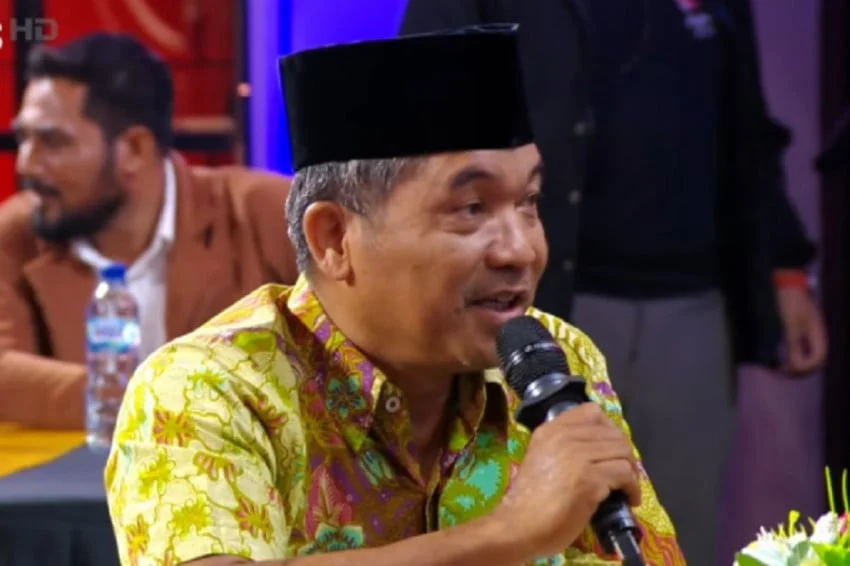
The political landscape in Indonesia continues to experience ripples of debate regarding the legitimacy of the current administration’s electoral journey as civil society figures persistently demand greater institutional transparency. Ray Rangkuti, the Executive Director of the Lingkar Madani (Mada Circle) NGO, has formally called upon the House of Representatives (DPR) to exercise its constitutional inquiry rights—known as hak angket—to thoroughly investigate the ongoing controversy surrounding the educational credentials of Vice President Gibran Rakabuming Raka. Furthermore, this parliamentary inquiry is proposed to scrutinize a deeply controversial regulation often referred to by critics as a "smuggled article," which allegedly paved the way for Gibran’s eligibility as a vice-presidential candidate during the 2024 general elections.
The demand for parliamentary intervention was articulated during a televised public discourse program broadcast by iNews on Tuesday, October 27, 2026, titled "Are There Smuggled Articles in the Diplomat Case?". According to Rangkuti, the utilization of the DPR’s right of inquiry is no longer merely an option, but a vital necessity to resolve lingering public skepticism concerning administrative documents that have faced persistent scrutiny from various legal and political factions.
Background Context of the Credentials and Regulatory Controversy
The controversy surrounding Vice President Gibran Rakabuming Raka’s academic background has remained a recurring theme in Indonesia’s sociopolitical discourse. Critics and various civil society coalitions have frequently questioned the documentary evidence regarding his educational history, particularly concerning certificates of completion or substitute letters (surat keterangan) used during the candidate verification process managed by the General Elections Commission (KPU).
While legal representatives and defenders of the administration have repeatedly insisted that all documentation—ranging from elementary schooling up to higher education levels—is complete and verifiable, skepticism persists within specific segments of the public and legal advocacy groups. The crux of the dissatisfaction lies in the perception that these documents have not been adequately subjected to open, official, and rigorous cross-examination in legislative or independent oversight forums.
Compounding the credential debate is the parallel controversy surrounding Article 18, paragraph (3) of KPU Regulation (PKPU) Number 19 of 2023, which governs the nomination procedures for presidential and vice-presidential candidates. Legal analysts and former legislative members have pointed out that this specific clause appeared during the regulatory drafting phase without prior robust consultation, debate, or explicit approval from the House of Representatives, specifically Commission II, which oversees domestic governance, regional autonomy, and elections.
Critics have labeled this regulatory addition as a "smuggled article" (pasal selundupan), arguing that it functioned as a tailor-made legal instrument to bypass existing age or administrative hurdles, thereby granting a smooth pathway—often described colloquially as a "red carpet"—for Gibran Rakabuming Raka to secure his candidacy alongside then-presidential candidate Prabowo Subianto.
The Rationale Behind the Proposed Parliamentary Inquiry
During the televised discussion, Ray Rangkuti emphasized that the parliamentary inquiry right (hak angket) is the most appropriate, official, and dignified mechanism available under the Indonesian constitutional framework to address these unresolved grievances.
"And for that reason, I continue to advocate so that the substitute letters, and the diplomas that are said to exist but have never been brought to the Constitutional Court, can be displayed through a forum that I consider official and dignified, namely the inquiry forum in the DPR," Rangkuti stated during the program.
Rangkuti further argued that the scope of the proposed inquiry must extend beyond mere paperwork to investigate the legislative anomaly surrounding PKPU No. 19/2023. He highlighted statements previously made by Ahmad Doli Kurnia, who served as the Chairman of House Commission II for the 2019–2024 legislative period. Doli and other lawmakers had previously expressed bewilderment or objection regarding how the contested clause manifested in the final regulatory text without legislative consensus.
By invoking the right of inquiry, the DPR would possess the legal authority to summon relevant stakeholders, demand official administrative records, subpoena institutional witnesses, and dissect the exact bureaucratic and political chain of events that led to the formulation of the contested KPU regulation. Rangkuti maintains that such transparency is indispensable for upholding the integrity of public institutions and restoring absolute public trust in the electoral framework.
Chronology of Events and Legal Challenges
To understand the current push for a parliamentary inquiry, it is essential to trace the chronological evolution of the legal and political challenges surrounding the 2024 presidential election candidacy requirements:
- October 2023: The General Elections Commission (KPU) finalizes and promulgates PKPU Number 19 of 2023 concerning the Nomination of Presidential and Vice-Presidential Candidates. Shortly thereafter, controversies begin to emerge regarding specific clauses, including Article 18 paragraph (3), which critics argue alters foundational candidacy requirements without parliamentary backing.
- Late 2023 – Early 2024: Various civil society organizations, legal scholars, and political activists file administrative challenges and public petitions questioning the validity of candidate qualifications, specifically focusing on educational documentation and the interpretation of age requirements set by the Constitutional Court’s controversial Verdict Number 90/PUU-XXI/2023.
- February 14, 2024: The Indonesian general election takes place, resulting in the victory of the Prabowo Subianto and Gibran Rakabuming Raka ticket, who subsequently assume office in October 2024.
- Throughout 2024 – 2026: Despite the transition of power, legal battles and public debates persist. Petitions are lodged in various administrative forums, including the State Administrative Court (PTUN), where legal representatives for the administration—such as Rullyandi—assert that all educational records from primary school through higher education are fully complete, authentic, and ready for judicial presentation.
- October 27, 2026: Ray Rangkuti utilizes the platform on iNews to formally revive the debate, shifting the focus from judicial courts to the legislative arena by demanding that the DPR initiate a formal hak angket to investigate both the credential dispute and the alleged smuggled regulatory articles.
Official Responses and Legal Defense
In response to ongoing skepticism, legal representatives and defenders of the administration have consistently pushed back against allegations of procedural manipulation or document fabrication. Legal counsel Rullyandi has previously emphasized that the educational credentials of Vice President Gibran Rakabuming Raka are thoroughly documented.
According to legal teams handling the defense in related PTUN proceedings, all necessary administrative proofs spanning from elementary education, middle school, high school, up to university levels have been systematically compiled. They maintain that these records completely satisfy all statutory prerequisites mandated by electoral laws and KPU regulations.
Furthermore, defenders of the KPU’s regulatory autonomy argue that administrative adjustments made during the formulation of PKPU rules fall within the statutory authority of the electoral commission to operationalize higher judicial rulings, such as those issued by the Constitutional Court. They contend that framing these regulatory updates as "smuggled" politically undermines the independent constitutional mandate granted to election organizers.
However, political observers note that government assurances and courtroom submissions have thus far failed to entirely pacify critics. The persistent demand for a political investigation via hak angket reflects a broader societal desire for legislative accountability that transcends standard judicial litigation.
Broader Implications for Indonesian Democracy and Institutional Integrity
The proposition to launch a parliamentary inquiry into the vice president’s credentials and electoral regulations carries profound implications for the political stability and democratic maturity of Indonesia.
From a constitutional perspective, the DPR’s right of inquiry is a potent oversight tool designed to investigate government policies or the implementation of laws that are deemed to have significant, widespread impacts on public life. If a faction within the DPR were to adopt Rangkuti’s proposal and successfully mobilize sufficient political support to initiate an inquiry, it could trigger a high-stakes legislative confrontation between parliamentary oversight bodies and the executive branch.
Conversely, political analysts suggest that securing the necessary political threshold to launch a hak angket remains an uphill battle. The current ruling coalition holds a substantial majority within the House of Representatives, making it statistically challenging for opposition or civil society voices to rally the multi-party consensus required to trigger such an assertive parliamentary measure.
Nevertheless, proponents of the inquiry argue that the value of the campaign lies not solely in its parliamentary outcome, but in its ability to keep institutional transparency alive in the public consciousness. Ray Rangkuti concluded his remarks by asserting that civil society actors and independent watchdogs carry a continuous moral responsibility to scrutinize governance practices, ensuring that the foundational principles of constitutional democracy and electoral fairness are uncompromised for future generations.
