
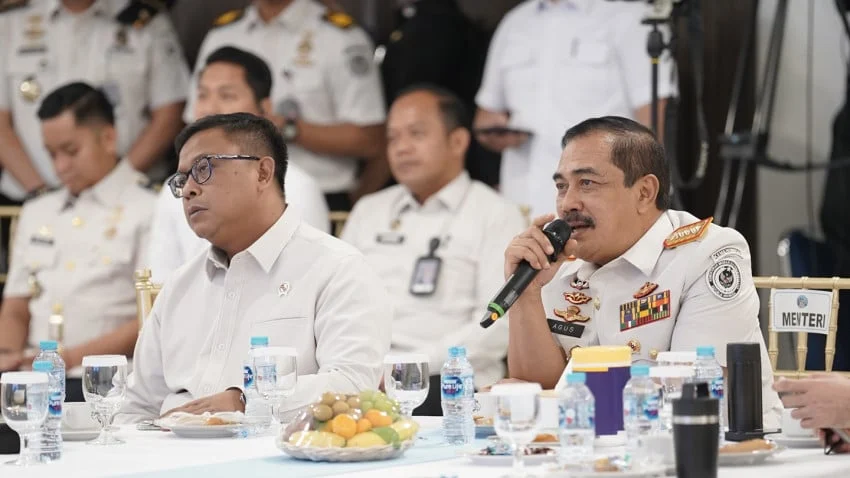
TANGERANG — In a concerted effort to alleviate humanitarian hardships caused by extreme weather and environmental disasters, the Ministry of Immigration and Corrections (Kemenimipas) has launched a nationwide social assistance initiative. The program, titled Imipas Peduli (Immigration and Corrections Cares), focuses on supporting vulnerable communities and the families of ministry personnel severely impacted by ongoing forest and land fires (karhutla) as well as prolonged droughts across several regions in the archipelago.
The comprehensive aid package includes essential medical supplies, respiratory masks, financial compensation, clean water distribution, staple food packages, and the construction of deep-well boreholes. The official rollout of this humanitarian campaign was inaugurated during the Kick-Off Ceremony for the 2nd Anniversary of the Ministry’s Service Day, held at the Auditorium of the Polytechnic of Immigration and Corrections (Poltekimipas) in Tangerang.
Targeted Interventions Based on Regional Needs
The distribution strategy implemented by Kemenimipas is tailored to address the distinct environmental challenges faced by specific provinces. In regions grappling with the hazardous aftermath of forest and land fires, immediate health and safety interventions took precedence.
In Central Kalimantan and East Kalimantan, provinces historically vulnerable to seasonal hotspots and thick haze, the ministry distributed medical-grade masks and specialized pharmaceuticals to mitigate respiratory illnesses. Additionally, financial relief and logistical support were extended directly to ministry employees and local families whose livelihoods and health have been compromised by the persistent smoke.
Meanwhile, in regions confronting severe hydrological droughts, the ministry mobilized heavy logistical support to secure access to potable water. Kemenimipas deployed a total of 150 water tanker trucks to the Special Region of Yogyakarta (DIY) and an even larger allocation of 200 water tanker trucks to Central Java, where agricultural sectors and rural households have suffered from depleted water tables.
Furthermore, the humanitarian mission in Central Java encompassed direct nutritional support. The ministry distributed 200 packages of basic daily necessities (sembako), split evenly between vulnerable populations in Cilacap and Blora regencies. To address the root cause of water scarcity in Blora, Kemenimipas initiated the construction of deep borehole water facilities, aiming to provide a sustainable, long-term source of clean water for communities frequently battered by seasonal dry spells.
Chronology and Strategic Context of the Humanitarian Program
The announcement and execution of the Imipas Peduli program on Wednesday, October 28, 2026, mark a significant milestone in the ministry’s corporate social responsibility and public service framework. The timing of the kick-off, coinciding with the preparatory lead-up to the 2026 Anniversary of the Ministry’s Service Day, underscores an institutional commitment to extending state presence beyond administrative duties and directly into disaster-stricken communities.
The escalation of forest fires and prolonged droughts in recent years has placed immense pressure on Indonesia’s disaster management infrastructure. Extended dry seasons, often exacerbated by climatic anomalies, routinely trigger agricultural failures, acute water shortages in Java, and hazardous air quality indices across parts of Sumatra and Kalimantan. Recognizing that state apparatuses and their surrounding communities are frequently on the frontline of these crises, Kemenimipas structured its relief operations to bridge immediate emergency response with sustainable infrastructure development.
Data and Environmental Implications
Environmental data from meteorological and disaster mitigation agencies consistently highlight the vulnerability of specific Indonesian regions to climatic extremes. Central Kalimantan and East Kalimantan remain perennial zones of concern during peak dry periods, where peatland degradation and high temperatures elevate the risk of uncontrollable brushfires. The resulting particulate matter poses severe public health risks, particularly acute respiratory infections (ARI) among children and the elderly.
In parallel, agricultural hubs in Central Java—such as Cilacap and Blora—as well as parts of the Special Region of Yogyakarta, frequently experience meteorological droughts that deplete local reservoirs and shallow groundwater wells. The reliance on emergency water trucking, while effective as an immediate stopgap, underscores the critical need for permanent hydrological infrastructure, such as the deep-well boreholes introduced by Kemenimipas in Blora.
Experts note that proactive interventions by non-traditional line ministries, such as the Ministry of Immigration and Corrections, reflect an evolving paradigm in disaster response. By mobilizing internal resources to support both civil servants and the broader public, civil service institutions amplify the national capacity to withstand environmental shocks.
Official Responses and Institutional Commitment
Speaking at the inauguration ceremony in Tangerang, leadership figures within Kemenimipas emphasized that the Imipas Peduli program is a manifestation of public empathy and operational solidarity. The ministry stressed that the welfare of its personnel is intrinsically linked to the well-being of the communities in which they operate.
"Our mandate extends beyond correctional facilities and immigration checkpoints; we are an integral part of the societal fabric of Indonesia," a ministry representative noted during the proceedings. "When our communities and staff face the hardships of haze and thirst, it is our collective duty to respond with tangible, life-supporting actions."
The integration of health provisions, nutritional aid, and infrastructure development demonstrates a holistic approach to disaster relief. By combining short-term relief—such as masks, medicine, and water tanks—with long-term assets like boreholes, the ministry aims to build community resilience against future climatic uncertainties.
Broader Socio-Economic Impact and Future Outlook
The implications of the Imipas Peduli initiative extend well beyond immediate material relief. For families in Kalimantan affected by toxic haze, the provision of protective gear and medical treatment reduces the economic burden of healthcare costs during crisis periods. Similarly, in the drought-stricken enclaves of Java, the steady supply of clean water prevents waterborne diseases, stabilizes local sanitation, and reduces the distress of agricultural communities struggling to sustain livestock and daily household routines.
As Indonesia continues to navigate the challenges of climate variability and environmental degradation, inter-agency cooperation and institutional responsiveness remain critical. The successful deployment of resources by Kemenimipas serves as a benchmark for how specialized government bodies can pivot to address national humanitarian emergencies.
Moving forward, the ministry has indicated that monitoring of the assisted regions will continue to ensure that the distributed aid translates into measurable recovery and improved public health standards. The completion of the deep-well infrastructure in Blora and the sustained delivery of water logistics in Central Java and Yogyakarta will be closely evaluated to determine the viability of replicating similar long-term resilience projects in other disaster-prone provinces across the nation.
