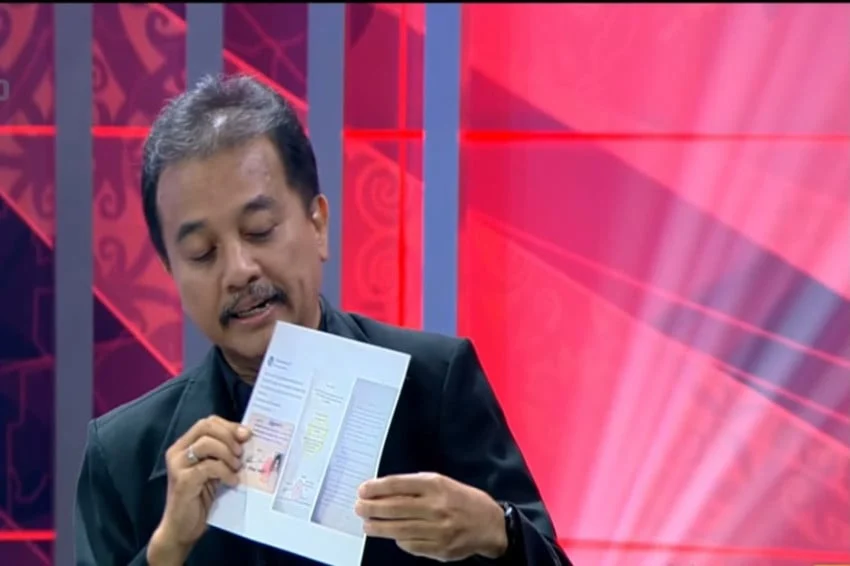
The ongoing public discourse surrounding the educational background of Indonesia’s seventh president, Joko Widodo, has taken a new turn as telematics expert Roy Suryo announced plans to present witnesses connected to Jakarta’s Pramuka Market. The statement was made during a televised appearance on iNews TV’s Interupsi program, adding another layer of complexity to a controversy that has persisted across various digital and traditional platforms despite multiple official clarifications and legal rulings.
Main Facts and the Pramuka Market Allegations
The controversy centers on persistent, unsubstantiated claims circulating on social media alleging that the university diploma of Joko Widodo (Jokowi) was fabricated or fraudulently produced. Among the various speculative narratives, specific allegations have pointed toward Jakarta’s Pramuka Market—a location traditionally known as a hub for stationery, medical equipment, and commercial printing services—as the purported site where the document was allegedly manufactured.
During the broadcast, Roy Suryo stated that he intends to bring forward witnesses who can speak to activities and historical events associated with the market. According to Roy, a thorough investigation by law enforcement into the premises could yield significant findings if approached with complete objectivity. He specifically referenced past incidents, including historical fires at the location, and suggested that authorities should re-examine individuals previously implicated in past legal cases tied to document forgery or related offenses in the area.
Furthermore, Roy directed attention toward an individual identified by the initial "P," who holds a professorial title. He urged law enforcement agencies to question this individual, as well as associated subordinates, to uncover potential links or insights relevant to the wider controversy surrounding the authenticity of official documents.
Background Context of the Controversy
The debate over the seventh president’s academic credentials is not a recent development. It originated years ago through online forums and was later amplified by various critics and activists who questioned the validity of his graduation from Universitas Gadjah Mada (UGM) in Yogyakarta.
Universitas Gadjah Mada has repeatedly and formally addressed these claims. University officials, including the rector and academic senate members, have officially confirmed that Joko Widodo graduated from the Faculty of Forestry in 1985. The institution has presented comprehensive archival evidence, including alumni records, graduation photographs, thesis documentation, and testimonies from his academic peers and professors who studied alongside him during the 1980s.
Despite these definitive institutional clarifications, various figures have continued to challenge the validity of the documentation, leading to a series of legal battles, public debates, and intense media scrutiny over the boundaries of free speech, defamation, and the dissemination of unverified information in Indonesia’s digital sphere.
Chronology of Key Events
To understand the trajectory of the ongoing discourse, a chronological overview of major milestones illustrates how the issue has evolved:
- 1985: Joko Widodo officially graduates with a bachelor’s degree from the Faculty of Forestry at Universitas Gadjah Mada (UGM).
- 2014–2019: Throughout successive presidential election cycles, occasional digital rumors regarding credentials surface but fail to gain significant mainstream traction or official validation.
- 2022: A formal lawsuit is filed by specific civil society figures regarding the authenticity of the presidential diploma, prompting renewed national attention and formal press conferences from UGM leadership.
- Late 2022 – 2023: Courts dismiss primary legal challenges concerning the documentation due to a lack of legal standing and verifiable evidence supporting the forgery claims. UGM reasserts the authenticity of the records through physical exhibitions of archival registers.
- 2024–2025: Digital discussions persist as public figures, including telematics analysts and legal representatives, continue to debate the technical verification methods and the legal implications of circulating unverified claims.
- September 2026: Roy Suryo appears on iNews TV’s Interupsi program, asserting his intention to introduce witnesses linked to Pramuka Market and calling for expanded investigations into specific individuals connected to the ongoing narrative.
Supporting Data and Legal Perspectives
The legal and technical dimensions of the diploma controversy involve complex arguments from both critics and defenders of the administration. Legal representatives for parties defending the authenticity of the credentials have consistently maintained that public assertions questioning the documents lack empirical backing and scientific rigor.
In response to previous claims made by public commentators, legal figures such as Yakup Hasibuan have publicly countered that critics have never conducted a legitimate, direct scientific examination of the original physical document held by the former president. Defense arguments emphasize that visual inspections of digital images or reproductions are insufficient for forensic authentication, and that accredited institutions hold the ultimate legal and administrative authority to verify academic records.
From a telematics and digital forensics standpoint, experts are divided on the methodologies required to authenticate historical documents predating the widespread use of modern digital security features. While defenders emphasize physical archival integrity—such as paper type, ink degradation, structural signatures, and university registry logs—critics often point to variations in typography or formatting across different eras of academic administration.
Official Responses and Institutional Stance
Universities and legal authorities have maintained a consistent position regarding academic verification standards in Indonesia. Under national education regulations, the authority to issue, verify, and retract academic degrees rests exclusively with the accredited higher education institution that granted the credential.
UGM’s leadership has repeatedly stressed that the university possesses all necessary primary documentation to prove graduation records beyond a reasonable doubt. University spokespersons have noted that entertaining speculative narratives without foundational evidence undermines institutional credibility and distracts from substantive public discourse on national development and policy.
Law enforcement agencies have similarly navigated the delicate balance between protecting freedom of expression and curbing the spread of defamation and misinformation. While citizens retain the right to voice inquiries, the dissemination of unverified allegations regarding official state documents has occasionally resulted in legal proceedings under the Electronic Information and Transactions (UU ITE) law, particularly when statements are deemed to cause public disruption or damage personal reputations.
Broader Impact and Implications
The persistence of the diploma controversy highlights broader structural challenges within Indonesia’s digital information ecosystem. The rapid dissemination of unverified claims across social media platforms demonstrates how polarized political narratives can sustain long-running controversies long after primary institutions have provided definitive factual refutations.
For the media landscape, the ongoing debate underscores the critical role of professional journalism in separating substantiated evidence from speculative commentary. Outlets covering these developments face the ongoing task of contextualizing statements made by public figures against established legal facts and institutional records, ensuring that audiences receive balanced, verifiable information.
As Roy Suryo prepares to present his prospective witnesses regarding the Pramuka Market allegations, legal analysts suggest that any new claims will ultimately be subjected to strict evidentiary standards should they formally enter judicial proceedings. Until concrete, verifiable proof is presented within a legal framework, educational institutions and state authorities maintain that the historical record of the seventh president’s academic qualifications remains fully validated by the issuing university.