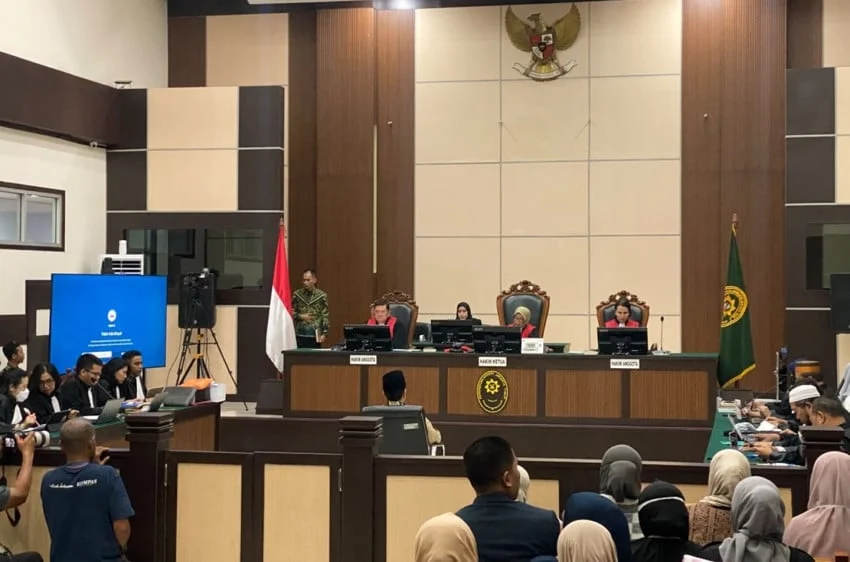
The courtroom atmosphere in Jakarta reached a point of high tension on Thursday, November 5, 2026, as legal representatives for Tifauzia Tyassuma—widely known as Doctor Tifa—engaged in a rigorous and highly unusual cross-examination of the 7th President of the Republic of Indonesia, Joko Widodo. The session, which was part of an ongoing legal proceeding, shifted from standard procedural questions to a contentious debate regarding the physical characteristics of the former head of state, specifically focusing on the presence of a mustache as depicted in archival academic documents.
The Core of the Dispute: Authenticity of Academic Records
The inquiry stems from long-standing, recurring allegations regarding the authenticity of Joko Widodo’s educational credentials, particularly his university diploma. The defense team for Doctor Tifa has persistently questioned whether the individual pictured in Jokowi’s official university graduation photograph is indeed the former president himself.
During the proceedings, the defense focused heavily on the visual discrepancy between the individual in the archival graduation photograph—who appears to be wearing glasses and sporting a mustache—and the appearance of the former president as he appeared in the witness stand on Thursday. The defense team’s line of questioning suggested that these physical markers are critical evidence in their broader argument that the person in the graduation photo may be a different individual.
"The witness is currently present without a mustache," stated a member of the legal team representing Doctor Tifa during the hearing. "Given the photographic evidence in the diploma, we are challenging the witness to grow his mustache back within a two-week period to verify the physical consistency of the person in the record."
The request, which bordered on the theatrical, drew immediate objections from the presiding judges and the Public Prosecutor’s Office (JPU). The judges dismissed the line of questioning as irrelevant to the core legal merits of the case, noting that the witness had already addressed the matter of his personal appearance and identity. The prosecution argued that the challenge was an attempt to derail the judicial process through distractions rather than substantive legal argumentation.
Chronology of the Controversy
The debate surrounding Joko Widodo’s educational history is not a new development. It has evolved through several distinct phases over the past several years:
- Initial Allegations (2022): Public discourse began to surface on social media platforms questioning the validity of Jokowi’s university degree, specifically targeting his enrollment at Gadjah Mada University (UGM).
- Official Verification (2022): Gadjah Mada University issued formal statements affirming that the diploma possessed by the former president is authentic and that he successfully completed his undergraduate studies at the Faculty of Forestry in 1985.
- Legal Escalation (2025): The controversy moved from the digital sphere to the courtroom as Tifauzia Tyassuma faced charges related to her public statements and dissemination of information regarding the alleged falsification of documents.
- Current Proceedings (November 2026): The trial has become a focal point for the defense to revisit the "Dumatno" theory—a claim that the photograph in the diploma actually belongs to a man named Dumatno.
During his testimony, Joko Widodo addressed the persistent "Dumatno" claim directly. He noted that the academic records in question were issued at a time when he was of a certain age, emphasizing that the individual frequently cited by critics as being the "true" owner of the diploma was significantly younger at the time the document was produced, making it chronologically impossible for the document to belong to that person.
Supporting Data and Contextual Realities
To understand the weight of these proceedings, it is essential to examine the context of academic documentation in Indonesia during the 1980s. Graduation records from that era were often produced with varying standards of photographic quality, and digital forensic analysis—which is now frequently demanded by social media observers—was nonexistent.
Educational institutions, including UGM, have consistently maintained that the administrative records, including student registration numbers, ledger books, and physical copies of the diplomas, remain consistent with the identity of Joko Widodo. The university has also provided testimonies from former faculty members and peers who were present during his tenure as a student.
Legal experts observing the case have noted that the defense’s reliance on physical appearance—such as the presence of a mustache or glasses—as a primary pillar of their case is legally tenuous. In Indonesian law, identity verification in court is typically handled through biometric records, civil registry data (KTP), and formal university archives rather than subjective photographic comparison.
Official Responses and Judicial Stance
The bench, led by the presiding judge, maintained a firm grip on the proceedings. When the defense insisted on their challenge for the former president to alter his physical appearance, the court intervened: "That has already been answered," the judge stated, effectively silencing the line of inquiry.
The Public Prosecutor’s Office remained steadfast in its stance, requesting that the court focus on evidence that meets the criteria of the Criminal Code. The prosecution’s goal is to establish that the defendant, Doctor Tifa, exceeded the bounds of protected speech by allegedly spreading false information that caused public unrest, rather than engaging in legitimate academic or critical inquiry.
The former president, throughout his appearance, remained composed. Having served two terms as the nation’s leader, he is no stranger to public scrutiny or political opposition. His legal team has maintained that the claims against him are baseless and intended to discredit his tenure and the institutions that verified his credentials.
Broader Implications for Indonesian Public Discourse
The trial of Doctor Tifa serves as a case study for the intersection of misinformation, social media-driven activism, and the legal system. In an era where "citizen journalism" and social media influencers often challenge established institutional narratives, the judiciary is increasingly finding itself in the role of arbiter for debates that were previously confined to online forums.
The implications of this trial are twofold:
- Legal Precedent: The court’s handling of this case will set a precedent for how far "critical expression" can go before it crosses the line into defamation or the dissemination of false information under the Electronic Information and Transactions (ITE) Law.
- Institutional Trust: The case highlights the persistent vulnerability of public officials to misinformation campaigns. Despite university verification and legal rulings, the "Dumatno" theory continues to find traction among certain segments of the public, suggesting that in the digital age, institutional confirmation is sometimes insufficient to dispel deeply held, albeit false, beliefs.
As the trial moves into its final phases, the focus is expected to shift away from the theatrical requests regarding physical appearance and back to the examination of the defendant’s intent and the impact of her statements on public order.
The defense team has indicated they will continue to explore "anomalies" in the documentation, while the prosecution prepares to wrap up its case by emphasizing the sufficiency of the existing academic evidence. For the observers and the Indonesian public, the trial represents a unique moment in the country’s democratic development—a test of how the legal system balances the right to challenge public figures against the necessity of maintaining factual integrity in public discourse.
The court has scheduled the next session for later in the month, where more witnesses are expected to provide testimony regarding the administrative processes of the university in the 1980s. Whether the defense will be granted further leeway to explore their claims remains to be seen, but the presiding judge’s recent interventions suggest that the court is losing patience with arguments deemed peripheral to the actual charges at hand.
Ultimately, this case underscores the challenges of navigating the "post-truth" landscape in Indonesia, where long-settled historical facts are increasingly subject to re-litigation in the public square, forcing the judiciary to play a more active role in demarcating the boundary between protected critique and harmful misinformation. The nation awaits the final verdict, which is expected to have lasting consequences for how legal challenges against high-ranking officials are conducted in the future.