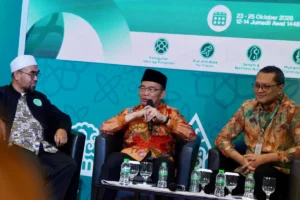
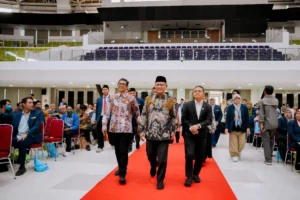
YOGYAKARTA — In an era marked by escalating climate volatility and frequent natural disasters, the Disaster Management Center—known locally as the Lembaga Resiliensi Bencana (LRB) or Muhammadiyah Disaster Management Center (MDMC)—operating under the Central Board (Pimpinan Pusat) of Muhammadiyah, has issued a resolute call to action. During the official opening of its 2026 National Working Meeting (Rakernas) held at the Saraswati Hall of the Center for Development of Vocational Education Quality Assurance (BBPPMPV) in Yogyakarta, leadership emphasized that building robust regional capacities, deploying modern technological frameworks, and respecting indigenous local wisdom are no longer optional supplementary measures, but rather fundamental prerequisites for national survival and sustainable development.
The high-profile gathering brought together disaster mitigation experts, regional coordinators, humanitarian volunteers, and top-tier organizational leadership to reevaluate Indonesia’s vulnerability to natural hazards. Against a backdrop of compounding ecological challenges—ranging from recurrent seismic shifts and volcanic eruptions to widespread forest fires and devastating floods—the three-day conference served as a strategic crucible for forging a unified, future-proof humanitarian agenda.
Contextualizing Disaster Resilience Within National Development
Indonesia sits squarely atop the Pacific Ring of Fire and at the convergence of three major tectonic plates, making it one of the most disaster-prone nations on earth. According to data from the Indonesian National Board for Disaster Management (BNPB), the archipelago experiences thousands of natural disasters annually, displacing hundreds of thousands of citizens and causing billions of rupiah in economic damage.
Addressing the assembly during the Friday (11/9) inauguration, General Chairperson of the Central Board of Muhammadiyah, Haedar Nashir, framed the discussion not merely as a reactive operational challenge, but as an existential moral duty deeply rooted in Islamic theology. Operating under the progressive Islamic framework known as Islam Berkemajuan (Progressive Islam), Haedar articulated that humanity bears the heavy responsibility of acting as a khalifah (steward) of the earth, tasked with managing and protecting natural resources with wisdom, accountability, and foresight.
Haedar forcefully argued that modern disaster management must transcend bureaucratic debates surrounding disaster status classifications and emergency response tiers. Instead, mitigation must pivot toward proactive readiness, tangible field actions, and comprehensive systemic integration.
"Disasters are not merely isolated events that we must face; rather, they must be situated within a broader ecosystem and national development framework. How we navigate and respond to these challenges dictates how effectively we can build an advanced nation, ultimately realizing Indonesia as a truly progressive society," Haedar told the attentive audience of delegates and stakeholders.
By embedding disaster resilience directly into national development paradigms, Muhammadiyah seeks to shift the cultural mindset from post-disaster charity to pre-disaster institutional resilience. This holistic approach recognizes that poverty, environmental degradation, and poor spatial planning exacerbate disaster risks, meaning that true humanitarian work must also address systemic socio-economic vulnerabilities.
Strategic Imperatives: Merging Society 5.0 Technology with Indigenous Knowledge
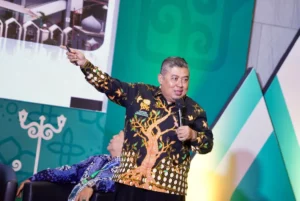
Building upon Haedar’s visionary framework, LRB PP Muhammadiyah Chairperson Budi Setiawan delivered a sobering address outlining the practical dimensions of the 2026 Rakernas theme. Budi stressed that the selected focus areas were designed as direct, pragmatic responses to the complex, overlapping environmental crises currently gripping various regions across the country.
"The theme of this year’s Rakernas is not merely a rhetorical slogan; it is a direct operational response to the multi-faceted disaster challenges confronting our communities," Budi stated. He pointed to the intensifying frequency of extreme weather events, prolonged droughts, catastrophic flash floods, and persistent seismic threats as undeniable evidence that fragmented responses are no longer viable. Effective mitigation demands deep, cross-sectoral collaboration among government bodies, civil society organizations, academic institutions, and local communities.
A core pillar of Budi’s presentation focused on leveraging the technological paradigms of Society 5.0. In an increasingly digital world, humanitarian organizations must move beyond traditional analog methods to maintain operational effectiveness. Budi urged the LRB network to aggressively scale up its technological infrastructure, particularly in the critical areas of geographic risk mapping, real-time data collection, and centralized volunteer information management systems.
By harnessing advanced Geographic Information Systems (GIS), drone mapping, and mobile-based data collection applications, Muhammadiyah aims to drastically reduce deployment times during emergency phases. Faster data processing translates directly into more precise resource allocation, ensuring that aid reaches the most vulnerable populations swiftly and equitably. Furthermore, digital accountability mechanisms enhance transparency, reinforcing the trust that donors and the public place in Muhammadiyah’s humanitarian wing.
However, Budi issued a timely caution regarding the blind adoption of technology. He emphasized that digital tools, algorithms, and automated systems must never become detached from the cultural and social realities of the communities they are designed to protect.
"Technology without cultural roots will become dry and ineffective. Indigenous wisdom, such as traditional food storage systems like lumbung pangan and the deeply ingrained cultural practice of gotong royong (communal cooperation), represents our greatest shared social capital," Budi asserted, highlighting the necessity of hybrid disaster management models that honor local traditions while embracing cutting-edge innovations.
Capitalizing on Social Networks and Grassroots Trust
One of Muhammadiyah’s greatest operational advantages lies in its vast, highly organized civil society infrastructure. Spanning thousands of schools, universities, hospitals, clinics, and local branches across the archipelago, the organization commands an unparalleled social footprint.
Budi noted that this expansive network serves as an established foundation for decentralized disaster response. When a disaster strikes a remote region, local Muhammadiyah chapters are frequently among the first responders on the ground, mobilizing community kitchens, medical clinics, and evacuation centers long before national government logistics pipelines can fully deploy.
"The true strength of Muhammadiyah lies within its extensive organizational networks and the deep trust it commands from the public. Therefore, our primary objective right now is the strategic unification of our steps," Budi explained.
This institutional synergy requires bridging the gap between national-level strategic planning and grassroots execution. Through standardized training modules, regular simulation exercises, rigorous cadre development programs, and institutional capacity-building, the LRB aims to transform its local units into self-sufficient vanguard teams capable of handling complex emergencies independently.
Chronology and Expectations of the 2026 Rakernas
The 2026 National Working Meeting of the LRB is structured as a multi-day intensive workshop designed to transition high-level policy declarations into actionable, measurable institutional outputs.
- Day One (Friday, September 11): The official opening ceremony at the Saraswati Hall in Yogyakarta, featuring keynote addresses by Haedar Nashir and Budi Setiawan, setting the philosophical and operational tone for the conference. Plenary sessions focused on analyzing current national climate trends and reviewing the performance metrics of regional LRB chapters over the preceding operational cycle.
- Day Two (Saturday, September 12): Deep-dive technical commission meetings. Delegates divided into specialized working groups to draft standardized standard operating procedures (SOPs) for rapid deployment, evaluate technological integration roadmaps, and design community-based disaster risk reduction (CBDRR) frameworks tailored to specific regional vulnerabilities (e.g., coastal flooding in northern Java, seismic risks in Sumatra and West Nusa Tenggara, and peatland fire prevention in Kalimantan and Sumatra).
- Day Three (Sunday, September 13): Finalization and ratification of the Rakernas resolutions, followed by the official closing ceremony and the release of the 2026–2027 Muhammadiyah Humanitarian Strategic Blueprint.
Conference organizers have set ambitious benchmarks for the outcomes of the three-day event. Specifically, the leadership has mandated that the assembly deliver three principal deliverables:
- Strategic Resolutions: Definitive policy stances capable of addressing immediate regional vulnerabilities while anticipating broader shifts in national disaster dynamics and climate change projections.
- Data-Driven Work Programs: Practical, quantifiable operational programs that can be implemented uniformly across the entire institutional network of LRB Muhammadiyah, complete with clear key performance indicators (KPIs) and monitoring frameworks.
- Institutional Rejuvenation: A renewed psychological and operational momentum across all ranks of disaster volunteers, reinforcing their commitment to humanitarian excellence, resilience, and ethical service.
Implications for Indonesia’s Broader Humanitarian Landscape
The proactive stance adopted by Muhammadiyah through its Disaster Management Center carries significant implications for Indonesia’s national resilience architecture. As climate change accelerates the frequency and severity of extreme weather events, state agencies alone cannot shoulder the massive burden of disaster response and post-disaster reconstruction.
By actively decentralizing risk management, integrating grassroots wisdom with cutting-edge technology, and framing disaster mitigation as an essential component of national development, Muhammadiyah is setting a benchmark for civil society participation in emergency management. The emphasis on local cultural assets ensures that resilience-building initiatives are culturally sustainable, reducing community friction and enhancing long-term project ownership.
Furthermore, as Indonesia strives to achieve its broader developmental milestones toward a prosperous future, the institutionalization of disaster risk reduction within religious and civil society frameworks demonstrates a mature, whole-of-society approach. Through rigorous planning, unwavering volunteer dedication, and a clear philosophical vision of stewardship, Muhammadiyah continues to fortify the nation against the uncertainties of a rapidly changing global climate, ensuring that vulnerable communities are not merely surviving disasters, but actively building a safer, more resilient tomorrow.