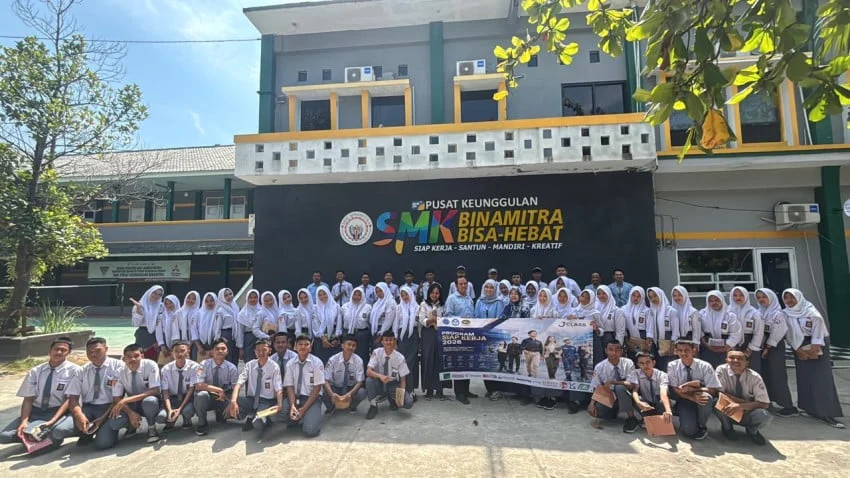
PT Jababeka Infrastruktur, a prominent subsidiary of PT Jababeka Tbk and the primary developer and manager of the sprawling Jababeka Industrial Estate, has officially announced a significant expansion of its corporate social responsibility (CSR) initiatives. The company is scaling up its flagship educational and workforce development program, known as the Jababeka Community Acceleration Class (JClass). Designed to strategically prepare high school and vocational school (SMA/SMK) graduates for the competitive demands of the modern workforce while simultaneously fostering grassroots entrepreneurship, the program represents a concerted effort to align educational outputs with private sector requirements.
The most recent iteration of this expanding initiative was successfully conducted at SMK Garuda Nusantara, located within the regency of Bekasi, West Java, on August 31, 2026. With this latest implementation, the JClass program has systematically broadened its operational footprint, successfully reaching a cumulative total of eight educational institutions across the region. This milestone underscores the developer’s long-term commitment to human capital development in one of Southeast Asia’s most vital industrial hubs.
Addressing the Persistent Skills Gap in Industrial Centers
The urgency behind the expansion of the Jababeka Community Acceleration Class lies in a structural economic challenge frequently observed in rapidly developing manufacturing districts: the skills gap. Kabupaten Bekasi stands as one of the largest and most concentrated industrial zones in the Republic of Indonesia, hosting thousands of domestic and multinational corporations ranging from automotive and electronics to consumer goods and heavy manufacturing. However, local educational institutions often face hurdles in rapidly updating their curricula to match the hyper-evolving technological and operational standards of these multinational tenants.
"JClass hadir untuk menjawab kesenjangan kompetensi (skills gap) antara lulusan SMA atau SMK dan kebutuhan industri di Kabupaten Bekasi, yang merupakan salah satu pusat kawasan industri terbesar di Indonesia," stated Vega Violetta Puspa, Director of PT Jababeka Infrastruktur, during an official statement released on Tuesday, September 15, 2026.
This strategic alignment is critical for regional economic stability. By intervening at the secondary and vocational education levels, Jababeka aims to preemptively equip students with the exact technical proficiencies, administrative competencies, and psychological readiness required by employers operating within its industrial township. The initiative serves as a vital bridge, transforming raw academic potential into industry-ready talent.
A Multifaceted Curriculum: The Three Core Pillars of JClass
To ensure comprehensive development, the Jababeka Community Acceleration Class is meticulously structured around three distinct training pathways. Each pathway targets a specific facet of workforce integration and economic empowerment, ensuring that participating students and local community members receive holistic preparation.
1. Career Acceleration Class
The first pillar focuses heavily on the intangible yet crucial elements of professional life. Beyond technical know-how, many fresh graduates struggle with the cultural transition from structured schooling to corporate environments. The Career Acceleration Class places significant emphasis on cultivating professional readiness, mental resilience, business etiquette, and workplace ethics. Trainees are taught how to navigate corporate hierarchies, manage professional communication, and develop a proactive problem-solving mindset, making them attractive candidates for entry-level positions within the industrial estate’s diverse tenant ecosystem.
2. Digital Acceleration Class
In an era defined by digital transformation and Industry 4.0 paradigms, digital literacy is no longer a luxury but a baseline requirement. The Digital Acceleration Class is designed to elevate students’ proficiencies in essential digital tools, modern office administration software, data management, and digital communication platforms. By ensuring that graduates are fluent in contemporary administrative technologies, the program significantly enhances their employability in administrative, logistical, and technical support roles across various corporate sectors.
3. EntrepreneurAcceleration Class
Recognizing that formal employment is only one avenue for economic self-sufficiency, the third pillar focuses on fostering local enterprise. The Entrepreneur Acceleration Class is specifically tailored to stimulate and develop Micro, Small, and Medium Enterprises (MSMEs) situated in the immediate vicinity of the Jababeka Industrial Estate. Participants receive foundational training in business planning, financial management, digital marketing, and product standardization, empowering them to build resilient local businesses that can eventually integrate into the broader supply chain of the industrial zone.
Chronology and Institutional Growth of the Program
Since its inception, the JClass initiative has followed a deliberate, phased rollout strategy, prioritizing schools with high potential for impact within the Bekasi regency. The chronological expansion of the program highlights Jababeka’s commitment to steady, sustainable growth rather than superficial metrics.
The program’s institutional network currently encompasses a diverse portfolio of vocational and senior high schools. The participating institutions include:
- SMK Garuda Nusantara (the site of the latest August 31, 2026 implementation)
- SMK Bina Mitra
- SMK Kitri Bakti
- SMKN 2 Cikarang Pusat
- SMK Islam Al-Amin
- SMKN 2 Cikarang Barat
- SMK Kesehatan Sentra Medika Cikarang
- SMK Dewantara 2 Cikarang Pusat
The steady inclusion of these eight schools reflects a growing demand from educational administrators who recognize the tangible benefits of corporate-backed supplementary training. By embedding these modules into the academic calendar or running them as intensive workshops, these schools have positioned their student bodies advantageously within the local job market.
Direct Industry Integration: A Collaborative Model
What fundamentally sets the Jababeka Community Acceleration Class apart from conventional, government-led or independent vocational training programs is the direct, unmediated involvement of corporate tenants operating within the Jababeka Industrial Estate. In traditional educational frameworks, academia and industry often operate in silos, leading to theoretical training that diverges from practical reality. JClass dismantles this barrier entirely.
According to Vega Violetta Puspa, the active participation of private enterprises serves as the cornerstone of the program’s efficacy. Tenant companies do not merely endorse the initiative from a distance; they are deeply integrated into the operational execution of the curriculum. Executives, engineers, human resource managers, and operational specialists from multinational and national corporations stationed within Jababeka step directly into the classrooms as guest lecturers, mentors, and technical trainers.
Furthermore, these corporate partners play a direct role in curriculum development. By collaborating with educators and Jababeka Infrastruktur coordinators, tenant companies help design the training modules, ensuring that the competencies taught reflect real-time industrial standards, machinery operations, safety protocols, and corporate expectations. This symbiotic relationship guarantees that the training remains relevant to current market demands.
From the perspective of the tenant companies, participating in JClass offers a unique, long-term return on investment. By helping shape the local talent pool, these corporations gain access to a pre-screened, well-prepared pipeline of local graduates who require significantly less on-boarding time and specialized training once hired. This reduces recruitment overheads and fosters a strong sense of community integration for corporations operating foreign or large-scale domestic manufacturing facilities in Indonesia.
Broader Economic Implications and Analyst Perspectives
Economic analysts and regional development experts have frequently emphasized the macroeconomic importance of localized workforce interventions, particularly in decentralized industrial corridors like Jababeka. As Indonesia continues to push toward its national development goals, shifting from a resource-dependent economy to a value-added manufacturing and technological powerhouse, the quality of intermediate labor becomes the primary bottleneck or accelerator.
Programs like JClass address several systemic socio-economic challenges simultaneously:
- Reduction of Structural Unemployment: By directly addressing the skills mismatch, the program reduces the friction that fresh graduates typically face when entering the job market, thereby lowering frictional and structural unemployment rates in West Java.
- Inclusive Economic Growth: By incorporating the Entrepreneur Acceleration Class, the initiative ensures that local communities are not merely passive spectators of industrialization—providing cheap labor—but active participants and beneficiaries who can build sustainable local businesses.
- Enhanced Regional Competitiveness: A localized workforce that is adaptable, digitally literate, and professionally disciplined makes the Jababeka Industrial Estate a more attractive destination for foreign direct investment (FDI). Investors are naturally inclined toward regions where human capital development is actively supported by master developers.
Future Outlook and Scalability
Looking ahead, PT Jababeka Infrastruktur has indicated its intention to evaluate the current phase of the JClass rollout with the view of scaling the program to additional schools across West Java. Discussions are reportedly underway with various stakeholders, including local government education offices and industrial associations, to explore how the curriculum can be standardized and expanded to reach hundreds more students annually.
As industrial automation, artificial intelligence, and advanced manufacturing techniques continue to reshape the global corporate landscape, initiatives that proactively bridge the gap between education and industry will only grow in importance. Through the sustained execution of the Jababeka Community Acceleration Class, Jababeka is not only reinforcing its position as a premier industrial estate developer in Indonesia but is also establishing a benchmark for corporate social responsibility that prioritizes structural empowerment over transient philanthropy.