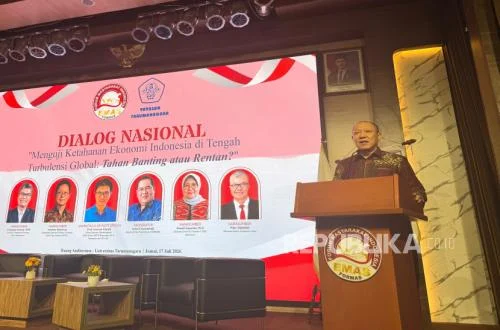
JAKARTA – The Forum Masyarakat Indonesia Emas (Formas), or the Golden Indonesia Community Forum, convened a pivotal National Dialogue on Friday evening, July 17, 2026, at the esteemed campus of Universitas Tarumanagara in Jakarta. The high-level forum brought together leading economists, academics, and business figures to meticulously formulate concrete policy recommendations for the Indonesian government, aiming to navigate the increasingly complex and uncertain global economic landscape. The initiative underscores a proactive approach by civil society and expert communities to bolster national economic fortitude in the face of unprecedented international challenges.
A Crucial Platform for Policy Formulation
The dialogue, themed "Testing Indonesia’s Economic Resilience Amidst Global Turbulence: Resilient or Vulnerable?", was orchestrated to move beyond mere academic discourse, striving instead for actionable strategies that policymakers can swiftly implement. Serian Wijatno, who serves as both the Head of the Dialogue Committee and Chairman of Formas’s Expert Council, articulated the urgent necessity for such a critical examination. Wijatno, also a respected social and community observer, employed a vivid metaphor to describe Indonesia’s current economic predicament, likening it to a ship battling a fierce storm on the high seas. This tempest, he elaborated, is fueled by a confluence of factors including escalating geopolitical conflicts, disruptive technological advancements, and a palpable weakening of global and domestic purchasing power.
"There is a wise saying that a calm sea never makes a skilled sailor," Wijatno remarked in a statement to the media in Jakarta on Saturday, July 18, 2026, drawing a poignant parallel between the proverb and the current state of the global economy. He unequivocally asserted that these global challenges represent a profound and genuine test of the nation’s economic resilience. Consequently, the dialogue was intentionally designed to be rigorously critical, with the explicit goal of producing economic policy recommendations that are not only realistic and lucid but also immediately actionable by decision-makers, thus ensuring they transcend the realm of theoretical discussion.
Echoing Wijatno’s sentiments, Yohanes Handojo Budhisedjati, the Chairman of Formas, elaborated in his introductory remarks that the initiative was a direct response to a phase marked by significant economic instability and inflationary pressures that have begun to trigger recessionary trends across various domestic sectors. The forum reflects a growing consensus among expert communities regarding the imperative for robust, forward-looking economic planning to safeguard Indonesia’s developmental trajectory and ensure the prosperity of its citizens.
Chronology of a Pivotal Event
The genesis of this National Dialogue can be traced back several months, as Formas, a prominent civil society organization dedicated to the realization of "Indonesia Emas 2045" (Golden Indonesia 2045), began observing an acceleration in global economic headwinds and their incipient impacts on the domestic front. Recognizing the need for a multi-stakeholder approach, Formas initiated planning for a comprehensive forum that would draw upon the collective wisdom of Indonesia’s foremost economic thinkers.
- April-May 2026: Formas’s Expert Council, led by Serian Wijatno, convenes internal discussions to identify key economic vulnerabilities and potential policy gaps. The core theme "Testing Indonesia’s Economic Resilience Amidst Global Turbulence: Resilient or Vulnerable?" is conceptualized, reflecting the pressing concerns of the time.
- June 2026: Invitations are extended to prominent economists, academics, business leaders, and government representatives. Universitas Tarumanagara is selected as the venue, symbolizing the collaboration between academia and policy-oriented civil society. Logistical arrangements are finalized, and the agenda is meticulously crafted to ensure comprehensive coverage of critical economic issues.
- July 17, 2026 (Friday Evening): The National Dialogue officially commences at Universitas Tarumanagara. The event opens with welcome remarks from the Rector of Universitas Tarumanagara, Ahmad Sudiro, emphasizing the role of universities as intellectual hubs for national problem-solving. Serian Wijatno delivers his impactful opening speech, setting the analytical tone with his "ship in a storm" analogy. Yohanes Handojo Budhisedjati follows, contextualizing the dialogue within the current climate of economic instability and inflation.
- Late July 17, 2026 (Friday Evening): The core panel discussions take place, featuring the distinguished lineup of economists: Piter Abdullah, Hendri Saparini, Anthony Budiawan, and Wijayanto Samirin. Each speaker presents their analysis on specific facets of Indonesia’s economic resilience, followed by a moderated discussion and a dynamic Q&A session with attendees comprising academics, business leaders, and policymakers. The discussions likely delved into granular details of fiscal policy, monetary strategy, sectoral vulnerabilities, and long-term structural reforms.
- July 18, 2026 (Saturday): Following the successful conclusion of the dialogue, Serian Wijatno issues a detailed statement to the media in Jakarta, summarizing the key takeaways and reiterating the forum’s commitment to producing actionable recommendations. This swift dissemination of insights underscores the urgency and relevance of the discussions held.
Distinguished Speakers and Their Insights
The National Dialogue featured a lineup of highly respected economic minds, each contributing a unique perspective to the complex challenge of economic resilience:
- Piter Abdullah: A veteran economist, Abdullah likely focused on the nuances of monetary policy and its role in combating inflation while fostering stable economic growth. His contributions would have revolved around the Central Bank’s (Bank Indonesia) strategy in managing interest rates, exchange rates, and liquidity to absorb external shocks. Discussions might have included the effectiveness of Bank Indonesia’s forward guidance, the challenge of imported inflation, and the delicate balance between price stability and economic expansion. He might have emphasized the need for continued vigilance against global financial market volatility and capital outflows.
- Hendri Saparini: Known for her expertise in international political economy and development, Saparini likely presented insights on Indonesia’s trade policies, investment climate, and the imperative of strengthening domestic supply chains. Her analysis would have explored how Indonesia can diversify its export markets, reduce dependence on critical imports, and attract quality foreign direct investment (FDI) that contributes to local value addition. She might have highlighted the importance of fostering small and medium-sized enterprises (SMEs) as a backbone of the domestic economy and a buffer against global disruptions.
- Anthony Budiawan: An economist with a strong focus on public policy and fiscal management, Budiawan’s intervention would have probably centered on the government’s fiscal posture, including budget discipline, debt sustainability, and the optimal allocation of public funds. He might have scrutinized the effectiveness of government stimulus packages, the need for transparent fiscal reporting, and strategies to expand the tax base while ensuring equitable burden sharing. The discussion could have also touched upon the role of state-owned enterprises (SOEs) in national development and their financial health.
- Wijayanto Samirin: As an expert in economic development and structural reforms, Samirin would have likely addressed the deeper, systemic issues affecting Indonesia’s long-term growth potential. His insights might have covered human capital development, educational reforms, labor market flexibility, and the regulatory environment for business. He could have emphasized the critical need for innovation, digital transformation across sectors, and sustainable practices to future-proof the Indonesian economy. The importance of bureaucratic reform and good governance in enhancing competitiveness would also have been a probable theme.
The presence of Rector Ahmad Sudiro, alongside numerous other business figures and national academics, ensured a rich, multi-faceted discussion, bridging the gap between theoretical frameworks and practical, on-the-ground realities.
Global Headwinds and Indonesia’s Position: Supporting Data
The backdrop to this dialogue is a global economy grappling with a multitude of interconnected crises. By mid-2026, the world continues to face the persistent aftershocks of geopolitical conflicts, notably the protracted war in Ukraine and simmering tensions in the Middle East, which have kept energy and food prices volatile. Furthermore, the strategic rivalry between major powers like the United States and China continues to disrupt global supply chains and investment flows, creating an environment of significant unpredictability.
- Geopolitical Instability: Global trade growth, which had seen a modest rebound in 2025 (e.g., estimated at 2.8%), has again decelerated in early 2026 due to renewed trade protectionism and logistical bottlenecks stemming from geopolitical flashpoints. Energy prices, particularly for crude oil and natural gas, have remained stubbornly elevated, impacting production costs and consumer prices globally.
- Technological Disruption: The rapid advancement of Artificial Intelligence (AI) and automation is reshaping labor markets worldwide. While offering productivity gains, it also poses challenges for workforce retraining and job displacement. Cybersecurity threats have escalated, with an estimated X% increase in cyberattacks targeting critical infrastructure and businesses in the past year, adding another layer of risk to digital economies.
- Weakening Purchasing Power and Inflation: Global inflation, while having peaked in 2023-2024, remains a concern in many economies. Major central banks, including the U.S. Federal Reserve and the European Central Bank, have largely maintained tight monetary policies through 2025 and into 2026 to bring inflation back to target levels, leading to higher borrowing costs globally. In Indonesia, inflation, which reached a peak of around 4.5% in early 2025, has shown signs of moderation but remains sensitive to imported price pressures and domestic demand. This has directly impacted the purchasing power of Indonesian households, particularly those in lower-income brackets, forcing them to reallocate budgets away from discretionary spending.
- Indonesia’s Economic Performance (Contextualized): Despite these formidable global challenges, Indonesia has demonstrated notable resilience. Its GDP growth, for instance, has consistently hovered above 5% in recent years (e.g., 5.1% in 2024, 5.0% in 2025), driven by robust domestic consumption and strategic infrastructure investments. The country’s trade balance has largely remained in surplus, supported by strong commodity exports, though efforts to diversify beyond raw materials are ongoing. Foreign exchange reserves have been maintained at healthy levels (e.g., around USD 140 billion in early 2026), providing a buffer against external shocks. However, challenges persist in attracting high-value manufacturing investment, improving ease of doing business rankings (e.g., currently ranked 73rd out of 190 economies), and addressing income inequality. The dialogue aimed to identify specific vulnerabilities and leverage existing strengths to further fortify this resilience.
Formas’s Vision and Potential Policy Recommendations
Formas’s core mission is intrinsically linked to the "Indonesia Emas 2045" vision, which aims for Indonesia to become a fully developed, high-income country by its centennial independence celebration. The recommendations emerging from this dialogue are therefore expected to align with this long-term national aspiration, ensuring that short-term policy adjustments contribute to sustainable, inclusive growth.
While the specific, detailed recommendations are yet to be formally published, based on the dialogue’s theme and the speakers’ known areas of expertise, several key policy directions are likely to emerge:
- Strengthening Macroeconomic Stability: Recommendations will likely include maintaining prudent fiscal policies to ensure debt sustainability (e.g., keeping debt-to-GDP ratio below 40%), while enabling targeted counter-cyclical spending when necessary. For monetary policy, proposals would advocate for Bank Indonesia’s continued independence and its proactive role in managing inflation and exchange rate stability, possibly through enhanced communication and flexible tools.
- Boosting Domestic Economic Resilience: This would involve strategies to reduce reliance on volatile global supply chains by promoting local content development and import substitution in critical sectors (e.g., food, pharmaceuticals, energy). Encouraging domestic investment, particularly in manufacturing and value-added industries, would be a priority, supported by streamlined regulations and incentives.
- Diversifying Exports and Markets: Recommendations would likely push for accelerated efforts to diversify Indonesia’s export basket beyond traditional commodities, focusing on higher-value manufactured goods and services. Exploring new non-traditional export markets, especially within emerging economies, would also be a key suggestion to mitigate risks associated with over-reliance on a few major trading partners.
- Enhancing Human Capital and Innovation: Proposals would include significant investments in education, vocational training, and digital literacy programs to prepare the workforce for the demands of the future economy, especially in the context of technological disruption. Fostering a vibrant innovation ecosystem through research and development (R&D) grants, startup incubators, and intellectual property protection would be crucial.
- Strengthening Social Safety Nets: Recognizing the impact of inflation and economic instability on vulnerable populations, recommendations would likely emphasize the expansion and improved targeting of social assistance programs to protect household purchasing power and prevent a rise in poverty.
- Accelerating Green Economy Transition: Given the global focus on sustainability and climate change, the dialogue would likely propose policies that accelerate Indonesia’s transition to a green economy, including investments in renewable energy, sustainable agriculture, and eco-tourism, which can also open new avenues for economic growth and attract green finance.
Official Responses and Broader Impact
While no immediate official government response was cited in the initial report, such high-profile dialogues by respected forums like Formas typically garner attention from relevant ministries and agencies. It is highly probable that policymakers would acknowledge the importance of multi-stakeholder input in shaping national economic strategy. Government spokespersons, in subsequent statements, are likely to emphasize their ongoing commitment to maintaining economic stability, fostering inclusive growth, and implementing structural reforms already underway. They might also highlight existing initiatives that align with the recommendations, demonstrating responsiveness to expert advice.
The broader impact of this National Dialogue extends beyond the immediate policy recommendations. It serves as a vital mechanism for:
- Informing Public Discourse: By bringing complex economic issues into a public forum, Formas helps to educate the public and foster a more informed national conversation about Indonesia’s economic future.
- Strengthening Policy Advocacy: The consolidated recommendations from a diverse group of experts provide a strong basis for advocacy, encouraging the government to consider and adopt specific policy measures.
- Fostering Collaboration: The dialogue exemplifies the critical collaboration between civil society, academia, and the business community in addressing national challenges, demonstrating a collective commitment to Indonesia’s prosperity.
- Enhancing International Credibility: A nation that actively seeks expert input and openly discusses its economic vulnerabilities often projects an image of transparency and strong governance, which can enhance its standing with international investors and partners.
Conclusion
The National Dialogue organized by Formas represents a timely and critical intervention in Indonesia’s ongoing journey towards achieving its "Indonesia Emas 2045" vision amidst a volatile global landscape. By framing the national economy as a ship navigating a storm, Serian Wijatno effectively conveyed the urgency and gravity of the situation. The forum’s commitment to generating "realistic, clear, and actionable" policy recommendations, rather than mere theoretical discussions, underscores a pragmatic approach to governance. As Indonesia continues to navigate geopolitical complexities, technological shifts, and economic uncertainties, the insights and recommendations emanating from such platforms will be indispensable in charting a resilient and prosperous course for the nation. The success of these endeavors will ultimately depend on the government’s willingness to embrace and implement these expert-driven strategies, ensuring that Indonesia truly emerges as a strong and golden nation by its centennial.