A Day of Parity and Upsetting Results
The fixture list provided a blend of tactical stalemates and high-scoring drama. While heavyweights like Chelsea and Liverpool struggled to impose their authority, mid-table clashes proved to be the day’s most entertaining spectacles. The common thread connecting the day’s action was a distinct lack of dominance from the traditional "Big Six" candidates, who found themselves stymied by disciplined defensive setups and clinical counter-attacking play from their respective opponents.
Chelsea Stumbles at Stamford Bridge
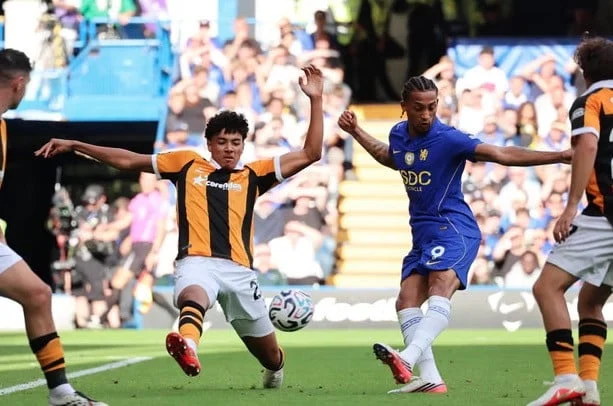
At Stamford Bridge, Chelsea’s quest for consistency took another hit as they were forced to scramble for a 2-2 draw against a resilient Hull City side. The match began with promise for the home side, as Morgan Rogers opened the scoring, sending a clear signal that the Blues intended to control the proceedings. However, the momentum shifted dramatically as the game progressed. Hull City, showcasing tactical maturity and composure in the final third, clawed their way back into the match.
Mohamed Belloumi proved to be the protagonist of the afternoon, netting a brace that stunned the home crowd and put the visitors in an improbable 2-1 lead. The atmosphere in West London grew tense as Chelsea struggled to find a response. It was not until the 66th minute that Joao Pedro managed to equalize, salvaging a point for the Blues. The result leaves Chelsea management with significant questions regarding their defensive transition, particularly their vulnerability to pace on the counter-attack. Post-match, observers noted that while Chelsea maintained higher possession statistics, their inability to convert sustained pressure into a victory remains a recurring theme early in the season.
Liverpool’s Attacking Drought Against Fulham
In a separate fixture, Liverpool faced an equally frustrating afternoon at Anfield, where they were held to a 0-0 stalemate by Fulham. Despite a formidable lineup and the backing of a vocal home support, the Reds failed to break down a compact and well-drilled Fulham defense. The Cottagers, employing a low block and disciplined man-marking, successfully neutralized Liverpool’s creative midfielders and prevented the high-intensity press that usually characterizes Jurgen Klopp’s (or the current tactical setup’s) philosophy.
Statistically, Liverpool dominated the shot count, yet they lacked the clinical edge required to bypass the visitors’ goalkeeper. The draw acts as a significant setback for a team looking to establish early dominance in the title race. The lack of goals will likely dominate the training ground discussions this week, as the team looks to address a sudden loss of fluidity in the final third.
Aston Villa’s Home Disappointment
Perhaps the most surprising result of the day occurred at Villa Park, where Aston Villa suffered a 1-2 defeat at the hands of Nottingham Forest. Having established themselves as a formidable force at home over the past two seasons, the defeat serves as a sobering reality check for the Villans. Nottingham Forest executed a disciplined game plan, absorbing pressure before delivering precise strikes that left the Villa defense scrambling. The loss is particularly painful for Villa, who were widely expected to secure all three points given their current form and home-field advantage. For Forest, the result is a statement of intent, suggesting that they have the personnel and the tactical flexibility to compete with Europe-chasing sides on their own turf.
High-Scoring Thrillers: Crystal Palace and Bournemouth
The remaining fixtures provided the day’s most exciting offensive displays. Crystal Palace’s 2-3 loss to Ipswich Town was a rollercoaster affair. Despite being at home, Palace’s defensive lapses were exploited by an Ipswich side that looked confident and sharp in transition. The victory marks a significant milestone for Ipswich, demonstrating their capacity to secure points away from home in high-pressure environments.
Similarly, the clash between Bournemouth and Brentford ended in a 2-2 draw, reflecting the competitive balance between these two clubs. The game was characterized by constant momentum shifts, with both sides finding the back of the net twice in a display of end-to-end football. Both managers will likely point to defensive errors as the primary cause for the dropped points, yet the entertainment value of the match underscored the quality of depth currently present in the Premier League.
Chronological Breakdown of the Saturday Fixtures
The schedule was packed tight, starting with the early kick-off that set the tone for the day. By the time the final whistle blew in the late evening matches, the landscape of the table had shifted significantly:
- 12:30 PM BST: The day kicked off with Crystal Palace hosting Ipswich Town, a match that saw early defensive cracks lead to a 3-2 victory for the visitors.
- 3:00 PM BST: A flurry of simultaneous action saw the draw between Bournemouth and Brentford, the shock defeat of Aston Villa by Nottingham Forest, and the frustrating stalemate between Liverpool and Fulham.
- 5:30 PM BST: The day concluded with the high-stakes clash at Stamford Bridge, where Chelsea’s late comeback ensured the points were shared with Hull City.
Statistical Context and Tactical Analysis
When analyzing the data from these matches, a clear trend emerges: defensive organization is currently outpacing attacking creativity in the lower to mid-table encounters. Across the five matches, there was an average of 2.6 goals per game, suggesting that while games are competitive, there is a lack of sustained goal-scoring dominance.
Furthermore, possession percentages in the Chelsea and Liverpool matches were heavily skewed in favor of the home sides, yet the "expected goals" (xG) metrics suggest that the visitors were far more efficient with their opportunities. This suggests that the league is seeing a tactical evolution where smaller teams are increasingly comfortable conceding possession to create high-probability counter-attacking opportunities.
Implications for the Premier League Table
The ripple effects of these results are substantial. For Liverpool and Chelsea, failing to secure maximum points against sides like Fulham and Hull City allows the league leaders to build a cushion early in the campaign. In a league where every point is contested with extreme intensity, these dropped points often prove to be the difference between a title challenge and a battle for the top four come May.
For clubs like Nottingham Forest and Ipswich Town, these results provide a crucial morale boost. Securing points against established Premier League entities provides the psychological reinforcement necessary for a sustained campaign. Conversely, for Aston Villa and Crystal Palace, the focus will now shift to defensive drills to prevent similar outcomes in the coming weeks.
Managerial and Player Reactions
While official post-match press conferences were characterized by diplomatic responses, the frustration among the "big" clubs was palpable. Managers emphasized the need for "better concentration" and "greater composure in the final third." Players, meanwhile, acknowledged the difficulty of breaking down low-block defenses.
"We knew it would be a physical battle," noted one Chelsea representative post-match. "We showed character to come back from a deficit, but the reality is that we expected three points. We have to learn to manage these situations more effectively when we are in the lead."
Conversely, the mood in the visiting dressing rooms was one of collective triumph. The ability to travel to stadiums like Anfield or Stamford Bridge and depart with points is a testament to the narrowing gap between the league’s top and bottom tiers.
Looking Ahead: The Road to Mid-Season
As the Premier League moves into the next set of fixtures, the focus will be on how the top clubs respond to these setbacks. Historically, teams that suffer early-season stumbles are forced to rotate their squads and adjust their tactical approach to find a winning formula. With European competitions set to begin soon, the pressure on squads will only increase, making these early-season points even more vital.
The results from September 12, 2026, serve as a microcosm of the current state of English football: unpredictable, demanding, and uncompromising. As the season continues, fans can expect the narrative of "the gap closing" to remain a central theme. With no clear hierarchy yet established, the coming months promise to be a tactical chess match played out at the highest level of intensity. The parity observed this Saturday ensures that the race for the title, European qualification, and survival remains entirely open, keeping supporters and analysts alike on the edge of their seats for the foreseeable future.