The opening matchday of the 2026/2027 UEFA Champions League season burst into life between Wednesday, September 9, and Thursday, September 10, 2026, delivering an intoxicating mix of clinical goalscoring masterclasses and tense, tactical stalemates. Europe’s premier club competition returned under its revamped league-phase format, immediately testing the depth, tactical flexibility, and psychological resilience of the continent’s finest football institutions. Across stadiums from Catalonia to Paris, and Merseyside to London, established powerhouses asserted their authority, while continental challengers endured harsh lessons on the realities of elite European competition.
Most notably, Spanish giants Barcelona and reigning French champions Paris Saint-Germain (PSG) captured the headlines with emphatic, high-scoring victories that sent a clear warning to the rest of the continent. Meanwhile, English Premier League heavyweights Liverpool and Arsenal were forced to dig deep into their reserves of character, grinding out hard-fought results against formidable opposition. As the tournament embarks on its grueling journey toward the knockout stages, the opening night provided definitive proof that the road to the European crown will be fiercely contested, unpredictable, and relentlessly high-paced.
Chronological Overview of Matchday One Action
The mid-week footballing marathon commenced on Wednesday evening with a flurry of early fixtures designed to test the readiness of clubs returning from their respective domestic weekend fixtures. The scheduling, meticulously organized by UEFA to maximize global television audiences under the unified league table format, saw matches stagger across two distinct time zones on both nights.
In the early kickoff slot, tension filled the air at several venues as tactical chess matches unfolded. However, as the evening progressed into the marquee late-night window across Central European Time (CET)—translating to midnight and the early hours of Thursday morning in Southeast Asia (WIB)—the floodgates opened. Barcelona welcomed Dutch Eredivisie powerhouse Feyenoord to the iconic, albeit partially renovated, Camp Nou. From the opening whistle, Hansi Flick’s side imposed a suffocating high press that immediately pinned the visitors deep into their own half.
Simultaneously, at the Parc des Princes in the French capital, Luis Enrique’s PSG prepared to defend their continental crown against Slovakian champions Slovan Bratislava. The atmosphere crackled with expectation as the Les Parisiens faithful anticipated another stellar European campaign following their historic triumph the previous season.
As Wednesday night bled into Thursday morning, attention shifted toward the high-profile clashes involving English representatives. Liverpool hosted Spanish defensive stalwarts Atletico Madrid at Anfield under the famous European floodlights, a fixture historically rich in high drama and tactical friction. Concurrently, Mikel Arteta’s Arsenal welcomed Italian powerhouse Napoli to the Emirates Stadium, pitting North London ambition against the tactical acumen of Serie A’s finest. By the time the final referee blew his whistle in London, the first chapter of the 2026/2027 league phase was firmly written, leaving analysts and supporters with a mountain of data, tactical shifts, and shifting odds to digest.
Catalan and Parisian Ruthlessness: Barcelona and PSG Shine
The most visually striking outcomes of the opening matchday belonged unequivocally to Barcelona and Paris Saint-Germain, both of whom treated their home supporters to masterclasses in attacking transition, positional fluidity, and ruthless finishing.
At Camp Nou, Barcelona dismantled Feyenoord with a commanding 5-1 scoreline. The Blaugrana displayed an offensive synergy that blended veteran composure with youthful exuberance. Brazilian winger Raphinha orchestrated much of the attacking brilliance, netting two sublime goals that underscored his importance to Flick’s tactical ecosystem. The supporting cast proved equally lethal. Summer arrival Karim Adeyemi injected devastating pace into the left channel, terrorizing the Feyenoord defensive line before getting his name on the scoresheet. Teenage sensation Lamine Yamal continued his meteoric rise, curling a sublime effort past the despairing dive of the Feyenoord goalkeeper, while newly acquired striker Gabriel Jesus capped off a stellar performance with a well-taken goal, demonstrating his seamless integration into the Catalan tactical blueprint. Feyenoord, to their credit, attempted to mount sporadic counterattacks, with Sem Steijn grabbing a consolation goal for the visitors, but the Dutch side was ultimately overwhelmed by the sheer intensity and technical superiority of the hosts.
Not to be outdone, reigning champions Paris Saint-Germain delivered an even more emphatic statement of intent, crushing Slovan Bratislava 6-1 at the Parc des Princes. PSG’s attacking machinery operated with terrifying precision, spearheaded by the scintillating form of Ousmane Dembele and Spanish international Ferran Torres. Dembele carved open the Slovakian defense repeatedly, contributing two clinical goals that highlighted his transformation into one of Europe’s most decisive wide forwards. However, the night undeniably belonged to Ferran Torres, who executed a brilliant hat-trick, showcasing exceptional movement inside the penalty box and a predatory instinct that left the Slovan backline completely helpless. Fabian Ruiz added a sixth with a thunderous long-range strike, while Slovan Bratislava’s Suleiman Camara scored a respectable lone reply for the visitors. The victory not only secured three vital points for PSG but also reinforced their status as the team to beat in this season’s competition.
Premier League Resilience: Liverpool and Arsenal Grind Out Narrow Wins
In stark contrast to the goal-fests witnessed in Spain and France, English representatives Liverpool and Arsenal had to rely on grit, tactical discipline, and late-game heroics to secure their opening victories. The matches served as a timely reminder that continental success often demands the ability to suffer and grind out results when performances fall short of perfection.
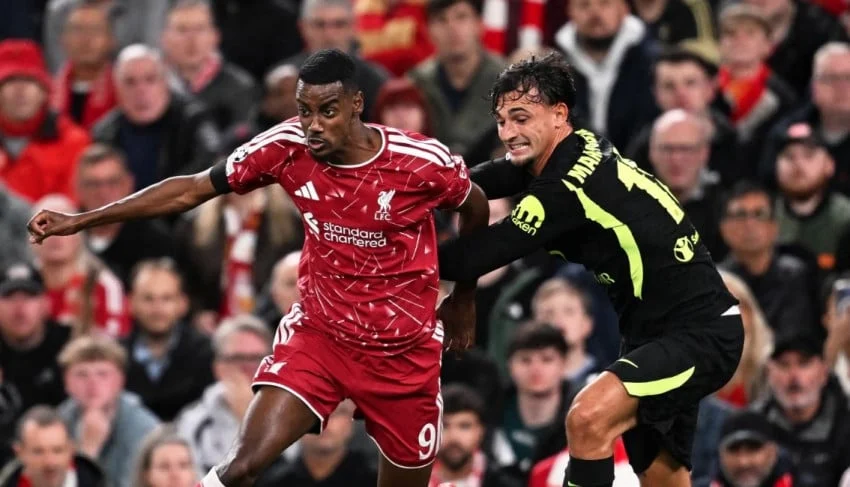
At Anfield, Liverpool welcomed Diego Simeone’s notoriously resilient Atletico Madrid side. The match lived up to its heavyweight billing, beginning in nightmarish fashion for the Reds when Marcos Llorente capitalized on a defensive lapse to fire the visitors ahead in the first half. The goal silenced the Anfield faithful and invited Atletico to drop into their trademark low block, frustrating Liverpool’s attempts to build rhythmic momentum. However, manager Arne Slot’s tactical adjustments at halftime breathed new life into the Merseyside club. Dominick Szoboszlai ignited the comeback with a ferocious long-range strike that rocketed into the top corner, sending the home crowd into raptures. Buoyed by the equalizer, Liverpool poured forward in waves. The pressure finally told late in the match when Argentine midfielder Alexis Mac Allister kept his composure inside a crowded box, poking home the winner to complete a dramatic 2-1 comeback and secure a massive psychological victory for the English side.
Meanwhile, in North London, Arsenal faced a deeply stubborn Napoli side that came to the Emirates with a meticulously crafted defensive plan. Mikel Arteta’s men dominated possession territory throughout the match, but struggled to break down a well-organized Italian rearguard that closed down shooting lanes with military precision. As frustration began to mount among the home supporters, captain Martin Odegaard stepped up when it mattered most. In the 75th minute, the Norwegian playmaker orchestrated a neat one-two on the edge of the box before curling a delicate, precise effort past the Napoli goalkeeper. The 1-0 victory was far from pretty, but it provided Arsenal with a clean sheet, three crucial points, and a valuable lesson in patience against elite defensive structures.
Tactical Evolution and League-Phase Dynamics
The 2026/2027 season represents another crucial chapter in the evolution of the UEFA Champions League under the expanded 36-team single-league phase format. Gone are the traditional four-team groups where calculators were required ahead of the final matchday; instead, every single goal, point, and goal difference metric now carries monumental weight on a monolithic table.
Tactical analysts observing the opening round noted a clear trend toward high-intensity pressing and numerical superiority in central midfield zones. Teams that failed to transition quickly from defense to attack found themselves brutally exposed—a fate that befell Feyenoord and Slovan Bratislava. Conversely, managers like Hansi Flick and Luis Enrique utilized fluid attacking structures that constantly rotated positions, making man-marking assignments nearly impossible for opposing defenders.
Furthermore, the physical demands placed on players at the beginning of the European autumn have intensified. With domestic leagues already three or four matchdays deep, physical fatigue is setting in earlier than in previous eras. This reality explains why teams like Liverpool and Arsenal had to dig deep into their physical and mental reserves rather than cruising through their fixtures. The depth of a squad is no longer a luxury; it is an absolute prerequisite for survival in a competition that now features more matches than ever before.
Post-Match Reactions and Managerial Perspectives
In the immediate aftermath of the opening fixtures, managers across Europe offered candid assessments of their teams’ performances, balancing satisfaction with cautious warnings about the grueling road ahead.
Barcelona manager Hansi Flick expressed immense pride in his squad’s offensive output while maintaining a steadfast focus on future challenges. Speaking to the press at Camp Nou, Flick emphasized the importance of maintaining defensive concentration despite the comfortable scoreline. "We played with incredible energy, and the quality of our combinations in the final third was exceptional," Flick remarked. "However, at this level, matches change very quickly. We allowed them a goal due to a momentary lapse in focus, and against tougher opponents, that can prove fatal. We celebrate tonight, but tomorrow the work begins for the next test."
In Paris, Luis Enrique lauded the collective hunger of his defending champions, singling out Ferran Torres for special praise following his stunning hat-trick. "Ferran worked tirelessly during the pre-season, and his movement off the ball tonight was world-class," Enrique stated. "More importantly, I am pleased with the attitude of the entire group. Winning the trophy is difficult, but defending it is twice as hard. The players showed tonight that they still possess the hunger and humility required to conquer Europe."
On the English front, Liverpool boss Arne Slot admitted that his side faced a baptism of fire against Atletico Madrid’s tactical discipline. "You never get an easy game against Diego Simeone’s teams, and going behind early tested our emotional control," Slot noted. "The reaction from the players in the second half was magnificent. Dominick’s goal changed the atmosphere inside the stadium, and Alexis showed great composure to win it for us. It’s three points, but we must learn from our slow start."
Arsenal manager Mikel Arteta echoed similar sentiments regarding the difficulty of breaking down disciplined European opponents. "Napoli are a top-tier tactical side with immense experience," Arteta said. "We had to be patient, disciplined, and maintain our defensive structure even when we weren’t scoring. Martin’s goal was a moment of pure quality, but the clean sheet and the maturity we showed in the final fifteen minutes pleased me just as much."
Broader Impact and Implications for the 2026/2027 Season
As the dust settles on the opening matchday of the 2026/2027 UEFA Champions League, the broader implications for the rest of the campaign are beginning to crystallize. The massive victories recorded by Barcelona and PSG have immediately established a psychological benchmark for goal difference, a metric that could prove decisive when determining automatic qualification spots for the Round of 16 versus the perilous playoff rounds.
For clubs finishing outside the top eight spots on the new league table, the pressure to secure points in upcoming away fixtures will escalate exponentially. Traditional powerhouses that stumbled or labored in their opening matches will be forced to recalibrate quickly, as the margin for error in the expanded league phase leaves little room for complacency.
Furthermore, the financial and commercial stakes attached to deep runs in this season’s competition continue to soar, placing immense pressure on technical directors and ownership groups. As fixture congestion peaks during the winter months, squad rotation will dictate which clubs maintain their domestic momentum while chasing European glory. For now, the opening week has delivered everything supporters could have hoped for: high drama, tactical ingenuity, spectacular goals, and a tantalizing glimpse into a season that promises to rewrite the history books of European football.