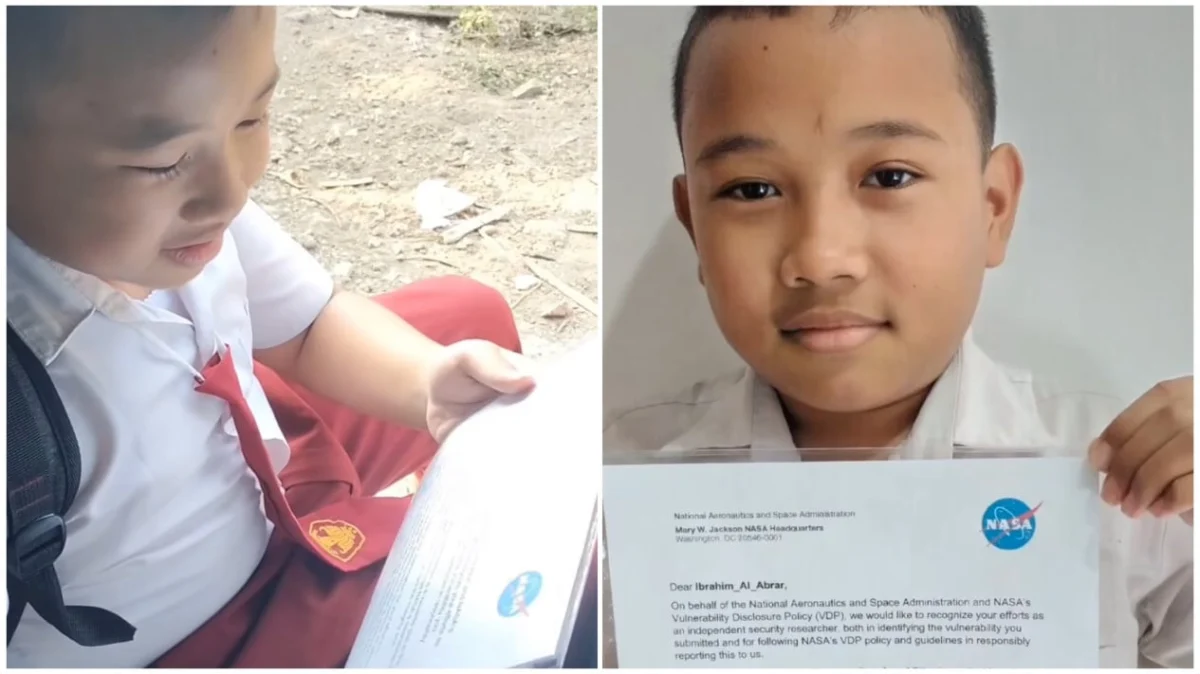
In an era where digital literacy is becoming as fundamental as traditional reading and writing, the story of Ibrahim Al Abrar stands as a testament to the potential of Indonesia’s youth in the global technological landscape. Ibrahim, an 11-year-old student from a rural village in Central Java, has captured national and international attention after receiving a formal Letter of Recognition (LOR) from the National Aeronautics and Space Administration (NASA). This commendation was awarded in response to his successful identification of a security vulnerability within one of the space agency’s public domains, marking a significant achievement for a self-taught coder who has yet to graduate from elementary school.
The recognition of Ibrahim, a sixth-grade student at SD Negeri Genengsari 3 in Boyolali, highlights a growing trend of "white-hat" hacking and ethical security research among Gen Alpha. While many children his age utilize the internet primarily for entertainment, Ibrahim has dedicated his extracurricular hours to mastering the complexities of cybersecurity. His journey from a casual gamer to a recognized security researcher serves as a blueprint for digital talent development in regions often overlooked by the tech industry.
The Genesis of a Young Ethical Hacker
Ibrahim Al Abrar, known affectionately as Ibra, was born on July 25, 2014. He resides in Genengsari Village, located in the Kemusu District of Boyolali Regency. This area, situated near the Kedung Ombo Reservoir, is characterized by its agricultural landscape, far removed from the high-tech hubs of Jakarta or Bandung. Despite the geographic isolation, Ibrahim’s access to the digital world provided him with a gateway to global knowledge.
The transition from consumer to creator began when Ibrahim was in the fourth grade. Like many children of the digital age, his initial entry point into technology was through video games. However, his father, Aminudin Salas, played a pivotal role in redirecting this interest. Aminudin, who serves as a teacher specializing in Computer and Network Engineering (Teknik Komputer dan Jaringan or TKJ), encouraged his son to look "under the hood" of the games he enjoyed. Rather than merely consuming content, Aminudin challenged Ibrahim to understand how software is built and, more importantly, how it can be secured.
Ibrahim’s mother, Hannisa Oktaviani, a dedicated homemaker, supported this intellectual pursuit by ensuring he had the environment necessary to focus on his self-directed studies. Without formal coding bootcamps or expensive private tutors, Ibrahim turned to the vast resources of the internet. He utilized YouTube tutorials, specialized coding forums, and increasingly, Artificial Intelligence (AI) tools to bridge the gap in his knowledge. When he encountered complex concepts in network security or programming syntax that were beyond the typical elementary curriculum, he leveraged AI to explain these theories in simpler terms, effectively creating a personalized, high-level learning path.
The NASA Discovery and the Letter of Recognition
The achievement that brought Ibrahim into the spotlight was his participation in a Vulnerability Disclosure Program (VDP). Many large organizations, including government agencies like NASA, maintain these programs to allow ethical hackers to report security flaws in a controlled and legal manner. This practice, often referred to as "crowdsourced security," helps organizations patch vulnerabilities before they can be exploited by malicious actors.
Ibrahim’s discovery involved identifying a loophole in the security architecture of a NASA-owned public domain. While the specific technical details of the vulnerability are often kept confidential to prevent further exploitation, the significance of the find was enough for NASA to issue a formal Letter of Recognition. Such a document is a highly coveted credential in the cybersecurity world, serving as a "proof of concept" of a researcher’s skills and ethical standards.
The LOR from NASA does not just signify a technical catch; it acknowledges the researcher’s adherence to the rules of engagement. By reporting the flaw through the proper channels rather than attempting to exploit it or publicizing it prematurely, Ibrahim demonstrated a level of professional maturity that belies his age. The news of this recognition first gained widespread traction through the Instagram account @IbraCoding, which documents Ibrahim’s progress and serves as an inspiration for other young Indonesians interested in STEM (Science, Technology, Engineering, and Mathematics).
Contextualizing the Achievement: Cybersecurity in Indonesia
Ibrahim’s success comes at a time when Indonesia is facing an urgent need for cybersecurity talent. According to data from the National Cyber and Crypto Agency (BSSN), Indonesia recorded hundreds of millions of "traffic anomalies" or potential cyberattacks annually over the past several years. As the nation pushes toward its "Golden Indonesia 2045" vision, the development of a digital-ready workforce is a top priority.
However, the path to becoming a cybersecurity professional is often steep. It requires a deep understanding of networking, cryptography, system architecture, and the psychology of social engineering. The fact that an 11-year-old from Boyolali could navigate these complexities autonomously highlights the democratization of education through technology. It also underscores a critical shift: talent is no longer confined to urban centers with elite infrastructure.
In the broader context of the global tech industry, Ibrahim joins a small but elite group of "junior" ethical hackers who have received acknowledgments from major entities like Google, Microsoft, and Tesla. These stories often trigger a mix of awe and a call to action for educational reform, suggesting that traditional curricula may need to adapt more quickly to include high-level digital skills.
Chronology of Ibrahim’s Skill Development
To understand the magnitude of Ibrahim’s achievement, one must look at the timeline of his self-education:
- 2022 (Grade 4): Initial interest sparked by gaming. Under his father’s guidance, Ibrahim begins exploring basic coding languages and the logic behind software development.
- 2023 (Grade 5): Ibrahim shifts his focus from general coding to cybersecurity. He begins studying how systems communicate and where the potential "cracks" in those communications exist. He starts using AI as a tutor to navigate advanced technical documentation.
- Early 2024 (Grade 6): Ibrahim begins exploring Vulnerability Disclosure Programs. He practices on various platforms that allow for legal security testing.
- Mid-2024: Ibrahim identifies a vulnerability in a NASA domain and submits a detailed report through the agency’s official VDP.
- July 2026: The story of his Letter of Recognition goes viral, positioning him as a symbol of Indonesia’s digital potential. (Note: Per the source date, this recognition remains a landmark event in his ongoing education).
Reactions from the Community and Experts
The local community in Boyolali has reacted with immense pride. Officials at SD Negeri Genengsari 3 have noted that while Ibrahim is a quiet and diligent student in his daily classes, his proficiency in a field as specialized as cybersecurity was a revelation to many. His story has prompted local educational boards to consider how to better support "gifted" students in the digital arts.
Cybersecurity experts in Indonesia have also weighed in on the significance of the NASA LOR. Many emphasize that Ibrahim’s journey is a perfect example of "Responsible Disclosure." In a country where the line between "hacking for fun" and "illegal cyber activity" can sometimes be blurred in the eyes of the youth, Ibrahim’s adherence to ethical standards provides a crucial lesson.
"What Ibrahim has done is the gold standard for any aspiring security professional," says one industry analyst. "He found a problem, he didn’t touch what wasn’t his, and he told the owners how to fix it. That integrity is just as important as his ability to code."
The Broader Impact and Implications
Ibrahim Al Abrar’s story carries several implications for the future of education and technology in Indonesia:
1. The Role of Parental Guidance: Ibrahim’s father did not ban gaming; he transformed it into a learning opportunity. This suggests that parental "digital mediation"—guiding how children use technology rather than just limiting screen time—is vital for fostering talent.
2. AI as an Educational Equalizer: Ibrahim’s use of AI to understand complex topics suggests that AI could be a powerful tool in narrowing the educational gap between rural and urban areas. It allows students in remote villages to access "tutors" that provide high-level technical explanations previously only available in specialized schools.
3. The Need for Early Cybersecurity Awareness: As more children go online at younger ages, the risks of cybercrime increase. Ibrahim’s story promotes the idea of "cybersecurity by design," encouraging the next generation to think about safety and ethics from the moment they start using digital tools.
4. Redefining the "Digital Divide": Traditionally, the digital divide was about access to hardware. Ibrahim’s case shows that with basic internet access and a motivated mind, the divide can be crossed. The focus must now shift to "skill-based" access—teaching children how to find and use the high-quality educational resources that are already available for free.
Future Aspirations
For Ibrahim, the NASA Letter of Recognition is not the finish line. As stated in his social media updates, this is merely the "initial step" toward his dream of becoming a professional cybersecurity expert. He continues to balance his schoolwork with his passion for technology, maintaining a disciplined schedule that allows him to remain a regular student while pursuing a career path that usually begins after university.
His journey serves as a reminder that the next great technological breakthrough or the next defender of global digital infrastructure could come from anywhere—even a small village in Boyolali. As Ibrahim approaches his teenage years, the tech community will undoubtedly be watching his progress, as he represents a new generation of Indonesians ready to compete and contribute on the world stage.
The story of Ibrahim Al Abrar is more than a human-interest piece; it is a signal of the changing tides in global talent distribution. It underscores the reality that in the digital age, curiosity, coupled with the right ethical framework and access to information, can propel a child from a rural schoolhouse to the recognition of the world’s most prestigious space agency.