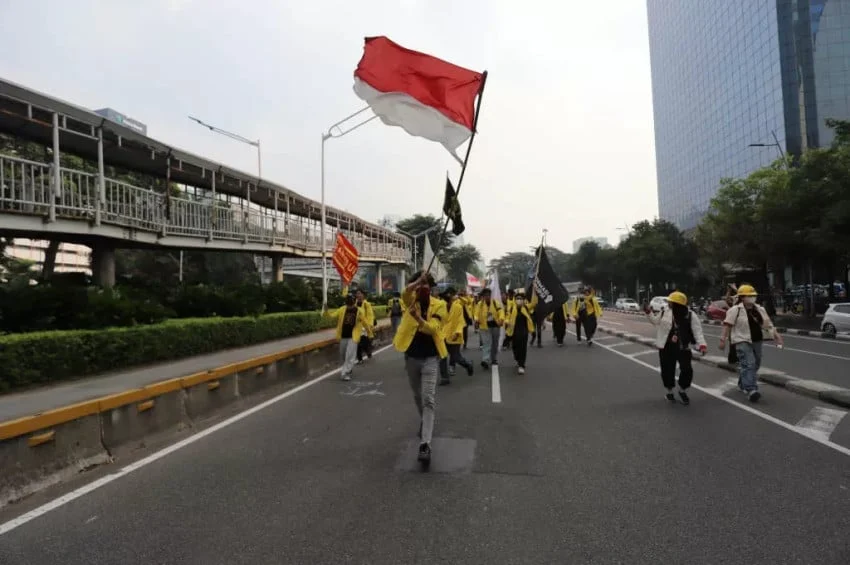
The streets of Central Jakarta are bracing for heightened mobilization and potential gridlock as a large coalition of university students, most notably spearheaded by the Student Executive Board of the University of Indonesia (BEM UI), alongside various civil society organizations, prepares to stage a widespread demonstration. Scheduled for Wednesday, October 28, 2026, the mass mobilization aims to voice critical socio-political demands concerning governance, policy transparency, and the protection of constitutional rights. In anticipation of the demonstrations, the Jakarta Metropolitan Police (Polda Metro Jaya) has announced comprehensive, situational traffic management strategies to mitigate congestion across four major focal points in the capital.
According to official advisories disseminated through the Traffic Management Center (TMC) of Polda Metro Jaya via its official social media channels, the demonstrations are slated to commence at 10:00 AM Western Indonesia Time (WIB) and will persist until the aspirations of the demonstrators have been formally articulated. The primary congregation zones identified by law enforcement authorities encompass the legislative complex of the People’s Consultative Assembly and the House of Representatives (DPR/MPR RI) in Senayan, the iconic Hotel Indonesia (HI) Roundabout, the National Monument (Monas) area, and the Tugu Tani historical monument. These locations historically serve as the epicenter for major civic expressions and policy-related protests in the sprawling Indonesian metropolis.
Main Facts and Security Adjustments
The convergence of thousands of students and labor or civic elements requires an extensive mobilization of security forces to maintain public order while safeguarding the constitutional rights of the participants. Polda Metro Jaya has urged city commuters, motorists, and the general public to proactively avoid the designated protest corridors. Furthermore, authorities have strongly recommended utilizing alternative routes, readjusting daily travel itineraries, and strictly adhering to the direct instructions issued by traffic officers stationed on the ground.
While law enforcement has confirmed that standard operational procedures will be deployed to secure the perimeters, the announcement has triggered a wave of proactive reminders from human rights watchdogs regarding the necessity of restraint and proportional handling. The simultaneous activation of multiple strategic locations across Central Jakarta underscores the scale of the coordinated action, which is expected to draw participants from various campuses across the Greater Jakarta (Jabodetabek) region. Public transportation networks, including the TransJakarta bus rapid transit corridors and local commuter lines intersecting the affected zones, are anticipated to experience rolling schedule adjustments and localized route truncations depending on the movement of the masses.
Background Context and Catalysts of the October 2026 Mobilization
The mobilization scheduled for late October 2026 does not occur in a vacuum; rather, it represents the culmination of mounting public discourse surrounding legislative decisions, economic pressures, and civic freedoms. In the preceding months, student factions and civil society groups have expressed growing discontent over several key policy developments, ranging from budgetary allocations and labor regulations to transparency in public administration.
Student movements in Indonesia have historically functioned as a vital moral compass and a formidable pressure group during critical junctures of the nation’s democratic journey. The involvement of BEM UI consistently elevates the national profile of these demonstrations, often galvanizing student bodies from other prominent institutions such as Gadjah Mada University (UGM), Bandung Institute of Technology (ITB), and Bogor Agricultural University (IPB) to issue solidarity statements or deploy auxiliary contingents to the capital. The choice of October 28 holds deep symbolic resonance for the Indonesian youth, historically commemorating Youth Pledge Day (Hari Sumpah Pemuda), a foundational milestone in the nation’s history where young nationalists swore allegiance to one motherland, one nation, and one language. By selecting this specific date, the organizers deliberately invoke the spirit of civic duty and historical responsibility inherent in the Indonesian student movement.
Chronology of Preparations and Escalating Tensions
The trajectory leading up to the October 28 demonstrations reflects a structured buildup of organizational meetings, consolidation of demands, and pre-emptive dialogues between stakeholder groups and authorities.
In early October 2026, coalition meetings were held across several university campuses in Depok and South Jakarta to draft a unified manifesto. These sessions focused on streamlining divergent demands into a cohesive set of policy recommendations directed at the central government and the parliament. By mid-October, formal notification letters regarding the peaceful intent of the assembly were dispatched to regional police headquarters in compliance with national legal frameworks governing freedom of expression.
As the date approached, law enforcement agencies conducted internal briefings to assess threat levels, designate security perimeters, and coordinate inter-agency responses involving municipal police (Satpol PP) and transportation personnel (Dishub). Concurrently, human rights organizations began monitoring the pre-action climate, issuing timely interventions to ensure that both demonstrators and security personnel remained committed to peaceful engagement. The dialogue between civil society watchdogs and state apparatuses set a cautious yet cooperative tone ahead of the high-stakes mobilization.
Official Responses and the Human Rights Imperative
A defining characteristic of the lead-up to the October 28 demonstrations has been the proactive stance assumed by oversight bodies, most notably the National Commission on Human Rights (Komnas HAM). In the days preceding the protest, the Chairperson of Komnas HAM, Anis Hidayah, issued a direct and unequivocal reminder to the security apparatus, emphasizing the absolute necessity of integrating a human rights-based approach into all operational protocols.
Anis underscored that the freedom of expression in public spaces is a fundamental constitutional right explicitly guaranteed by the 1945 Constitution of the Republic of Indonesia as well as national and international human rights instruments. Consequently, the exercise of this right must be met with institutional facilitation rather than obstruction, provided it is conducted peacefully and within the boundaries of the law.
"The duty of the apparatus is certainly to ensure the conduciveness of the implementation of this right, ensuring it is carried out peacefully, without using excessive force, and without acts of violence," Anis stated during a press briefing. This official stance serves as a vital benchmark for evaluating the professionalism of law enforcement officers deployed to the field, establishing clear accountability frameworks should friction arise between security personnel and civilian demonstrators.
Furthermore, legal experts and civil society leaders have echoed these sentiments, pointing out that transparent communication between protest organizers and police commanders significantly reduces the likelihood of tactical misunderstandings. Past demonstrations in Jakarta have occasionally suffered from opportunistic infiltrations by agitators unaffiliated with the student coalitions, a dynamic that both police and student marshals have vowed to actively monitor and prevent during the upcoming rally.
Broader Impact and Socio-Economic Implications
The convergence of thousands of demonstrators in four critical hubs of Central Jakarta inevitably generates a ripple effect across the capital’s economic, logistical, and social ecosystem. Central Jakarta houses not only the core organs of national governance—such as the parliament building and presidential palace surroundings—but also major commercial districts, financial centers, and diplomatic missions.
From an economic perspective, localized gridlock and preemptive road closures temporarily disrupt commercial activities, supply chain logistics, and commuter efficiency. Retail establishments, corporate offices, and service providers operating within the vicinity of the HI Roundabout, Monas, and Tugu Tani frequently report fluctuating customer traffic and alter operational hours on major protest days. Public transport authorities face the constant challenge of balancing commuter mobility with safety protocols, often necessitating dynamic rerouting that tests the resilience of Jakarta’s integrated transit network.
Yet, beyond the immediate logistical inconveniences, large-scale demonstrations serve as a barometer of the nation’s democratic health. They provide an institutionalized safety valve for public grievances, allowing citizens and youth leadership to directly address policymakers without resorting to systemic instability. The manner in which the state apparatus responds to the October 28 mobilization will be closely scrutinized by domestic analysts and international observers alike, serving as a litmus test for the administration’s commitment to upholding civic space, democratic dialogue, and fundamental human rights. As Jakarta prepares for the influx of thousands of placard-bearing citizens, the collective focus remains fixed on the peaceful articulation of grievances and a measured, professional response from those entrusted with maintaining public order.