The high-ranking leadership of the Indonesian National Police (Polri) and the central executive board of Muhammadiyah, one of the country’s largest Islamic organizations, have renewed their commitment to collaborative national security governance. This strategic alignment was emphasized during a high-profile visit by the Chief of the Indonesian National Police, General Police Suyudi Ario Seto, to the Kantor Pimpinan Pusat (Central Executive Board) of Muhammadiyah in Jakarta.
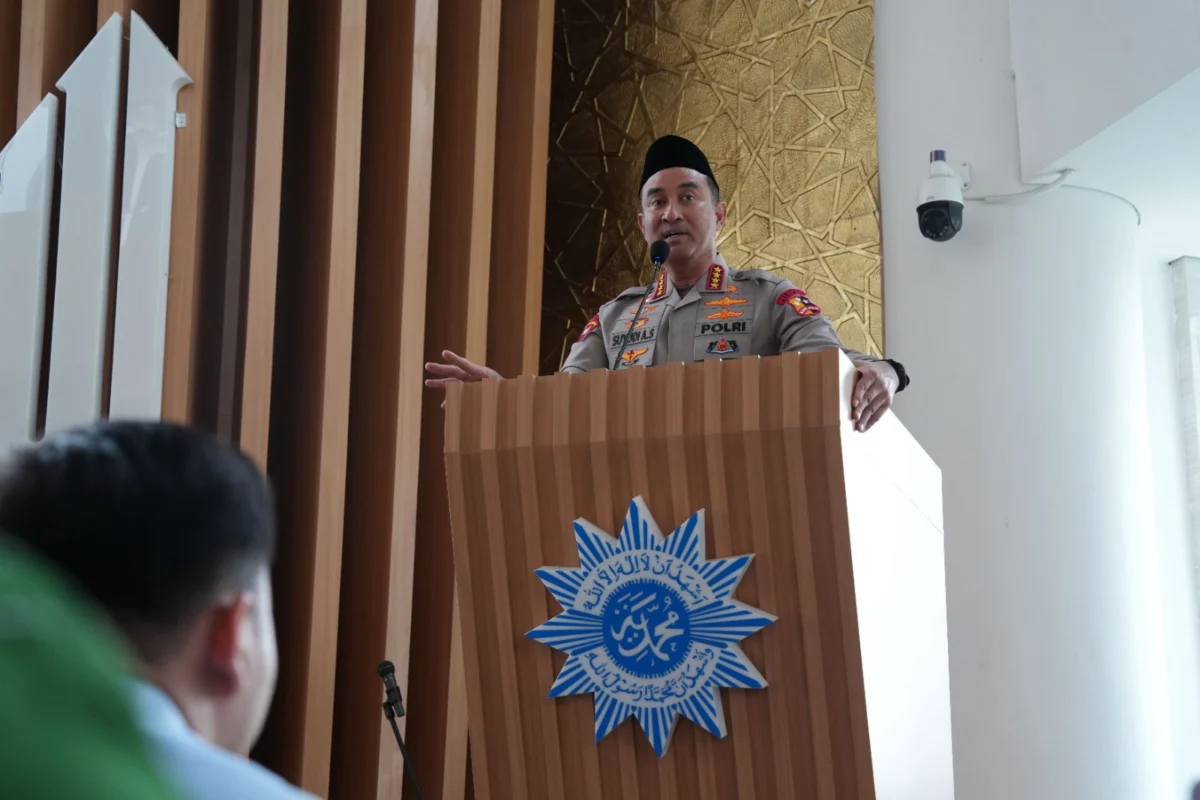
The visit, which took place on a Wednesday, was marked by strategic discussions addressing some of the most pressing socio-security challenges facing contemporary Indonesia. Beyond administrative diplomacy, the engagement carried a strong moral and community-centric message. General Suyudi delivered a religious lecture, known locally as a kultum, following the congregational Zuhur prayer at the At-Tanwir Mosque situated within the Muhammadiyah complex. Through this spiritual platform, the nation’s top law enforcement official articulated a comprehensive vision for grassroots security, digital literacy, and the total eradication of illicit substances, framing these efforts as fundamental prerequisites for the realization of Indonesia Emas (Golden Indonesia) 2045.
Main Facts of the Strategic Engagement
The primary objective of General Suyudi’s visit was to institutionalize and expand the existing cooperative framework between law enforcement agencies and religious civil society organizations. The cooperation spans multiple administrative tiers, cascading down from the national headquarters (Mabes Polri) to provincial police departments (Polda), municipal resorts (Polres), and sub-district sectors (Polsek).
During the deliberations, General Suyudi formally acknowledged the indispensable role played by Muhammadiyah’s extensive network of educational institutions, healthcare facilities, and social organizations in maintaining public order (kamtibmas). He noted that the triad of law enforcement, religious scholarship (ulama), and community participation forms an impenetrable bulwark against criminal syndicates and social fragmentation.
The discourse centered heavily on three critical pillars: the containment of digital toxicity and misinformation, the uncompromising war on narcotics and localized crime catalysts, and the preservation of national cohesion amid deep-rooted demographic and cultural diversity. By leveraging the moral authority of Muhammadiyah, Polri seeks to penetrate deeper into local communities, fostering a culture of compliance, mutual respect, and proactive civic responsibility.
Chronology of the Visit and Apostolic Address
The sequence of events on Wednesday began with the formal arrival of General Suyudi and his high-ranking entourage at the Muhammadiyah Central Executive Office in Jakarta. Following official welcoming protocols and closed-door bilateral discussions with senior Muhammadiyah executives regarding inter-institutional security cooperation, the delegation proceeded to the At-Tanwir Mosque.
At approximately 12:30 PM local time, the congregation gathered for the congregational Zuhur prayer, led in accordance with standard institutional protocols. Immediately following the prayer session, General Suyudi stepped up to deliver the scheduled kultum.
Rather than confining his remarks to conventional religious tropes, the Chief of Police utilized the religious platform to address acute secular vulnerabilities affecting Indonesian society. He dissected the nexus between modern digital behavior and real-world violence, warned against the societal decay caused by rampant drug trafficking, and issued a direct call to action to the congregants and the wider public. The event concluded with an exchange of tokens of appreciation and a reaffirmation of the shared historical commitment between Polri and Muhammadiyah toward nation-building and moral rectitude.
Supporting Data and Contextual Background on National Security
To fully understand the gravity of General Suyudi’s appeals, one must examine the broader socio-legal landscape of modern Indonesia. The urgency surrounding the eradication of narcotics is backed by extensive empirical data from the National Narcotics Agency (BNN) and criminological studies, which consistently correlate substance abuse with violent crime surges, including armed robbery, homicide, street brawls (tawuran), and domestic violence.
Law enforcement data from recent fiscal years indicates that drug-related offenses remain among the highest contributors to the prison population across provincial correctional facilities. Illicit supply chains have increasingly targeted vulnerable youth demographics, undermining human capital development. General Suyudi’s explicit linkage of anti-narcotics campaigns to national productivity metrics highlights the stark reality that substance dependency acts as a heavy anchor on economic and social mobility.
Concurrently, the digital landscape in Indonesia presents unprecedented regulatory and social challenges. According to reports from the Ministry of Communication and Digital Affairs, alongside independent digital rights watchdogs, the proliferation of hoaxes, hate speech, and engineered polarization on social media platforms such as X (formerly Twitter), Facebook, TikTok, and WhatsApp has reached concerning thresholds. The digital sphere frequently serves as a staging ground for radicalization, ethnic friction, and targeted defamation, necessitating robust counter-measures grounded in digital literacy and community policing.
Official Responses and Institutional Implications
The reinforcement of ties between Polri and Muhammadiyah carries profound implications for the domestic stability of the archipelago. Muhammadiyah, boasting tens of millions of members and managing thousands of schools, universities, hospitals, and orphanages, represents a powerful institutional partner capable of shaping public opinion and behavioral norms.
Historically, Muhammadiyah has maintained a constructive, independent stance regarding state governance, championing the concept of a Negara Pancasila sebagai Darul Ahdi wa Syahadah (The Pancasila State as a Nation of Agreement and Testimony). By welcoming the Chief of Police and engaging in direct dialogue on security and public morality, the organization reaffirms its commitment to cooperative state-society relations.
While formal statements from individual Muhammadiyah executives following the meeting are integrated into the broader organizational stance, representatives have consistently echoed the necessity of ethical governance, anti-corruption measures, and public safety. The alignment between Polri’s enforcement capacity and Muhammadiyah’s moral advocacy creates a dual-pronged approach to social engineering—combining structural law enforcement with community-level character education.
A particularly notable dimension of General Suyudi’s address was his uncompromising stance on internal accountability within the police force. By explicitly urging citizens to report drug networks—even if those networks involve law enforcement personnel—the Chief of Police signaled a zero-tolerance policy toward institutional corruption and complicity. This transparency is vital for restoring and maintaining public trust in state security apparatuses, which is frequently tested by high-profile misconduct cases.
Broader Impact and Analysis: Indonesia Emas 2045 Versus Indonesia Cemas
The culminating analytical framework presented by General Suyudi centers on the dichotomy of Indonesia Emas (Golden Indonesia) 2045 versus Indonesia Cemas (Anxious Indonesia). As the nation approaches its centennial of independence in 2045, demographic projections indicate that Indonesia will enjoy a peak demographic bonus, with a high proportion of working-age citizens relative to dependents.
However, demographic dividend alone does not guarantee economic prosperity or national resilience. Experts across economic, sociological, and security sectors warn that if the demographic window is compromised by systemic issues—such as widespread narcotics addiction, educational deficits, social polarization, and moral degradation—the anticipated golden era could devolve into an era of profound crisis, characterized by high crime rates, diminished labor productivity, and systemic institutional failure.
General Suyudi’s warning that "your finger can become your tiger" updates the traditional Indonesian proverb mulutmu harimaumu (your mouth is your tiger, warning against careless speech) to the digital age, underscoring the enduring consequences of online defamation and misinformation. In an era where a single unverified post can incite localized riots or destroy reputations instantly, the cultivation of digital ethics is no longer a matter of mere etiquette, but a core component of national security.
The implication of this high-level visit is clear: national security cannot be outsourced exclusively to men and women in uniform. It requires a whole-of-society mobilization where religious institutions, educational networks, community leaders, and law enforcement agencies operate in seamless coordination. By addressing the root causes of civil unrest—ranging from digital irresponsibility to the narcotics trade—Polri and Muhammadiyah are attempting to fortify the social fabric against internal fractures.
Ultimately, the meeting at the Muhammadiyah Central Executive Office serves as a strategic blueprint for collaborative governance in Indonesia. Whether these policy orientations and moral appeals translate into measurable reductions in crime and digital toxicity will depend on the sustained execution of localized joint initiatives across the archipelago in the months and years leading toward the 2045 centennial milestone.