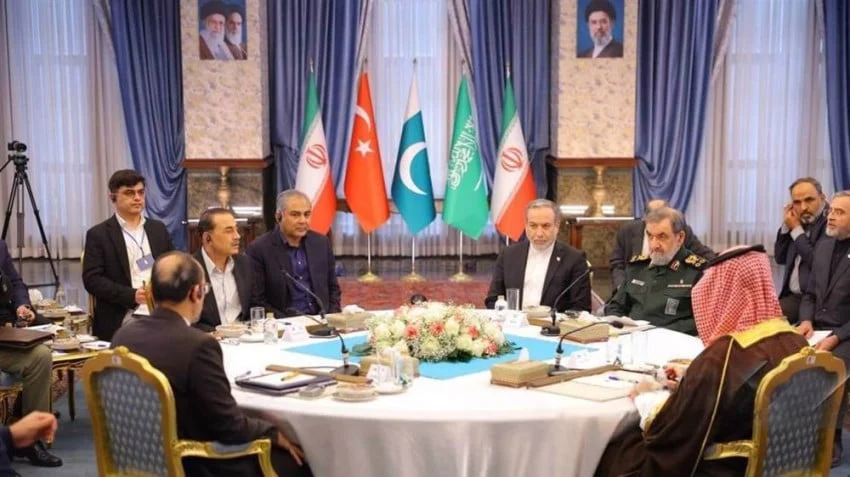
The geopolitical landscape of the Middle East is undergoing a profound transformation as high-ranking military and security officials from Saudi Arabia, Pakistan, and Turkey convened in Tehran this week. This unprecedented diplomatic assembly, involving representatives from the core members of the Makkah Defense Alliance, marks a significant departure from the containment-focused strategies that have dominated the region for decades. The meetings, held in the Iranian capital, included Saudi Defense Minister Prince Khalid bin Salman, Pakistan’s Chief of Army Staff General Asim Munir, and Turkish Intelligence Chief Ibrahim Kalin, who held substantive discussions with Mohsen Rezaei, the secretary of Iran’s Supreme National Security Council.
The gathering takes place against the backdrop of persistent regional instability, exacerbated by the ongoing conflict in Yemen and the persistent threat of direct escalation between Iran and the United States. While these nations previously aligned themselves against what they perceived as Iranian expansionism, the shift toward direct engagement suggests a pragmatic pivot toward "endogenous security"—a framework designed to minimize reliance on external powers, particularly the United States, and foster local conflict resolution mechanisms.
The Evolution of the Makkah Defense Alliance
To understand the gravity of these talks, one must analyze the genesis of the Makkah Defense Alliance. Formalized in August 2026, the alliance was initially conceived as a regional bulwark against the influence of the Islamic Republic of Iran and its constellation of proxies, including the Houthi movement in Yemen and various militias in the Levant. The alliance brought together three distinct but complementary pillars of regional power: the immense financial resources and energy market influence of Saudi Arabia, the nuclear deterrent and professional military apparatus of Pakistan, and the advanced industrial-military complex of Turkey, which also holds the unique advantage of NATO membership.
The treaty governing this alliance contains a mutual defense clause, mandating that an armed attack on one member be viewed as an attack on all. For years, the alliance operated under the assumption that Iran represented an existential threat to the stability of the Gulf and the broader Islamic world. However, the operational reality has been more complex. The recurring drone and missile strikes by Houthi insurgents against Saudi infrastructure highlighted the limitations of conventional military alliances in addressing asymmetric, proxy-based warfare. Consequently, the member states have increasingly recognized that a purely confrontational approach—even one bolstered by a defense pact—has failed to secure the region’s critical energy infrastructure or maritime trade routes.
Chronology of Shifting Strategic Alliances
The path to the current Tehran summit is marked by several key developments that signaled a cooling of tensions and a search for new diplomatic pathways:
- August 2026: The signing of the Makkah Defense Agreement, initially framed as a collective security mechanism to deter Iranian influence.
- Late 2026–2027: Escalating Houthi strikes on Saudi energy facilities, which revealed that the Makkah Alliance could not fully mitigate the risks posed by Iran’s regional proxies.
- Early 2028: Renewed diplomatic efforts, facilitated by regional mediators, to stabilize the Iran-Saudi relationship.
- Mid-2028: Growing fatigue with prolonged military engagements in Yemen and a shared realization that regional economic integration is being hampered by the "containment" paradigm.
- November 2028: The Tehran Summit, where leaders from the Makkah Alliance transitioned from rhetoric to direct security dialogue with Iranian officials.
The Concept of Endogenous Security
During a weekly press conference in Tehran, Iranian Foreign Ministry spokesperson Esmaeil Baghaei articulated the intellectual core of the recent meetings. He emphasized the necessity of "endogenous security," a concept that posits that regional stability is most sustainable when it is managed by the nations directly impacted by it. According to the Iranian perspective, external intervention—frequently cited as the presence of U.S. naval assets and military bases—tends to invite more tension than it resolves.
The Iranian proposal for an indigenous security architecture rests on three pillars: intelligence sharing, joint maritime patrols in the Persian Gulf and the Arabian Sea, and a formal non-aggression framework that extends to proxy groups. By bringing Saudi Arabia, Pakistan, and Turkey to the table, Iran is effectively testing whether these nations are willing to prioritize regional trade and stability over their traditional alignment with Western security interests.
Data-Driven Analysis of Regional Realignment
The economic and military weight represented by these four nations—Iran, Saudi Arabia, Pakistan, and Turkey—is staggering. Collectively, they represent a significant portion of the global energy supply and a massive demographic bloc.
- Energy Impact: Saudi Arabia remains a global leader in crude oil exports, while Iran possesses one of the world’s largest natural gas reserves. A security agreement that protects these assets would dramatically lower global insurance premiums for shipping in the Strait of Hormuz.
- Defense Capabilities: Pakistan provides the only nuclear-armed component to this dialogue, while Turkey’s defense industry has surged, particularly in the production of unmanned aerial vehicles (UAVs) and advanced naval corvettes. The integration of these capabilities into a regional security framework would arguably render the region less vulnerable to external interference.
- Geopolitics: Turkey’s dual role as a NATO member and a key player in this dialogue is particularly notable. It suggests that Ankara is attempting to navigate a "third-way" policy, balancing its Western obligations with its strategic imperative to dominate the Middle Eastern security sphere.
Official Responses and Diplomatic Nuance
While the meetings in Tehran represent a significant breakthrough, all parties remain cautious. Saudi officials have been careful to frame these discussions as a necessary measure to ensure the safety of the Kingdom’s citizens and economic infrastructure. There is a palpable concern in Riyadh that moving too quickly toward an Iranian-inclusive security pact could alienate the United States, with whom Saudi Arabia still maintains significant defense procurement ties.
Similarly, Turkish officials have consistently maintained that the Makkah Defense Alliance is not inherently anti-Iranian. "Our primary objective is the cessation of conflict and the establishment of a rules-based regional order," a Turkish diplomatic source stated, speaking on condition of anonymity. "The inclusion of Tehran in these discussions is not a betrayal of our partners, but an admission that peace is impossible without the involvement of all regional stakeholders."
Pakistan’s role, often acting as a bridge between the Middle East and South Asia, is critical in this equation. As the only Muslim-majority nation with a significant nuclear arsenal, Islamabad’s participation provides a layer of credibility to the security guarantees discussed in Tehran. General Asim Munir’s presence at the talks underlines the military-to-military nature of the engagement, shifting the dialogue from abstract diplomatic posturing to concrete security protocols.
Broader Impact and Global Implications
The shift in the Middle Eastern security landscape carries profound implications for the global order. For the United States, a regional security arrangement that excludes its direct participation, or even marginalizes it, represents a decline in its traditional hegemony. If these four nations successfully establish a permanent security dialogue, the demand for U.S. military presence in the Gulf may decline, potentially forcing a significant restructuring of U.S. strategic posture in the CENTCOM area of responsibility.
However, the durability of this alignment remains a subject of intense debate. Historical grievances, sectarian differences, and competing interests regarding Syria and Iraq continue to simmer beneath the surface. Furthermore, the Houthi factor remains a volatile variable; unless Iran can demonstrate a genuine ability to curb the activities of its proxies, Saudi and Turkish confidence in these talks may quickly evaporate.
In conclusion, the meeting in Tehran is a watershed moment in 21st-century diplomacy. By moving from a posture of containment to one of inclusive regional engagement, the Makkah Alliance members and Iran are attempting to rewrite the security architecture of the Middle East. Whether this transition leads to a new era of regional stability or merely a temporary tactical pause in a much longer-term power struggle remains to be seen. What is clear, however, is that the era of relying solely on external powers for regional security is being challenged by a bold, new commitment to indigenous governance and direct, high-stakes diplomacy.